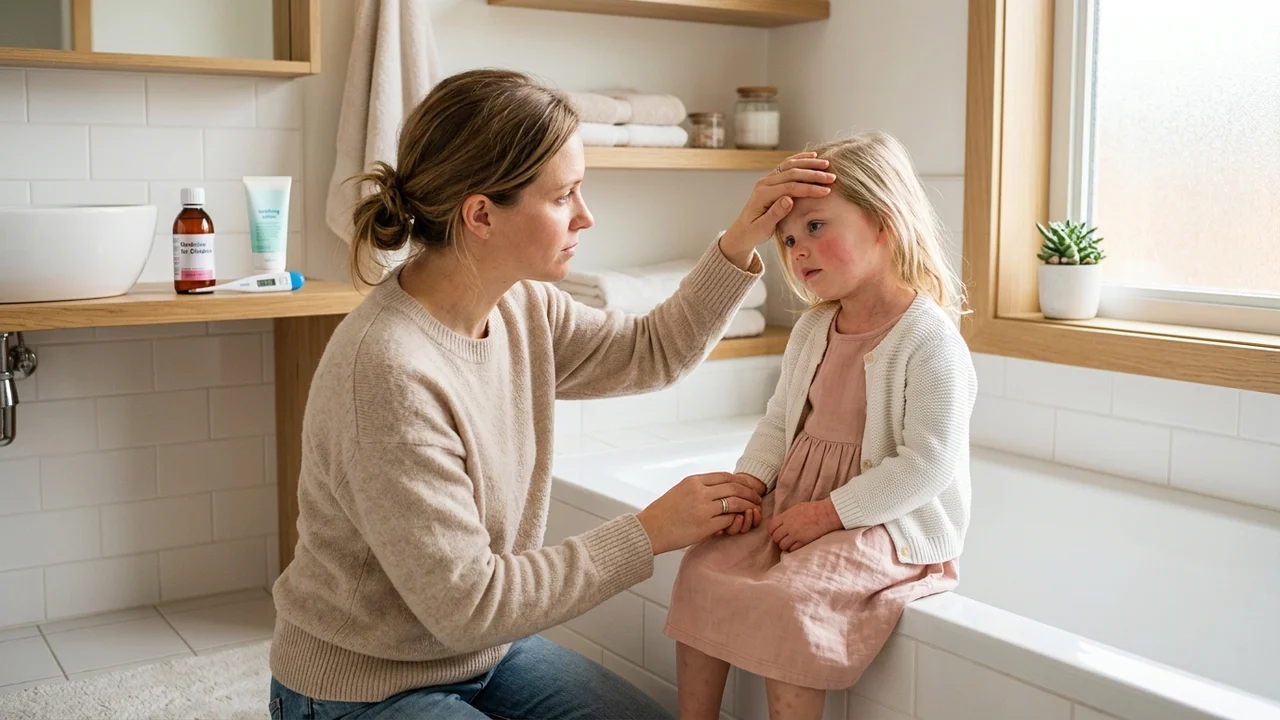
Your child has had a high fever for three days. Suddenly the temperature drops, and a pink rash appears on the body. Is it dangerous? What is happening?
Roseola (roseola infantum, exanthema subitum) is one of the most common childhood illnesses. It is a mild viral infection that almost all children go through, usually without complications. The most characteristic feature is the sudden rash that appears precisely when the fever disappears.
The short answer: Roseola is a mild viral illness caused by HHV-6 (human herpesvirus 6) that follows a classic two-phase pattern, 3 to 5 days of high fever (often 102-105°F / 39-40.5°C) followed by a pink, blotchy rash that appears as the fever breaks. The rash starts on the trunk, spreads outward, does not itch, and resolves on its own within 1-3 days. Most children recover without treatment. Incubation is typically 9-14 days from exposure.
What Is Roseola?
Roseola is caused by human herpesvirus 6 (HHV-6), and less commonly HHV-7. The virus belongs to the herpesvirus family, but has nothing to do with genital herpes or cold sores.
Key facts:
- Most commonly affects children between 6 months and 2 years
- Most common between 9 and 21 months
- Most children have had the illness by the age of 3
- After recovering from the infection, the child is immune, roseola is only experienced once
- The illness is mild and very rarely causes complications
Roseola is also called the sixth disease because it was historically counted as the sixth of the classic childhood illnesses with a rash (after measles, scarlet fever, rubella, fourth disease, and fifth disease).
Symptoms and Course
Roseola has a very characteristic two-phase course:
Phase 1: Fever (Day 1–3, sometimes up to 5 days)
- Sudden high fever, the temperature rises rapidly to 38.5–40.5°C (101–105°F)
- The fever lasts 3–5 days, remaining consistently high
- The child is often surprisingly unaffected, many children play and eat quite normally despite the high fever
- Mild irritability, the child may be slightly more demanding than usual
- Possibly swollen lymph nodes, particularly behind the ears and in the neck
- Mild cold symptoms, some children have a slightly runny nose or mild cough
Phase 2: Rash (After the Fever Breaks)
- The fever disappears suddenly, often within a few hours
- A pink-red rash appears, usually the same day or the day after the fever is gone
- The rash starts on the body (chest, abdomen, back) and may spread to the neck, face, and arms
- Small, flat or slightly raised pink spots, 2–5 mm in diameter
- The rash blanches when pressed (if you gently press on a spot, it temporarily disappears)
- No itching, unlike many other rashes
- The rash lasts 1–3 days and disappears without treatment
The characteristic feature of roseola is the sequence: first fever, then rash. With many other childhood illnesses (such as chickenpox or measles), the fever and rash appear at the same time. The rash with roseola means the child is on the way to recovery.
Incubation Period and Contagion
- Incubation period: 5–15 days, usually 9–10 days
- Contagious: Mainly during the fever period, before the rash appears
- Transmission: Droplet transmission (coughing, sneezing) and contact transmission (saliva)
An important point: When the rash appears, the child is usually no longer contagious. Many parents only discover the illness when the rash appears, by which time the child has already been contagious during the days with fever.
Treatment
There is no specific treatment for roseola. The illness is self-limiting and requires only symptomatic measures:
Fever Management
- Acetaminophen (Tylenol), give the age-appropriate dose to reduce fever and relieve discomfort
- Ibuprofen (Motrin, Advil), can be used in children over 6 months as an alternative or supplement
- Plenty of fluids, offer frequently, in small sips. Breast milk, formula, water, or diluted juice
- Light clothing, don't overdress the child. Layer clothing so you can adjust as needed
General Comfort
- Rest, let the child rest, but don't force them to stay in bed if they want to play
- Normal diet, offer food as usual, but don't force it if appetite is poor
- Cool room, ensure a comfortable temperature in the bedroom (65–68°F / 18–20°C)
Remember that the fever with roseola is the body's natural response to the viral infection. You don't necessarily need to treat the fever with medication if the child is doing well. Give fever-reducing medication if the child is clearly uncomfortable, sleeping poorly, or not drinking enough.
Treatment of the Rash
The rash with roseola requires no treatment. It does not itch and is not painful. It will disappear on its own within 1–3 days.
Can Roseola Cause Complications?
Roseola is a mild illness, and complications are rare. However, it is useful to know about:
Febrile Seizures
The most common complication is febrile seizures, which can occur with rapid temperature rise. Approximately 10–15 percent of children who get febrile seizures do so in connection with roseola.
If febrile seizures occur:
- Place the child on their side
- Do not hold the child down or put anything in their mouth
- Note how long the seizure lasts
- Call 911 if the seizure lasts more than 5 minutes
- Contact a doctor after the seizure, even if it was brief
Read more about fever and febrile seizures in our article on fever in children.
Other Rare Complications
- Encephalitis (brain inflammation), very rare
- Hepatitis (liver inflammation), very rare
- These complications are extremely uncommon in otherwise healthy children
When Should You Contact a Doctor?
Contact your pediatrician or urgent care if:
- The child is under 3 months with a fever above 38°C (100.4°F)
- The fever lasts more than 5 days
- The child is drinking very little and showing signs of dehydration
- The child is very lethargic or difficult to wake
- You are unsure whether the rash is caused by roseola or something else
- The child has a weakened immune system
Call 911 if:
- The child has seizures
- The child has severe breathing difficulties
- The child is limp, pale, and difficult to rouse
- The child has a rash that does not blanch when pressed (petechiae), this is NOT typical of roseola and may indicate a more serious condition
Important about the rash: The rash with roseola blanches when you press on it. If the child has a rash that does NOT blanch when pressed (small, purple-red spots that remain visible), this may indicate a more serious illness such as meningococcal sepsis. Contact a doctor immediately.
Roseola vs. Other Childhood Illnesses
It can be difficult to distinguish roseola from other conditions. Here are some differences:
| Illness | Fever | Rash | Difference |
|---|---|---|---|
| Roseola | First, 3–5 days | After fever breaks | Rash is a good sign |
| Chickenpox | Concurrent with rash | Blisters that itch | Itchy blisters at various stages |
| Measles | Concurrent with rash | From face downward | Cough, pink eye, sicker child |
| Fifth disease | Little/no fever | "Slapped cheek" rash | Intensely red cheeks |
| Scarlet fever | Concurrent | Sandpaper-like | Strawberry tongue, sore throat |
Daycare and Contagion
Can the Child Go to Daycare?
- During the fever period, the child should stay home (fever-free for at least 24 hours without fever-reducing medication)
- When the rash has appeared, the child is usually no longer contagious and can return
- The child should be in good general condition
Is Roseola Dangerous for Pregnant Women?
HHV-6 generally poses no risk to pregnant women. It is not comparable to, for example, rubella, CMV, or fifth disease (parvovirus B19), which can affect the fetus.
Frequently Asked Questions
Can you get roseola twice?
Very rarely. After recovering from an HHV-6 infection, the child develops lifelong immunity. In very rare cases, HHV-7 (a closely related virus) can cause a similar illness.
How old is the baby usually when they get roseola?
Most children get roseola between 6 and 24 months. Before 6 months, the baby is often protected by maternal antibodies. After 3–4 years, almost all children have been through the illness.
Does the child need antibiotics?
No, roseola is caused by a virus, and antibiotics only work against bacteria. Sometimes a doctor may start antibiotics because the cause of the fever is unknown, if it turns out to be roseola, antibiotics can be discontinued.
Should the child avoid bathing when they have the rash?
No, the rash does not itch and is not worsened by water. The child can bathe and shower normally.
Can roseola cause cold sores?
No. Although HHV-6 belongs to the herpesvirus family, it is a completely different virus from HSV-1, which causes cold sores.
🔧 Helpful Tools
- Baby Milestones Tracker. Track developmental milestones and note any post-illness regressions
- Baby Sleep Tracker. Log sleep during illness and recovery to spot disruption patterns
- All Baby Tools. Browse all free tools for pregnancy and baby care
Related Articles
- Fever in Children: When Should You Contact a Doctor?
- Chickenpox in Children: Symptoms and Treatment
- Nighttime Cough in Children: Causes and Remedies
- Stiff Neck in Children: When Should You Act?
- Hand, Foot, and Mouth Disease in Children
Sources
- CDC. Roseola. Centers for Disease Control and Prevention
- AAP. Roseola Infantum. American Academy of Pediatrics
- Mayo Clinic. Roseola. Mayo Clinic
This article is written for informational purposes and does not replace medical advice. Contact your pediatrician if you are unsure about your child's symptoms or diagnosis.