Your child has developed a round, red patch on their skin that itches. Maybe it has a lighter center and a clearly defined red border. You're wondering if it could be ringworm.
Ringworm is a very common fungal infection in children, and despite its name, it has nothing to do with worms or parasites. It is generally harmless and can be treated effectively with antifungal cream available over the counter at the pharmacy.
Here you'll find everything you need to know about ringworm in children, from symptoms and transmission routes to treatment and when to see a doctor.
What Is Ringworm?
Ringworm (medical name: tinea) is a fungal skin infection caused by dermatophytes. These fungi live in the outermost layer of skin, in hair, and in nails. The name "ringworm" comes from the characteristic ring-shaped rash, not from any worm.
There are three main groups of dermatophytes:
- Anthropophilic, spreads from person to person (most common)
- Zoophilic, spreads from animals to humans (especially cats, dogs, guinea pigs, and rabbits)
- Geophilic, found in soil
Ringworm is especially common in children of daycare and school age. Children who are in close contact with other children or with pets have a higher risk.
Ringworm is not dangerous and causes no permanent skin damage. With proper treatment, the infection usually clears up within 1–4 weeks.
Symptoms: What Ringworm Looks Like
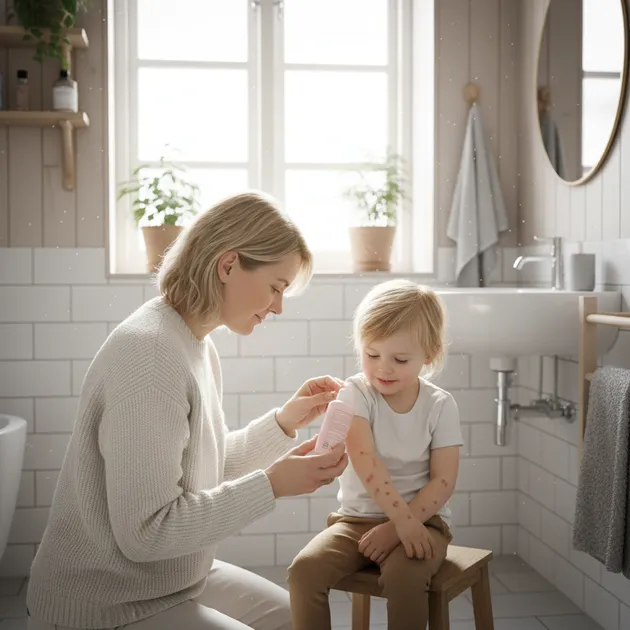
The typical sign of ringworm is a round or oval rash with a red, raised border and a lighter center. The rash can itch, flake, and slowly grow outward. What ringworm looks like depends on where on the body the infection is located.
Ringworm on the Body (Tinea Corporis)
This is the most common form in children. You'll see:
- Ring-shaped, red patches with a distinct border
- Lighter, more normal-looking skin in the center of the ring
- Itching that can range from mild to moderate
- Flaking skin along the edges
- Patches can grow from a few millimeters to several centimeters
Ringworm on the body can appear anywhere, but is most common on the arms, legs, abdomen, and back.
Ringworm of the Scalp (Tinea Capitis)
Ringworm of the scalp is most common in children between 3 and 10 years of age. Symptoms include:
- Flaky, scaly patches on the scalp
- Hair loss in defined areas
- Hair that breaks off at the root (looks like black dots)
- Itching and irritation
- In severe cases: swollen lymph nodes in the neck
Ringworm of the scalp always requires a doctor's visit. Antifungal cream alone is not sufficient. The child needs oral antifungal treatment (systemic treatment) for the fungus to reach the hair follicles. Contact your pediatrician if you suspect this type.
Athlete's Foot (Tinea Pedis)
Athlete's foot is less common in young children, but can occur in older children who use communal showers (swimming pools, sports facilities). Symptoms include:
- Flaking, red skin between the toes
- Itching and burning
- Cracked skin that can become sore
- Moist, whitish skin between the toes
How Does Ringworm Spread?
Ringworm is contagious and can be transmitted in several ways:
Direct contact:
- Skin-to-skin contact with an infected person
- Cuddling and playing with infected pets (cats and dogs can carry the fungus without showing symptoms)
Indirect contact:
- Sharing towels, clothes, bedding, or hairbrushes
- Shared toys, mats, and equipment at daycare
- Contact with contaminated surfaces in moist environments (locker rooms, showers)
The fungus thrives in warm, moist environments. The risk of transmission is greatest in daycares, swimming pools, and during sports activities where children are in close contact.
Dermatophytes can survive on surfaces and objects for a long time, even freezing does not kill them. That is why good hygiene is important to limit the spread.
Treatment of Ringworm in Children
Most cases of ringworm on the body can be treated effectively with antifungal cream available over the counter at the pharmacy.
Antifungal Creams (Over the Counter)
The most common options are:
- Terbinafine cream (e.g., Lamisil), applied once daily for 1–2 weeks
- Clotrimazole cream (e.g., Lotrimin), applied twice daily for 2–4 weeks
Terbinafine generally has a shorter treatment duration than clotrimazole, but both are effective.
How to Use Antifungal Cream
- Wash and thoroughly dry the affected area
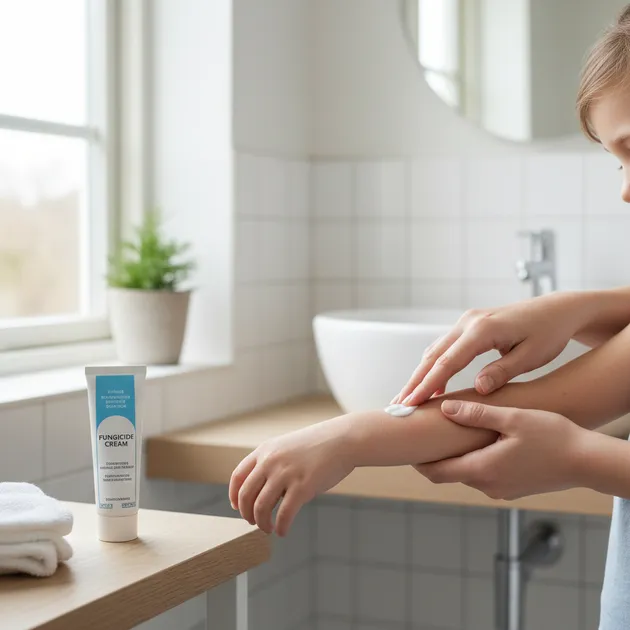
- Apply a thin layer of cream over the entire rash and slightly into the healthy skin around it (about 1–2 cm beyond the edge)
- Wash your hands thoroughly afterward
- Continue treatment for the full recommended duration, even if the rash appears to clear up before then
Do not use cortisone cream alone on ringworm. Cortisone reduces inflammation and itching but does not inhibit the fungus. The rash may look better temporarily, but the infection continues to spread. Some combination products contain both antifungal and cortisone ingredients, these can be used on the advice of a doctor or pharmacist.
When Is Oral Treatment Needed?
A doctor may prescribe oral antifungal medication (usually terbinafine or griseofulvin) if:
- Ringworm is on the scalp or nails
- The infection has spread to large areas of the body
- Cream treatment has not been effective after 2–4 weeks
- The child has a weakened immune system
Oral treatment is usually combined with topical cream treatment for best effect.
When Should You See a Doctor?
Contact your pediatrician if:
- You suspect ringworm on the scalp (hair loss, scalp flaking)
- The rash does not improve after 7–14 days of cream treatment
- The infection spreads to new areas despite treatment
- The rash is very widespread or located on the face
- You are unsure whether it is ringworm (it can be confused with eczema, psoriasis, or other skin conditions)
- The child has a fever or swollen lymph nodes in addition to the rash
- The child has recently traveled abroad (travel-related fungal infections may require different treatment)
The doctor can take a skin scraping to confirm the diagnosis by microscopy or culture.
Ringworm and Daycare: Rules and Advice
One of the most common questions parents ask is whether the child needs to stay home from daycare.
General guidance from the AAP: Children with ringworm do not need to stay home. The child can return to daycare the day after antifungal cream treatment has been started.
Measures at Daycare for Ringworm
- Inform the daycare so they can follow up with extra hygiene measures
- Avoid sharing towels, hats, hair accessories, and bedding
- Thoroughly clean shared toys, mats, and equipment
- Good handwashing for all children and staff
- Cover the rash with clothing or a bandage while at daycare
In the event of repeated cases or outbreaks at daycare, close contacts should be examined to find the source of infection. Also check any pets.
Preventing Ringworm
You can reduce the risk of ringworm with these measures:
Hygiene:
- Regular and thorough handwashing, especially after contact with animals
- Wear sandals in public showers and locker rooms
- Dry skin thoroughly after bathing and showering
Clothing and textiles:
- Avoid sharing towels, clothes, hair accessories, and brushes
- Wash clothes and bedding at at least 60°C (140°F) if someone in the family has ringworm
- Change underwear and socks daily
Pets:
- Take pets to the vet if you suspect ringworm (flaky, hair-loss areas)
- Wash hands after contact with animals
- Remember that cats and dogs can carry the fungus without visible symptoms
When there is infection in the family:
- Examine all household members and treat simultaneously if multiple people are infected
- Disinfect surfaces with chlorine-based cleaning products
- Discard hair accessories and brushes that have been used by the infected person (with scalp ringworm)
Ringworm in Babies
Babies can also get ringworm, although it is less common than in older children. In infants, it is especially important to see a doctor to get the correct diagnosis, because rashes in babies can be caused by many different things.
Some antifungal creams have age restrictions, the pharmacist or doctor can advise on what is safe for the youngest children. Terbinafine cream is generally not recommended for children under 1 year of age without medical assessment.
Keep track of your child's health and skin issues in Babysential's health log. There you can note symptoms, treatment start, and progress, so you have an overview when talking with the doctor.
Frequently Asked Questions
Is ringworm the same as a worm infection?
No. Despite the name, ringworm is a fungal infection, not a parasite or worm. The name comes from the ring-shaped rash that the infection produces.
How long does it take for ringworm to clear up?
With proper treatment, you will usually see improvement within a week. Full healing typically takes 2–4 weeks depending on the type and location. Always complete the full course of treatment.
Can ringworm come back?
Yes, ringworm can recur if the source of infection has not been removed. Check pets, examine other family members, and maintain good hygiene to avoid reinfection.
Can I use natural remedies for ringworm?
There is no documented evidence of effectiveness of natural remedies against ringworm. Use antifungal cream from the pharmacy. Untreated ringworm can spread and infect others.
Does ringworm spread between siblings?
Yes, ringworm spreads easily through close contact. Avoid sharing towels and bedding, and wash hands thoroughly. Start treatment quickly to limit transmission.
Sources
- Centers for Disease Control and Prevention (CDC). "Ringworm." cdc.gov
- American Academy of Pediatrics (AAP). "Tinea Infections (Ringworm)." healthychildren.org
- WHO. "Dermatophytosis (Ringworm)." who.int
- Mayo Clinic. "Ringworm (body)." mayoclinic.org
Read also: Impetigo in Children | Eczema in Babies and Children | Baby Skincare Guide | Rashes in Children
🔧 Helpful Tools
- Baby Milestones Tracker. Track your baby's developmental milestones
- All Baby Tools. Browse all free tools for pregnancy and baby care
📖 Related Articles
- Chickenpox in Children: Symptoms, Treatment, and Contagion. Everything about chickenpox in children and babies. Symptoms, incubation period, home treatment, when to call a doctor, and vaccine recommendations from the CDC. Updated for 2026.
- Chickenpox in Children: Symptoms, Treatment, and Contagion. Everything you need to know about chickenpox in children and babies. Symptoms, incubation period, home treatment, when to call the doctor, and vaccine recommendations from the AAP. Updated for 2026.
- Sick Child and Daycare: When Should Your Child Stay Home?. When should your child stay home from daycare? Guide to fever, vomiting, pink eye, and other common childhood illnesses, with practical guidelines.