Photos capture what your baby looked like. But a letter captures something photos never can, what you felt, what you dreamed, and who you were as a parent right at that moment.
A letter to your baby is a time capsule of love. A few lines written one evening while the baby sleeps can become your child's most treasured possession in 18 years. It's impossible to know exactly what will matter to your child in the future, but an honest letter from mom or dad is a pretty safe bet.
Why Write a Letter to Your Baby?
There's something about the written word that lands differently than a photo or video. A letter is personal, it's considered, and it conveys feelings in a way no other format can.
It Preserves Feelings, Not Just Facts
The baby book records that the baby got their first tooth on August 15th. But a letter tells of how you stayed awake all night, sang the same song over and over, and felt like the proudest parent in the world when the tooth finally appeared.
It Strengthens the Bond Over Time
The connection between parent and child is fundamental to children's development. A letter is a tangible reminder that the child was wanted and loved from the very first second.
It Gives the Child Roots
As the child grows older, the letters offer a glimpse into who the parents were as people. What mattered to you, what you dreamed of, how the world looked at the time.
Digital letters last forever. You can write letters to your baby in a digital journal and store them safely to share with your child when the time is right. No risk of the letter disappearing in a drawer.
What Can You Write About?
There are no rules for what a letter to your baby should contain. But here are some themes that work well and that children love to read when they're old enough.
The Day the Baby Was Born
Describe the day in detail. What was the weather like? What did you feel the first time you held the baby? These details seem ordinary now, but they're magical for a child reading them 15 years later.
Feelings and Dreams
Write honestly about what it's like to be a parent. The joy, the uncertainty, the love that almost hurts. And your dreams, not grand ambitions, but the simple things. That the child will feel safe, will find something they're passionate about, and will always know they are loved.
The World Around You
What's happening in the world right now? What is everyone talking about? These everyday details give the letter a historical dimension that becomes fascinating with the years.
Funny Moments
Grimaces, strange sounds, that one time the baby pulled the cat's tail. The funny details are often what the child will laugh most at when reading.
Templates for Different Occasions
Sometimes you just need a starting point. Here are templates for the most common occasions.
Birth Letter. The First Letter
Dear [baby's name],
Today you are here, and everything is different. You came into the world on [date] at [time], and I have never experienced anything like it. You weighed [weight] and had [description, dark hair, big eyes, tiny little fingers].
The first thing I thought when I saw you was [thought/feeling]. Dad/Mom [what the other parent did]. The midwife/doctor said [something lovely/funny].
We have waited for you for so long, and now you are finally here. The world is a better place with you in it.
All my love, Mom/Dad
Monthly Letter
Dear [baby's name],
Today you are exactly one month old. You are sleeping on my chest as I write this, and your hands are wrapped around my finger.
This month you have [what the baby has learned/done]. Your favorite spot is [place], and you love [activity] best. At night [sleep habits], and we have discovered that [something you have learned].
The hardest thing right now is [honest challenge]. The best thing is [the finest moment].
You make me a better version of myself, every single day.
A hug from Mom/Dad
Birthday Letter
Dear [baby's name],
Today you turn [age]! [Age] years ago we held you for the first time, and it feels like both yesterday and an eternity ago.
This year you have [the year's big milestones]. You have become so [description]. Your favorite thing is [thing], and you always say [funny quote/word].
Something I want you to know: [important message].
Happy birthday, my little one.
Mom/Dad
Don't stress about writing the perfect letter. A few honest lines mean more than a whole page of polished prose. Your child will love the letter because it comes from you, not because it's beautifully written.
Time Capsule Letters
A time capsule letter is a letter you write now, but that the child isn't meant to open until a specific date. It could be their 18th birthday, graduation, or the day the child becomes a parent themselves.
What Should You Include?
- Who you are right now, your age, job, what you enjoy doing
- Who the baby is, personality, habits, funny traits
- What daily life looks like, mornings, bedtime, weekend routines
- What you hope for the child, dreams, wishes, values
- A secret or a promise, something personal just between the two of you
When Should the Letter Be Opened?
That is entirely up to you. Popular moments include:
- High school graduation, the child is old enough to appreciate it
- 18th birthday, a meaningful marker of the transition to adulthood
- Wedding day, if you dare to plan that far ahead
- When the child becomes a parent, that's when they'll truly understand what you felt
Store the letter safely. Write it digitally in a secure journal and set a date for when your child can read it. No risk of the letter being lost or damaged over the years.
Example Time Capsule Letter
Dear [baby's name],
You are 6 months old as I write this. You just learned to sit, and you love chewing on your own toes.
When you read this, you are [age], and I have no idea what kind of person you have become. But I already know you are brave, curious, and full of life.
Some things I hope for you: That you find someone who truly sees you. That you dare to fail. And that you know, deep down, that you are enough exactly as you are.
With all the love in the world, Mom/Dad, [date]
Tips for Getting Started
Many parents want to write a letter to their baby, but put it off because it feels big and difficult. Here are some simple strategies.
Don't Wait for the Perfect Occasion
You don't need a birthday celebration to write. An ordinary Tuesday with the baby lying on the floor babbling is a perfect occasion.
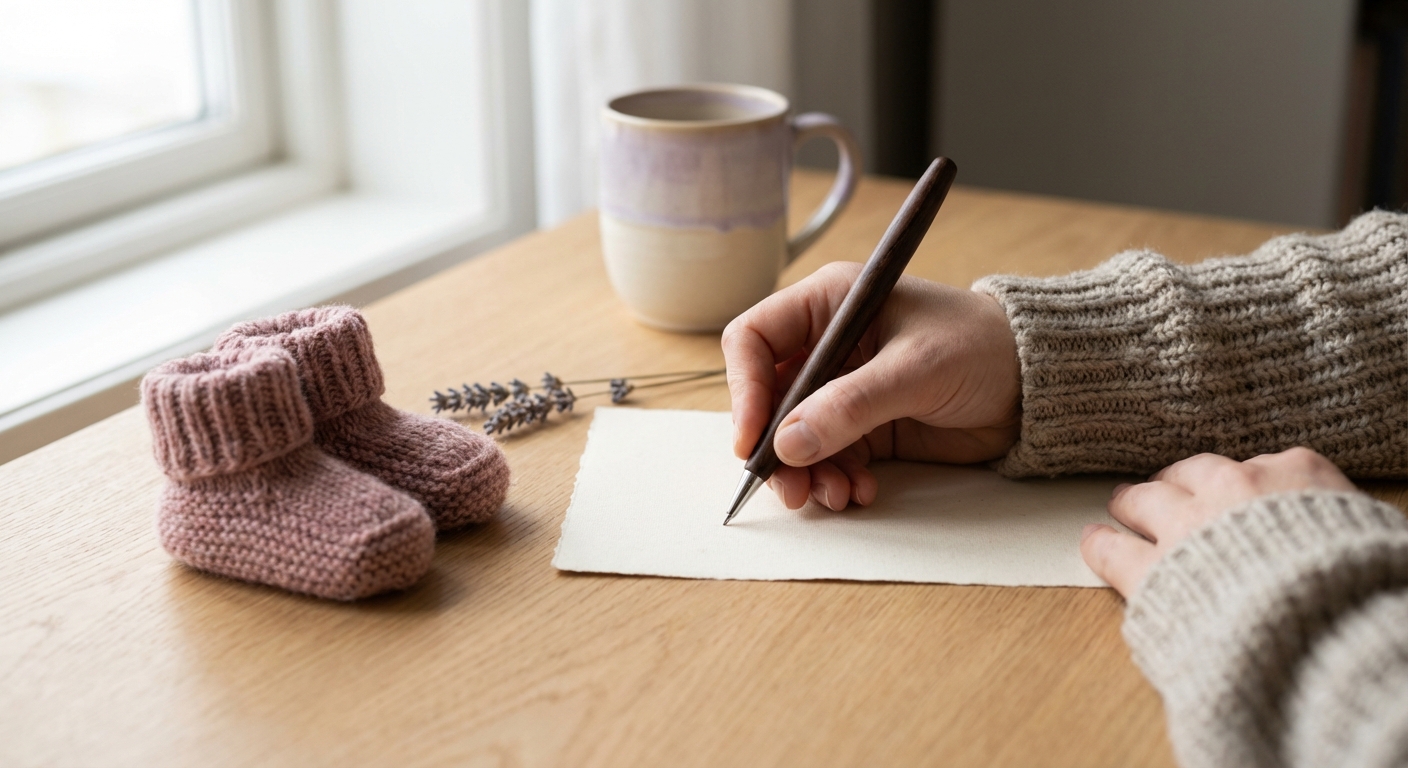
Write by Hand or Digitally
Some prefer pen to paper. Others find it easier to type on their phone while the baby sleeps in their arms. Both are equally valuable.
Start with One Letter
Don't plan a system of monthly letters. Start with one. See how it feels. If it gives you something, write more.
Do It Together
Invite your partner to write a letter too. Two letters from two different parents give the child a richer picture of their family.
Combine letter-writing with your baby book or journal. A letter is a natural chapter that many parents overlook, but that often becomes the most-read part.
Frequently Asked Questions
When should I write the first letter?
You can start while still pregnant. The first letter after the birth is often the most emotionally charged. But it's never too late, your baby will appreciate a letter written when they were two just as much.
How long should the letter be?
As long or short as you like. Five honest sentences are better than two pages of clichés. What matters most is that it's genuine.
Should I write by hand or digitally?
Handwritten letters show the child your handwriting. Digital letters are safe from fire and moving chaos. A good solution is to write digitally and also print out a copy for a physical album.
What if I start crying while I write?
Completely normal. Writing a letter to your baby is surprisingly emotional. Let the tears come, they mean you're writing something that matters.
Can grandparents also write letters?
Absolutely. Grandparents have a unique perspective and know the family history. A letter from a grandmother or grandfather can become an irreplaceable treasure.
Sources
- American Academy of Pediatrics. Attachment and child development
- AAP. The importance of play and communication in early childhood
🔧 Helpful Tools
- Baby Sleep Tracker. Track and optimize your baby's sleep
- Baby Food Guide. Safe foods and introduction schedule for your baby
- All Baby Tools. Browse all free tools for pregnancy and baby care
📖 Related Articles
- 52 Baby Memories from the First Year You Won't Want to Forget. Week by week baby memories to treasure. A complete list of moments to document during your baby's first year.
- Digital Memory Book for Baby: Preserve the Moments That Matter. Create a digital memory book for your baby. Tips on apps, photos, and writing that preserve the precious moments forever.
- What to Write in Your Baby Book: A Complete Guide. Struggling with what to write in your baby book? Here are concrete tips, templates, and examples that make it easy to preserve the memories.