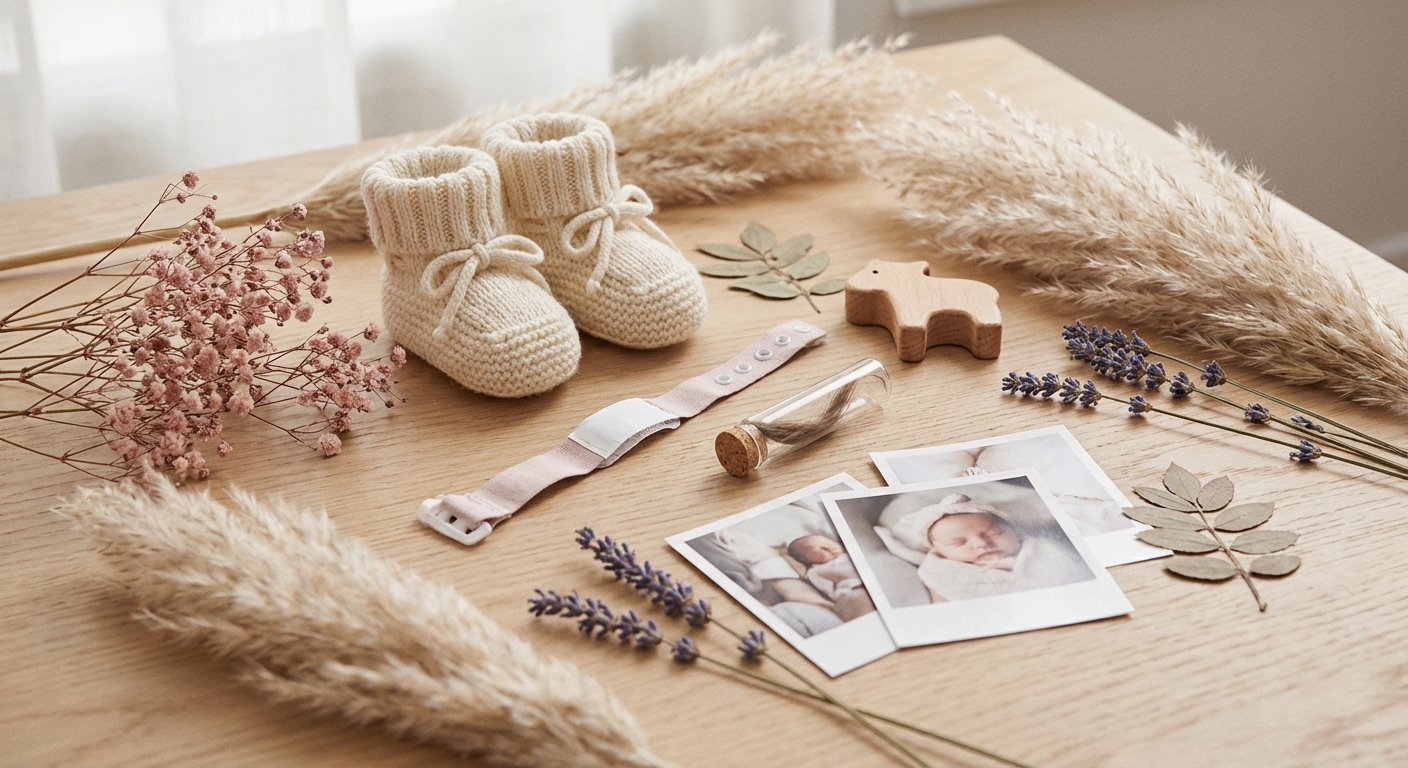
The first year goes faster than any other year in life. One day you're counting the hours since birth. Then suddenly you're watching a one-year-old crawl at full speed toward their birthday cake.
Between sleepless nights and mountains of diapers, hundreds of moments happen that are worth remembering. The problem is that you think you'll never forget them. But you will. Your brain is too exhausted to store everything.
That's why we created this list. 52 baby memories, one for each week of the first year, to inspire you to stop, take a photo, write a sentence, and capture what's happening right now.
This list is inspiration, not a checklist. Your child does things in their own order and at their own pace. The most important thing is to capture the moments that matter to your family.
Memories from 0–3 Months (Weeks 1–13)
The first months are a mix of euphoria and exhaustion. Everything is new. Your baby is new. You as a parent are new. Here are the moments you'll thank yourself for documenting.
- Week 1: First time you held your baby, the very first meeting. Take a photo of your hands around that tiny body. Write down what you were thinking.
- Week 2: First bath, the careful lowering into water, the expression on their face, the little kicks.
- Week 3: First stroller ride, the great expedition into the world. Where did you go? What was the weather like?
- Week 4: The umbilical cord stump falls off, a small, strange moment that marks your baby's growth.
- Week 5: First visit from grandparents, take a photo of the first meeting between generations.
- Weeks 6–8: First real smile, not just a reflex, but a smile directed at you. It changes everything.
- Week 9: First time baby sees you and lights up, eyes that recognize you from a distance and a face that beams.
- Week 10: The first sounds, gurgling, vowel sounds, little "aah" and "ooh" that are the beginning of communication.
- Week 11: First time baby holds their head up, the newfound strength, the proud expression.
- Week 12: Three months, take a comparison photo with the same background as the newborn photo. You'll be surprised by the difference.
- Week 13: First laugh, the liberating, delightful laugh that makes everyone in the room smile.
Most babies smile intentionally around 6–8 weeks and laugh out loud around 3–4 months, according to the AAP. But variations are large, and it's completely normal to be a bit earlier or later.
Memories from 3–6 Months (Weeks 14–26)
Now your baby starts to become more active. Hands discover the world. Sounds become babbling. And suddenly one day, your baby rolls over all by themselves.
- Weeks 14–15: First time baby reaches for something, the little hand stretching purposefully toward a toy or your hair.
- Weeks 16–17: The hand discovers the mouth, everything must be tasted. Everything. The entire world is explored with the tongue.
- Weeks 18–19: First time baby rolls over, from back to tummy, or vice versa. The big breakthrough.
- Weeks 20–21: Favorite toy right now, take a photo of the toy your baby loves most. In a year, you won't remember which one it was.
- Weeks 22–23: All the funny sounds, babbling, spitting, humming, squealing. Record a video of the soundtrack of everyday life.
- Weeks 24–25: First taste of food, around 6 months, many babies are ready to taste. Take a photo of the expression. It's priceless.
- Week 26: Half birthday, halfway through the first year. Write down what life is like right now.
Memories from 6–9 Months (Weeks 27–39)
The pace picks up. Your baby sits, crawls, maybe pulls up to stand. Their personality shows more clearly every day. And separation anxiety may appear.
- Weeks 27–28: Sits alone for the first time, without support, with that unsteady, concentrated balance.
- Weeks 29–30: First tooth, the little white edge in the gum. Take a photo (if baby lets you).
- Weeks 31–32: First "mama" or "dada", maybe just random babbling, but your heart skips a beat anyway.
- Weeks 33–34: Crawls for the first time, or scoots, rolls, or finds their own unique way of getting around.
- Weeks 35–36: The separation anxiety phase, baby clings and cries when you leave the room. Exhausting, but a sign of secure attachment.
- Weeks 37–38: Waves "bye-bye", that little hand waving. One of the sweetest moments there is.
- Week 39: The pointing finger, baby starts pointing at things. A whole new world of communication opens up.
Memories from 9–12 Months (Weeks 40–52)
Now you're approaching the finish line of the first year. Your baby is barely a baby anymore. Their personality is blooming, and new skills appear almost daily.
- Weeks 40–41: Pulls up and cruises along furniture, the unsteady journey from the couch to the table while little hands hold on tight.
- Weeks 42–43: First real word, not babbling, but a word with meaning. Maybe "mama," maybe "ball," maybe "no."
- Weeks 44–45: Understands "no", and ignores it completely. Welcome to a new phase.
- Weeks 46–47: Claps hands, either on their own initiative or because someone is singing a clapping song.
- Weeks 48–49: Imitates you, baby copies what you do. Talks on the "phone," sweeps the floor, stirs the pot.
- Weeks 50–51: First steps, maybe. Some babies walk at 9 months, others at 16. Both are perfectly normal.
- Week 52: First birthday!, the cake, the song, the little person who has become a whole human with opinions, humor, and willpower.
How to Capture the Moments
It's not hard to document, but it requires making it a habit. Here are some simple tips that work in a busy everyday life.
Have Your Phone Ready
Many of the best moments last seconds. You don't always have time to find your phone, unlock it, and open the camera. Keep it easily accessible during play and activities.
Take Video, Not Just Photos
Photos are great, but video captures sounds, movements, and atmosphere in a completely different way. Baby laughter, babbling, and uncertain first steps are magical on video. Short clips of 10–30 seconds are perfect.
Write a Sentence
A photo says a lot, but it doesn't say everything. Write a sentence about what happened, what baby learned, or what you felt. In five years, it's the text that makes the photo really hit home.
Take Photos of Yourself Too
It's easy to always be behind the camera. But your child will want to see photos of you too. Ask your partner to take photos of you together, or use the self-timer.
Don't stress about perfect photos. The messy, everyday photos with food stains and morning hair are often the most beautiful to look back on. They show life as it actually was.
Frequently Asked Questions
My baby isn't doing what's "on the list" for their age. Should I worry?
No. This list is loose inspiration, not a developmental chart. All babies develop at different rates. According to the AAP, large variations in when children reach different milestones are completely normal. Talk to your pediatrician if you're concerned.
How do I document without always having my phone up?
Choose some set times during the week when you take photos and notes. For example, Sunday evening: one photo and two sentences about the week that was. It doesn't need to be more than that.
Is it too late to start if my baby is already several months old?
Never. Start with what you have. Scroll through your camera roll and pick out the best photos. From now on, you can take it week by week.
Should I document the tough moments too?
Yes, if you want to. The colic nights, the tears, the exhaustion, that's also part of the story. You don't have to share everything, but for your own sake, it can be nice to remember that it wasn't all perfect. It makes the good moments even more valuable.
Sources
🔧 Helpful Tools
- Baby Sleep Tracker. Track and optimize your baby's sleep
- Baby Food Guide. Safe foods and introduction schedule for your baby
- All Baby Tools. Browse all free tools for pregnancy and baby care
📖 Related Articles
- Digital Memory Book for Baby: Preserve the Moments That Matter. Create a digital memory book for your baby. Tips on apps, photos, and writing that preserve the precious moments forever.
- A Letter to Your Baby: How to Write One They'll Treasure. Write a letter to your baby that becomes a cherished keepsake. Tips, templates, and inspiration for time capsule letters and birthday letters.
- What to Write in Your Baby Book: A Complete Guide. Struggling with what to write in your baby book? Here are concrete tips, templates, and examples that make it easy to preserve the memories.