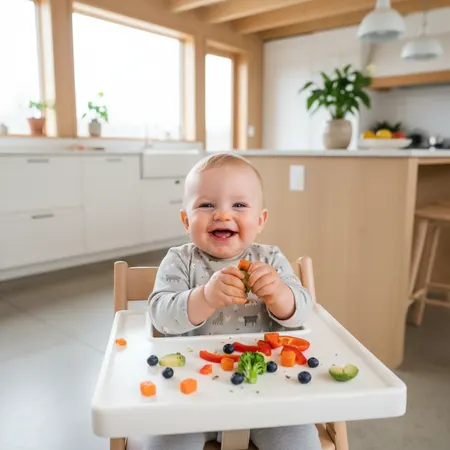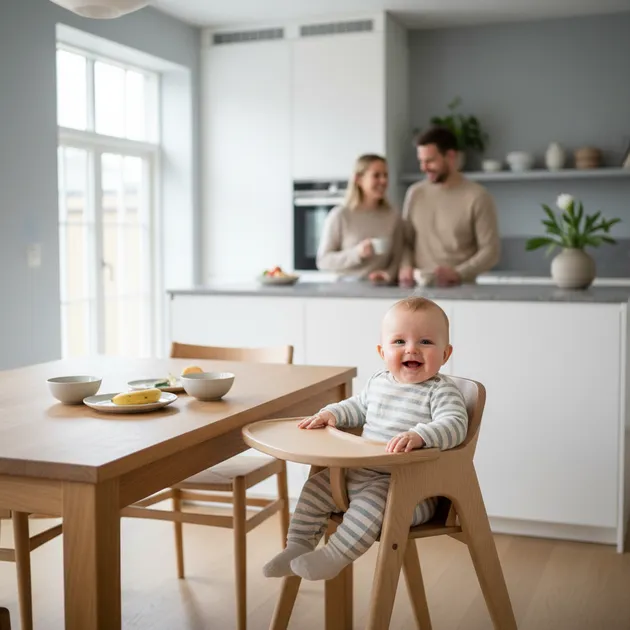
Eating together as a family is one of the best daily routines with a baby. A good high chair makes this possible from around 6 months of age, and the right chair lasts for many years.
Here is an overview of types of high chairs, what to look for, and which models parents tend to prefer.
Key Takeaways
- Most babies are ready for a high chair around 6 months, the key signs are sitting with support, good head control, and showing interest in food.
- A grow-with-me chair (like the Stokke Tripp Trapp) is a long-term investment that adjusts from baby to adult, while simple plastic chairs (like the IKEA Antilop) are excellent affordable options.
- Correct foot support is essential, a footrest at a 90-degree angle helps your baby sit stably and focus on eating rather than balancing.
- Always use a 5-point harness until your baby has solid core strength and can sit confidently without slumping.
- High chair safety: always stay within arm's reach, never leave your baby unattended, and ensure the chair cannot tip over.
When is your baby ready for a high chair?
Most babies are ready for a high chair around 6 months, but age alone is not the deciding factor. Look for these signs:
- Baby can sit with support and holds their head steady
- Good upper body control
- Shows interest in food and reaches toward the table
- Can sit upright in the chair without slumping to the side
Some babies are ready as early as 5 months, others need a little more time. Always use a high chair with good back support and a harness in the beginning.
The timing for a high chair and starting solid food often go hand in hand. Read our guide to introducing solids to know when your baby is ready for food.
Types of high chairs
Grow-with-me chair (Tripp Trapp style)
An adjustable wooden chair that adapts to your child from babyhood to adulthood. The seat and footrest are adjustable in height as the child grows. The most popular style among parents who want a long-term investment.
Pros:
- Lasts from baby to adult
- Ergonomic with correct footrest support
- Child sits at table height with the family
- Solid wood construction
Cons:
- Higher upfront cost
- Baby seat and harness often sold separately
- Takes up a fixed spot at the table
Simple clip-on or classic plastic chair (IKEA Antilop style)
A lightweight, affordable plastic chair with a removable tray. Easy to clean and a popular choice as a second chair or for those with a limited budget.
Pros:
- Very affordable
- Lightweight and easy to move
- Very easy to clean
- Folds flat
Cons:
- No footrest (can be added separately)
- Child outgrows it around age 3
- Plastic legs can scratch hardwood floors
Travel high chair
A folding chair or clip-on booster that you take on the go. Attaches to a regular chair or freestanding. Convenient for travel, visits, and restaurants.
Pros:
- Light and compact
- Great as a second chair
- Practical for travel and dining out
Cons:
- Not as stable as a full chair
- Limited lifespan
- Often lower weight limit
Chair with recline function
Some high chairs can recline for very young babies. Convenient if you want your baby at the table before they can sit fully upright, but these tend to be pricier and more complex.
Safety, what to check
A high chair should keep your child safe and stable at the table. Check these points:
Requirements for a safe high chair:
- 5-point harness to keep the child in place (shoulders, hips, and crotch)
- Wide base or solid attachment that prevents the chair from tipping
- Smooth surface without sharp edges
- Pinch risk, check that little fingers cannot get caught in adjustment mechanisms
- Safety certification (ASTM, JPMA, or similar)
Always use the harness. Children can slide out of the chair or try to stand up. The harness should be used every time, regardless of the child's age. Place the chair on a flat surface, never near a stove or table with hot pots.
Footrest is underrated:
A footrest gives the child stability and better posture. Children who have support under their feet sit more securely and eat better. Some chairs lack a footrest, but third-party add-ons are available.
Popular high chair models
Stokke Tripp Trapp
A design classic first made in 1972. Adjustable wooden chair that grows with the child. Holds up to 300 lbs (136 kg), so the whole family can use it. Baby set (from about 6 months) and newborn insert sold separately.
Price: Around $300 (chair), baby set around $100 extra.
Stokke Clikk
Stokke's simpler and more affordable option. Comes complete with tray and harness, ready to use out of the box. Fits from 6 months to about 3 years. Simpler design, easier to clean.
Price: Around $200.
IKEA Antilop
One of the most budget-friendly high chairs available. Gets the job done without fuss. Tray included, easy to clean. Add a footrest attachment for better ergonomics.
Price: Around $25.
Nomi by Evomove
Scandinavian design with a sleek look. Adjustable like the Tripp Trapp, but with a more contemporary appearance. Good footrest and simple tool-free adjustment.
Price: Around $350–400 (chair), baby set extra.
Grow-with-me chairs like the Tripp Trapp last for generations. Check secondhand marketplaces for used ones, they are almost impossible to wear out. A new baby set and new harness straps, and the chair is as good as new.
Cleaning and maintenance
The high chair will get messy. Every day. Here are tips that make life easier:
- Plastic chairs (Antilop): Rinse with water after each meal. Can be put in the shower
- Wooden chairs (Tripp Trapp): Wipe with a damp cloth. Avoid too much water on the wood
- Cushions and covers: Choose machine-washable covers. Check the washing instructions
- Harness: Clean with a cloth and mild soapy water. Check that the buckles work
Put a splash mat under the high chair. It protects the floor and makes cleanup much faster. An old tablecloth or a silicone mat works great.
From high chair to regular chair
Most children are ready for a regular chair with a booster cushion around ages 2–3. With a grow-with-me chair like the Tripp Trapp, you skip this step, just remove the harness and adjust the seat and footrest.
Signs that the child is ready to sit without a harness:
- Sits calmly through the whole meal
- Can climb up and down independently
- Understands that you sit still at the table
Budget tips for high chairs
- Start with an Antilop. For around $25 you get a chair that works perfectly. Upgrade to a Tripp Trapp when you know your preferences
- Buy secondhand. Wooden chairs like the Tripp Trapp last for decades. A used chair at half price is great value
- Skip unnecessary accessories. The baby needs a chair, harness, and footrest. Cushions and special covers are nice, but not necessary
- Choose a chair that grows. A Tripp Trapp at $300 lasts 15+ years, that's $20 per year
High chairs and baby-led weaning (BLW)
Using baby-led weaning (BLW)? Then chair choice is especially important. The child needs:
- Good seated posture with a straight back
- Footrest for stability
- Tray or table surface in front of them
- Harness to keep the child safely in place while exploring food
A grow-with-me chair with a baby set gives the best seated position for BLW.
Frequently asked questions
When can a baby sit in a high chair?
Most babies are ready around 6 months, when they can sit with support and hold their head steady.
Which high chair is best for a baby?
The Stokke Tripp Trapp is very popular. The IKEA Antilop is the best budget choice. Both are safe options.
Is the IKEA Antilop a good high chair?
Yes, it gets the job done at a very low price. It lacks a footrest, but one can be added separately.
Does the baby need a footrest?
Yes, a footrest provides better stability and posture. Children with footrest support eat better.
How long do you use a high chair?
A standard high chair fits to about age 3. A grow-with-me chair like the Tripp Trapp adjusts and lasts for many years.
Read more
Sources
- American Academy of Pediatrics. "Feeding Your Baby." AAP, 2024.
- JPMA. "High Chair Safety Standards." Juvenile Products Manufacturers Association, 2024.
- CPSC. "High Chair Safety Guidelines." U.S. Consumer Product Safety Commission, 2024.
Last updated: March 2026
🔧 Helpful Tools
- All Baby Tools. Browse all free tools for pregnancy and baby care