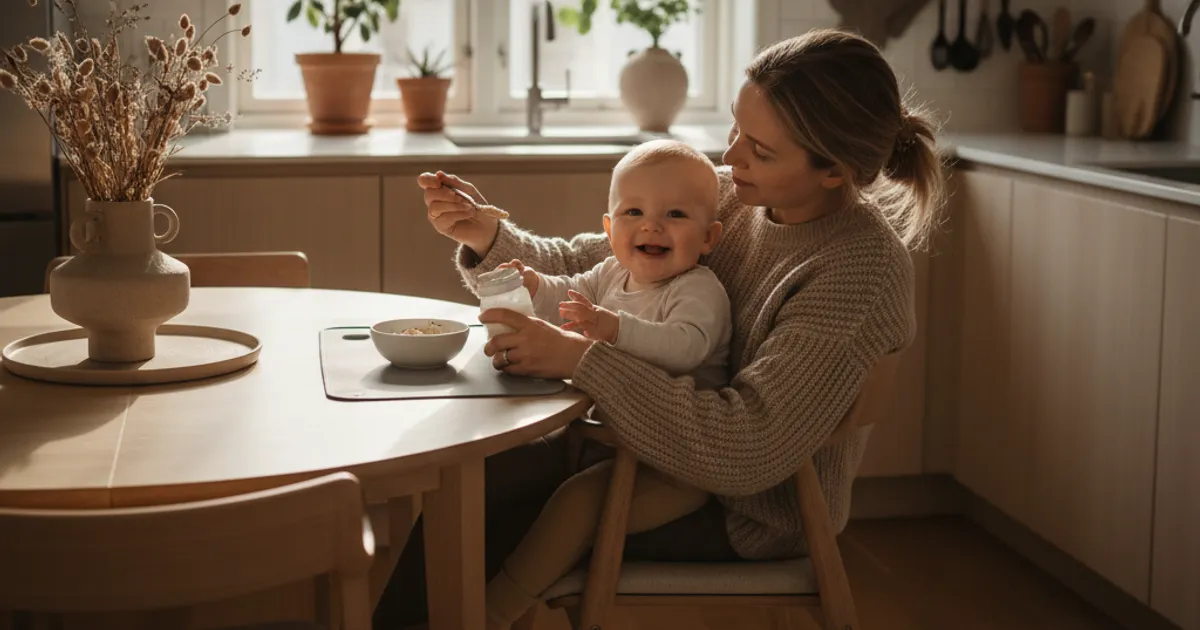
You've pumped, warmed, and found the perfect chair, but baby turns their head away, presses their lips together, and cries. Bottle refusal is one of the most common frustrations among breastfeeding parents, and it hits especially hard when going back to work is approaching or someone else needs to care for the baby.
Fortunately, there are strategies that work. Most babies can learn to take a bottle with the right approach, patience, and a little creativity.
Why does baby refuse the bottle?
A baby who has gotten used to the breast can feel the difference immediately. Breast and bottle require completely different sucking techniques, and the transition is bigger than many people realize.
Sucking technique: At the breast, baby uses tongue, jaw, and lips in a complex interaction. Milk doesn't come on its own, baby has to actively work for it. A bottle works differently. Some bottles deliver milk too fast and too easily, while others require a technique baby hasn't learned.
Smell and scent: Baby knows mom's scent and associates it with the breast. When mom holds the bottle, baby can become confused, why is a bottle being offered when the breast is right there?
Nipple taste: Silicone tastes different from skin. Many babies react to the taste and texture of a bottle nipple.
Timing: Babies who have only had the breast for the first months have a harder time accepting a bottle than babies who are introduced to it early.
Lactation consultants recommend introducing a bottle around 3–4 weeks of age if you know the baby will need to take a bottle later. At this point, breastfeeding is usually well established, but baby is still open to new sucking techniques.
Strategies that work
There's no miracle solution, but combining several approaches significantly increases the chances of success.
Let someone else give the bottle
The single most important change many families can make is having a different person give the bottle. When baby smells mom, they'll instinctively search for the breast. A partner, grandparent, or caregiver often has better success because baby doesn't associate them with breastfeeding.
Try leaving the room, or better yet, leaving the house, the first few times. Babies have an extraordinary sense of smell and can detect mom's presence even from another room.
Timing is everything
Don't wait until baby is starving. A desperately hungry baby has a short fuse and little patience for trying something new. Offer the bottle when baby is awake, content, and a little hungry, roughly halfway between two usual feeding times.
Many parents have the best results offering the bottle as the first meal after the morning nap, when baby is rested and in a good mood.
Try different bottles and nipples
Not all bottles suit all babies. Some babies prefer a wide nipple that resembles the breast, others like a narrower nipple. You don't need to buy ten different brands at once, try two or three different types and give each a few days.
Helpful tips:
- Choose a slow-flow nipple (size 0 or 1)
- Try dipping the nipple in a little breast milk before offering it
- Warm the nipple under warm running water, body-warm silicone is more inviting
Paced bottle feeding: Hold the bottle almost horizontal so baby has to work for the milk, just like at the breast. This prevents baby from being overwhelmed by milk flowing too fast and makes the transition from breast to bottle more natural.
Different positions
Surprisingly, it often works better to NOT hold baby in a typical nursing position. Try:
- Upright position, baby sits upright in your lap, with their back to you
- Rocking position with movement, walk slowly around while offering the bottle
- In a bouncy seat, some babies accept the bottle more easily when they're not held close to a body
Experiment and see what works for your specific baby.
Milk temperature
Some babies are very particular about temperature. Breast milk from the breast is body-warm (around 98.6°F / 37°C). Pumped milk from the fridge may feel uncomfortably cold. Warm the milk to body temperature, drop a little on the inside of your wrist to check.
Other babies actually prefer milk slightly cooler than body temperature. Try both.
Step-by-step plan
If baby consistently refuses the bottle, a gradual approach works best.
Week 1. Introduction without pressure: Let baby play with the bottle nipple without any milk in it. Hold it near their mouth, let baby take it voluntarily. No stress, no expectation.
Week 2. Small amounts: Fill a few milliliters of breast milk in the bottle. Offer once a day, at a time when baby is in a good mood. Accept that baby may only take a few sips.
Week 3. Increase gradually: Increase the amount as baby accepts more. Have someone else take over the bottle feeding. Measure success in progress, not in milliliters.
Week 4. Establish a routine: Once baby accepts the bottle, build it into a regular part of the day. Keep that one bottle feeding even if you nurse for the rest of the time.
Never force the bottle into baby's mouth. Force creates negative associations and makes the problem worse. If baby is crying and turning away, stop and try again later. Patience is the most important ingredient.
Alternatives to the bottle
If baby absolutely won't take a bottle after several weeks of trying, there are alternatives.
Cup: Babies from newborn age can drink breast milk from a small cup. This requires a little practice but is an accepted method used by healthcare workers in neonatal units.
Spoon: Time-consuming but works for small amounts.
Medicine syringe: Can be used along the inside of the cheek for small amounts.
Open cup or 360-degree cup: For babies over 6 months, a training cup may be a better alternative than a bottle.
When should you seek help?
Most babies eventually accept a bottle, but sometimes you need professional guidance.
Contact your pediatrician or a lactation consultant if:
- Baby refuses all alternative feeding (bottle, cup, spoon)
- Baby is losing weight
- You're going back to work soon and baby won't take a bottle
- Bottle refusal is causing major frustration and affecting family life
La Leche League (llli.org) offers free support from experienced breastfeeding helpers who can give individual guidance.
Your pediatrician knows your baby and can assess whether there's something other than preference causing the refusal.
Common questions
When is it too late to introduce a bottle?
Strictly speaking, it's never too late, but it gets harder the older baby is. The optimal window for introducing a bottle is between 3–6 weeks, according to lactation consultants. After 3–4 months it may take longer, but most babies will eventually accept a bottle with patience and the right approach.
Can the bottle interfere with breastfeeding?
Nipple confusion is debated among professionals. Lactation consultants recommend waiting until breastfeeding is well established (around 3–4 weeks) before introducing a bottle. Use paced bottle feeding technique and a slow-flow nipple to minimize the risk.
Baby takes a bottle from everyone but me. What do I do?
This is completely normal and actually a good sign. Baby associates you with the breast and prefers the real thing. Let your partner or others give the bottle, and make sure you're out of sight and smell range. Over time, baby may become more flexible.
Does it help to mix breast milk and formula in the bottle?
Yes, this can help babies who are used to the taste of breast milk. Start with mostly breast milk and a small amount of formula, and adjust gradually. Talk to your pediatrician about the right approach.
Read more
- Pumping and storing breast milk, complete guide
- Formula: everything you need to know, choosing the right formula
- Breastfeeding challenges and solutions
Sources
- La Leche League International. Bottle Introduction
- American Academy of Pediatrics. Bottle Feeding
- WHO. Infant and Young Child Feeding Recommendations
🔧 Helpful Tools
- Breastfeeding Tracker. Log feeds, track supply, and monitor nursing sessions
- Baby Food Guide. Safe foods and introduction schedule for your baby
- All Baby Tools. Browse all free tools for pregnancy and baby care
📖 Related Articles
- Weaning From Breastfeeding: How to Do It Gradually. Ready to stop breastfeeding? Learn how to wean gradually without engorgement, what to replace breast milk with at different ages, and how to take care of yourself through the transition.
- Baby Always Hungry? Causes and What to Do. Does your baby seem constantly hungry? Learn about common reasons for frequent feeding, when it's normal, and when to talk to your pediatrician.