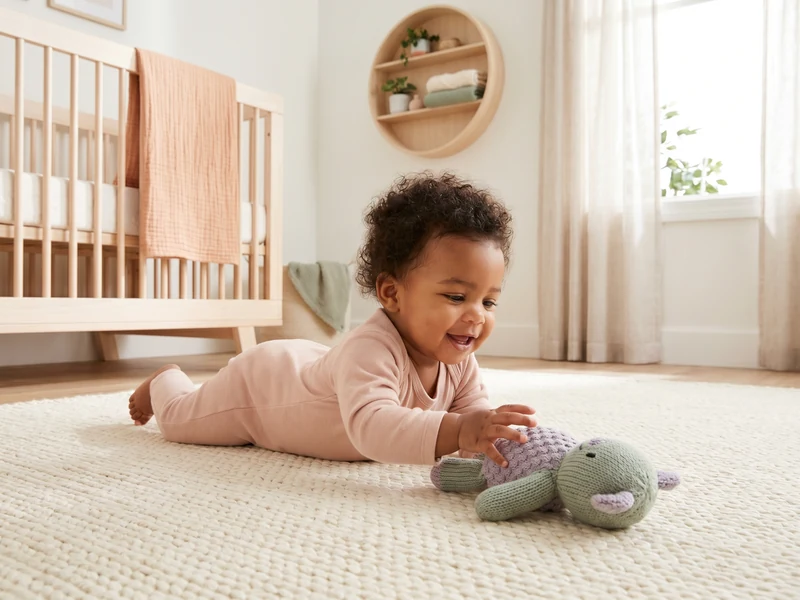
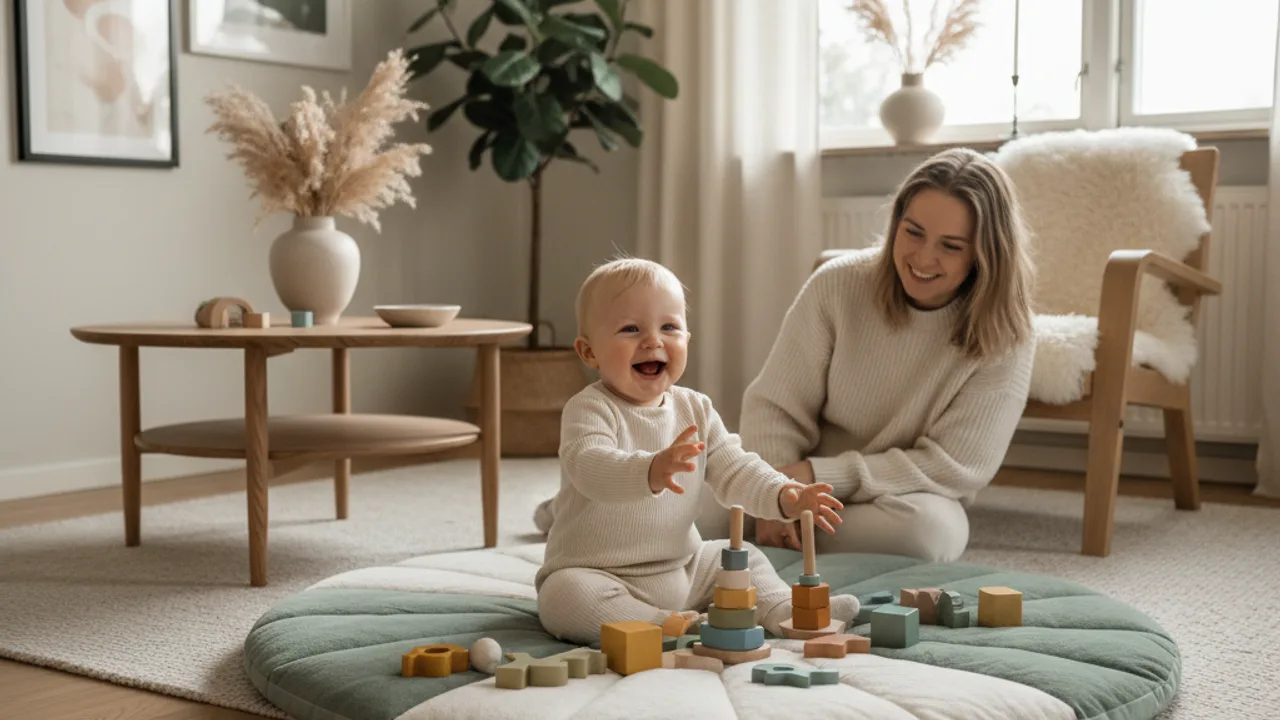
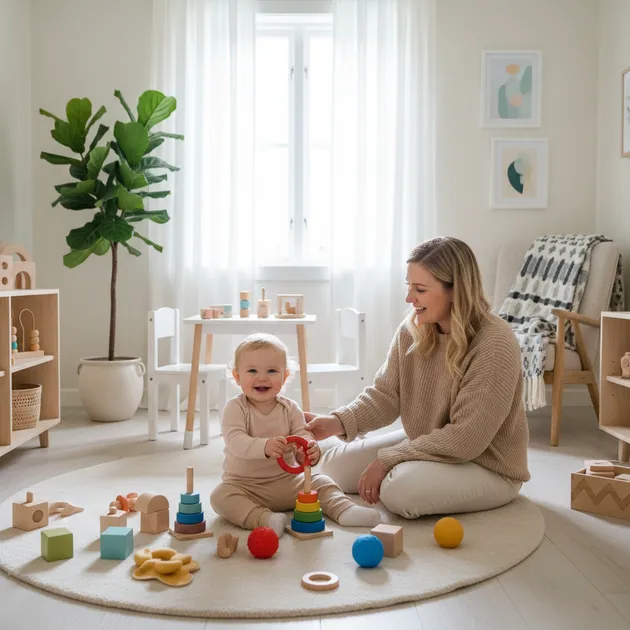
The best toys for 6 to 12 months aren't the flashiest ones, they're the ones that match what your baby's brain is actually ready to do. Between 6 and 12 months, infants move from passive sensory observers to active experimenters: they grab, bang, drop, mouth, shake, and begin to understand that their actions cause predictable reactions. A well-chosen toy at this stage does more developmental work in 20 minutes of floor time than a passive screen ever could.
Key Takeaways
- Choose toys that respond to the baby's actions, not toys that perform independently while the baby watches.
- The 6–9 month window prioritizes grasping, mouthing, and basic cause-and-effect; 9–12 months adds object permanence and early problem-solving.
- All toys for infants under 12 months must pass ASTM F963 toy safety standards; check for choking hazard warnings (avoid anything with parts smaller than 1.75 inches diameter).
- Rotation beats accumulation: 4–6 toys in the environment at once is better than 20, which leads to overstimulation.
- The best toy for this age group is often a parent, responsive face-to-face play, object passing, and narrated exploration beat any manufactured product.
What Babies Are Developing at 6–12 Months
Understanding the developmental arc helps you choose toys that are challenging without being frustrating.
6–7 months: Babies are sitting with support (and beginning to sit independently), transferring objects between hands, and bringing everything to their mouths. They track moving objects with their eyes and begin to understand that partially hidden objects still exist, the early emergence of object permanence. The CDC milestone markers for this window include grasping and shaking objects, and responding to the emotional tone of voices.
7–9 months: Pincer grasp is developing (though not fully refined until 9–12 months). Babies enjoy dropping objects repeatedly, this is not misbehavior; it is physics experimentation. Cause-and-effect toys that respond to pressing, squeezing, or shaking are deeply satisfying at this stage.
9–12 months: Object permanence is now established, babies will look for objects that have been hidden. They begin to point, wave, clap, and imitate actions. Stacking and nesting toys become engaging because babies can now plan a sequence of actions. Fine motor skills are sharper, and babies enjoy manipulating smaller (but still safe) parts.
Best Toy Categories for 6–12 Months
Sensory Toys (6+ months)
Sensory toys engage multiple senses simultaneously: texture, sound, color contrast, and movement. At this stage, high-contrast patterns (black and white, or high-saturation primary colors) continue to capture attention because an infant's visual cortex is still maturing.
What works:
- Soft crinkle books with varied textures per page
- Silicone or fabric teethers with multiple textures (helps with emerging teeth and oral sensory needs)
- Rattles and shakers with satisfying sound-to-action ratio, if shaking the rattle produces an immediate, predictable sound, babies learn that they caused it
- Water play mats (supervised floor use)
What to avoid: Overly complex sensory toys that activate automatically, the learning value is in the action-response loop, not in the toy performing on its own.
Cause-and-Effect Toys (7+ months)
According to Zero to Three, the 6–12 month window is when cause-and-effect understanding accelerates most rapidly. Toys that respond immediately and proportionally to an action are ideal.
What works:
- Pop-up toys (press a button → animal appears)
- Simple shape sorters, at 7–8 months, the goal is exploring the pieces; actual sorting begins closer to 12 months
- Stacking cups that nest inside each other (bang them, knock them over, stack them back, each action produces a clear result)
- Balls that roll in interesting directions when pushed
- Simple board books read aloud with page-turning participation
Developmental note: When a baby drops a toy repeatedly, hand it back with neutral affect, this is object permanence + physics experimentation combined. Repetition is the point.
Stacking and Nesting Toys (8–12 months)
Stacking rings and nesting cups become the workhorses of late-infant toy play. The AAP highlights that stacking-type play supports fine motor control, spatial reasoning, and goal-directed behavior, a baby who successfully places one ring onto a post has completed a multi-step planned action.
What works:
- Classic stacking rings (smooth edges, varied sizes, lightweight)
- Nesting cups in graduated sizes (at 8–9 months: banging and nesting; at 11–12 months: beginning to stack deliberately)
- Soft blocks in 2–3 inch sizes (can be stacked, knocked down, and mouthed safely)
What to look for on the label:
- "Ages 6 months and up" or "Ages 12 months and up", use the actual rated age as a minimum
- No small parts. ASTM F963 defines a small part as anything that fits entirely in a small-parts cylinder (1.75 inches diameter × 2.25 inches deep)
- Non-toxic materials, BPA-free plastics, food-grade silicone for teethers
Musical and Auditory Toys (6+ months)
Babies at 6 months are increasingly responsive to music, rhythm, and their own voice. Auditory play supports language development, and the AAP specifically cites singing and responsive vocalization as high-value developmental activities.
What works:
- Simple shakers and maracas (baby-sized, no rattle beads loose)
- Piano floor mats (supervised, moderate volume)
- Parent singing, any song, any quality, is the highest-value auditory input at this age
Caution: Toys with very loud electronic sounds (above 85 dB at 10 cm distance) can damage infant hearing. Battery-powered toys should have volume limits or a way to place a strip of tape over the speaker to dampen output.
Toy Safety Checklist for 6–12 Month Babies
Before introducing any toy, run through this quick check:
- Rated for 6 months and up (or younger) by the manufacturer
- No parts smaller than 1.75 inches in diameter
- No sharp edges or points
- Strings or cords under 12 inches (strangulation risk above this length)
- Non-toxic paint and materials (look for ASTM F963 compliance)
- No loose battery compartments (button batteries are a critical ingestion hazard)
- Survives a tug test, seams hold, eyes/buttons don't detach easily
Inspect toys monthly for wear, a cracked plastic ring or detached part that was safe at purchase can become a hazard after heavy use.
How Many Toys Is Enough?
Research consistently shows that toy rotation, cycling 4–6 toys in and out of the environment every 1–2 weeks, produces more focused engagement than a room full of options. When everything is available all the time, babies experience option paralysis and shorter engagement windows. When a toy "returns" after two weeks away, it's novel again.
A practical starting point: two sensory toys, two cause-and-effect toys, and one stacking set. Rotate two of the five every week or two. Store the resting toys out of sight rather than in a visible toy bin.
🔧 Helpful Tools
These free Babysential tools support developmental play at 6–12 months:
- Development Leaps. Track your baby's mental leap windows; knowing when a leap is active helps you understand why play engagement drops or shifts suddenly.
- Milestones. Log and monitor developmental milestones so you can select age-appropriate toys and spot any delays worth discussing with your pediatrician.
- Food Guide. From around 6 months, solid food introduction begins alongside toy play; this tool helps you track first foods and allergenic introductions.
- Smart Start. Personalized guidance for the 0–12 month period, including play and development recommendations tailored to your baby's age.
Sources
- American Academy of Pediatrics. Developmental Milestones 3 to 12 Months: https://www.healthychildren.org/English/ages-stages/baby/Pages/Developmental-Milestones-3-to-12-Months.aspx
- Centers for Disease Control and Prevention. Milestones at 6 Months: https://www.cdc.gov/ncbddd/actearly/milestones/milestones-6mo.html
- Zero to Three. What to Expect: The First Year of Development: https://www.zerotothree.org/resource/what-to-expect-the-first-year-development/
Disclaimer: This article is for informational purposes only. Toy recommendations reflect general developmental guidance and do not constitute medical advice. Always supervise infant play and consult your pediatrician with developmental concerns.