Your baby is nine months old, and suddenly nothing is safe. Cables, socks, dog food, the remote control, everything ends up in the mouth. Your baby crawls (or scoots, rolls, or slides) toward anything interesting, and "interesting" basically means everything that exists.
Nine months is an age full of exploration. Your baby is mobile, curious, and brave. Separation anxiety may peak, food starts getting more texture, and you realize that baby-proofing was something you should have done three weeks ago.
Here's everything you need to know about this energetic age.
Key Takeaways
- Most babies start crawling between 7 and 10 months, but some skip crawling entirely and go straight to walking, which is completely normal.
- At 9 months, babies develop object permanence: they understand things still exist when hidden, which is why separation anxiety typically peaks now.
- The pincer grasp (picking up small objects between thumb and index finger) begins around 9 months, a major fine motor milestone.
- About 50% of babies still wake at night at 9 months; this is developmentally normal and not a sign of poor sleep habits.
- Baby-proofing should be complete by 9 months: secure furniture, cover outlets, and remove choking hazards smaller than 1.5 inches.
Motor Development at 9 Months
Motor development is in full swing. Your baby has grown stronger, more coordinated, and increasingly independent in their movements.
What most babies can do at 9 months
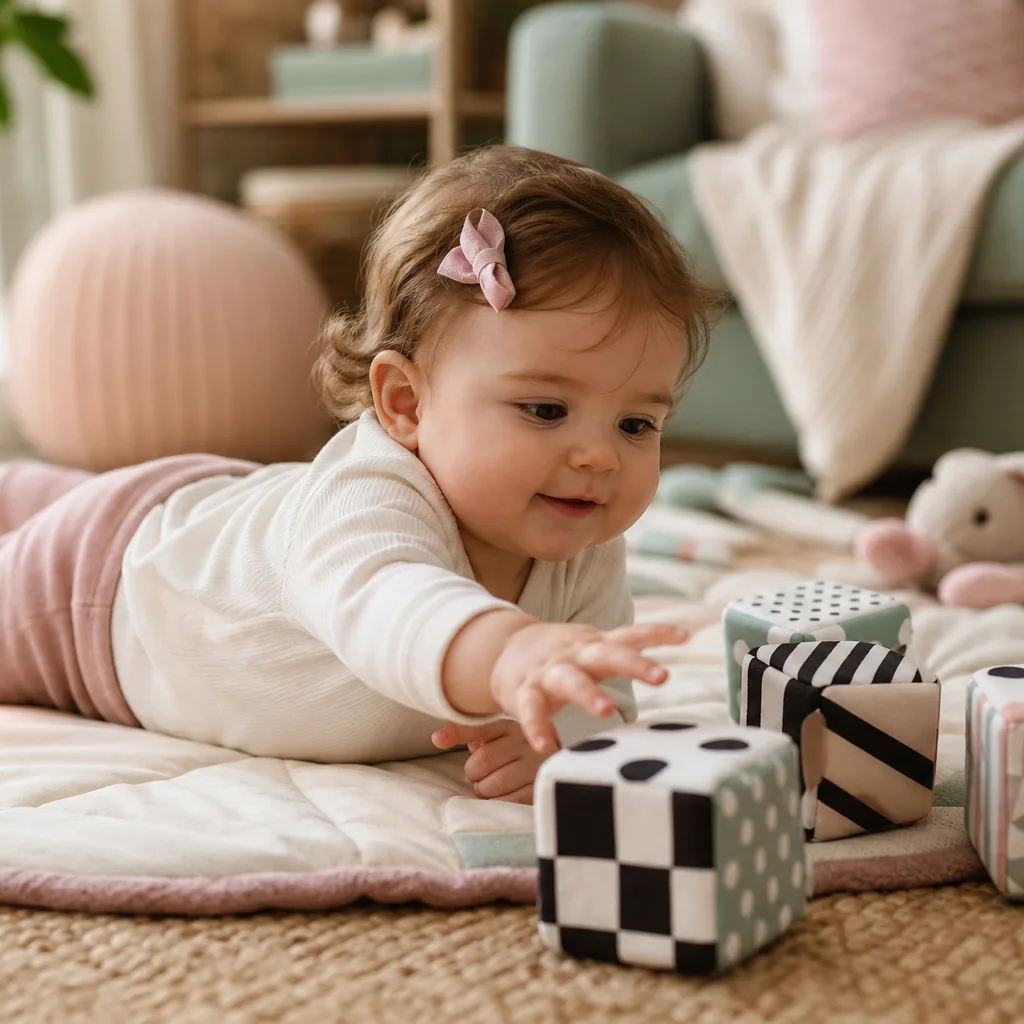
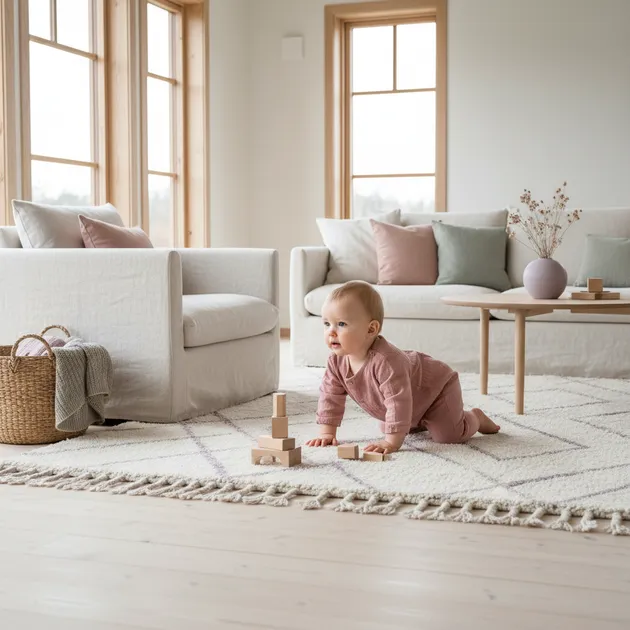
- Crawl, many crawl on hands and knees, some prefer bottom shuffling or commando crawling
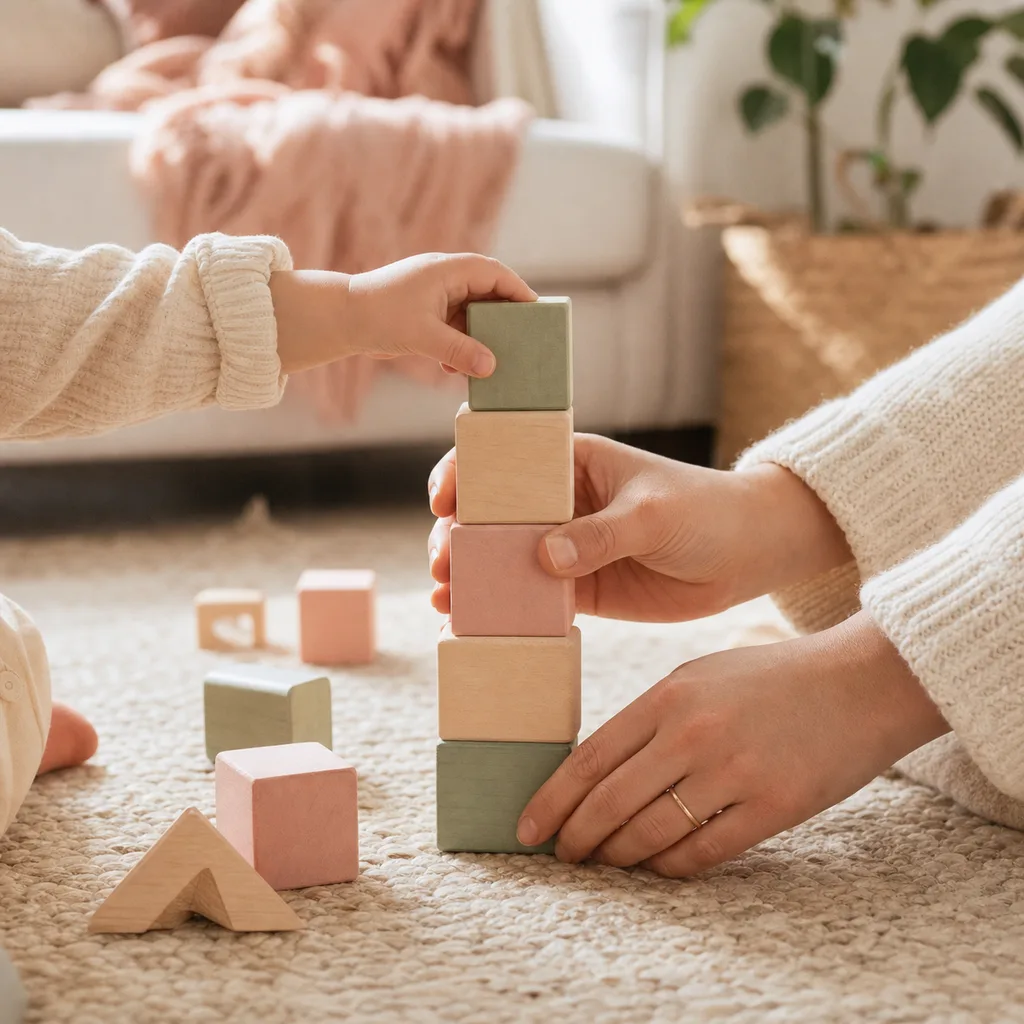
- Sit independently without support and play with both hands free
- Pull to standing by holding onto furniture
- Pincer grasp begins, picking up small items with thumb and index finger
- Clap their hands
- Point at things that interest them
Every baby crawls differently
There isn't one right way to crawl. Some babies do the classic crawl, others bottom shuffle, commando crawl (on their belly), or use one knee and one foot. All variations are normal and effective.
Some babies skip the crawling stage entirely and go straight to walking. That's also completely normal.
Worried because your baby isn't crawling yet? Many babies start crawling between seven and ten months, but some wait until eleven or twelve months or skip crawling altogether. Talk to your pediatrician if your baby isn't mobile in any way by ten months.
Pulling to standing
The big thing now is pulling up. Your baby uses anything available, the sofa, the coffee table, your legs, to get up on their feet. Proud and wobbly, they stand there with a wide smile.
The problem? Babies can often get up but don't know how to get back down. Expect a few rounds of frustrated crying until your baby learns to bend their knees and sit down.
Show your baby how to sit down from standing. Hold your baby gently by the hands and guide them down to sitting. After a few demonstrations, most babies learn to do it themselves.
Cognitive Development
The brain is working hard. At nine months, your baby understands much more than they can express, and they're starting to show it.
Object permanence
One of the biggest cognitive milestones: your baby now understands that things still exist even when they're hidden. If you hide a toy under a blanket, your baby searches for it.
This understanding is also the reason separation anxiety peaks. Your baby knows you exist, but doesn't know that you'll come back.
Cause and effect
Your baby loves experimenting with cause and effect. "What happens if I throw this cup on the floor?" The answer is always the same: the parents pick it up. Fantastic entertainment.
Typical behavior:
- Throws objects to see what happens
- Opens and closes doors and drawers
- Presses buttons
- Shakes everything to see if it makes a sound
- Peeks behind and under things
Separation Anxiety
Separation anxiety tends to peak around eight to ten months. The baby who was delighted by every visitor may suddenly scream when grandma holds them.
What's happening:
Your baby now understands that you are the most important person in their life, and that you can disappear. Combined with object permanence (you exist even when you're gone), this creates anxiety about losing you.
How to handle it:
- Don't sneak away, always say goodbye before you leave
- Keep the farewell short and calm
- Use peekaboo games to practice the concept that things come back
- Give your baby time to feel comfortable with new people
- Be patient, this phase will pass
Separation anxiety is a sign of healthy development. It means your baby has formed a secure attachment bond with you. The phase is intense but temporary.
Food at 9 Months
Your baby has been eating solid food for a few months now, and it's time for more texture and variety.
Increasing texture
At nine months, you should gradually move from smooth purees to coarser textures. Your baby has a pincer grasp and can handle finger foods.
Good food choices:
- Finger foods: Soft pieces of fruit, steamed vegetables, bread sticks, cheese (from 10 months)
- Coarser mashes: Mashed with a fork, not a blender
- New proteins: Fish, ground meat, beans, lentils, chickpeas
- Grains: Whole wheat pasta, couscous, bread
Choking hazards: Avoid whole grapes, whole cherry tomatoes, whole nuts, round slices of hot dogs, popcorn, and hard raw vegetables. Always cut grapes and tomatoes lengthwise, and slice hot dogs lengthwise.
Self-feeding
Let your baby practice eating on their own. It will be messy, but self-feeding is great practice for fine motor skills and independence.
- Give your baby their own spoon to hold
- Offer finger foods your baby can grab themselves
- Accept that most of it ends up on the floor, that's learning
- Sit with your baby and eat together
Sleep at 9 Months
Most nine-month-old babies sleep twelve to fourteen hours total, split between nighttime sleep and two daytime naps.
Common challenges:
- Sleep regression: Motor development can disrupt sleep, your baby practices standing up in the crib
- Separation anxiety at night: Your baby wants to make sure you're there
- Teething: Pain from new teeth can cause restless nights
- Three-to-two nap transition: Some babies drop the third nap now
Baby-Proofing: It's Urgent Now
With a crawler in the house, baby-proofing is no longer something you can put off. Go through every room and think like a baby, everything at floor level up to about three feet high is fair game.
Baby-proofing checklist:
- Baby gates, at the top and bottom of stairs
- Outlet covers, in every room
- Cabinet locks on cupboards with chemicals, medications, and knives
- Anchor furniture to the wall, bookshelves, dressers, TV stands
- Remove heavy objects from tables your baby can reach
- Toilet lock, babies are fascinated by the toilet
- Secure windows and balcony doors
- Check plants, some houseplants are poisonous
Babies can open cabinets, pull on cords, and reach higher than you think. Get down on all fours and see the room from your baby's perspective. Everything you see is something your baby will explore.
9-Month Pediatric Checkup
The nine-month checkup is one of the more thorough well-child visits. Your pediatrician will check:
- Growth, length, and head circumference
- Motor development (crawling, sitting, pulling up)
- Fine motor skills (pincer grasp)
- Language development (babbling, recognizing words)
- Social development (stranger anxiety, imitation)
- Vision and hearing
- Diet and nutrition
Frequently Asked Questions
My baby isn't crawling yet, is that normal?
Yes. Many babies don't crawl until ten to eleven months, and some skip crawling entirely. As long as your baby is mobile in some way (rolling, scooting, sliding), they're developing normally.
How long does separation anxiety last?
It typically peaks between eight and twelve months but can come in waves until age two. It gradually decreases as your baby understands that you always come back.
Should my baby be wearing shoes now?
No, not yet. Barefoot or with soft socks is best for foot development. Your baby only needs shoes when they're walking outdoors.
Can my baby drink cow's milk now?
No. Cow's milk as a drink is not recommended before twelve months. Cow's milk in cooking (sauces, porridge) is fine from ten months. Breast milk or formula is still the main milk source.
My baby stands up in the crib and won't lie down, what do I do?
Show your baby how to lie back down. Gently lay them down, offer comfort, and leave. It may take a few nights of repetition, but your baby will learn.
Sources
🔧 Helpful Tools
- Baby Milestones Tracker. Track your baby's developmental milestones
- Development Leaps. Understand your baby's developmental leaps
- All Baby Tools. Browse all free tools for pregnancy and baby care