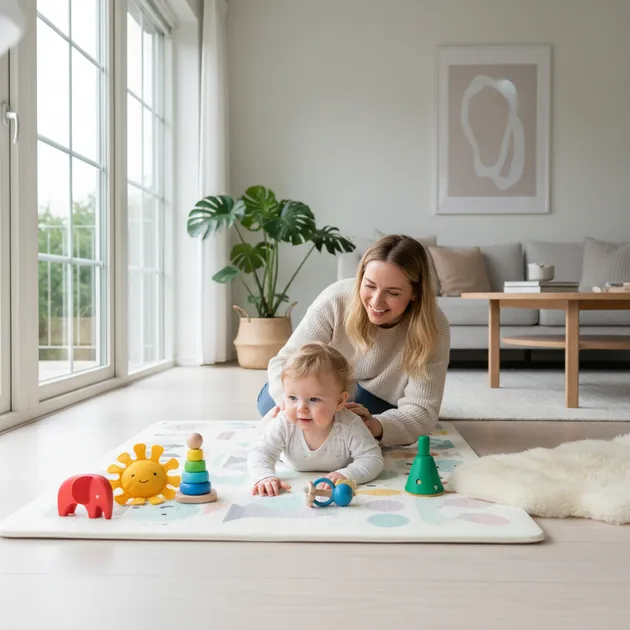
Your baby has reached three months, and the changes are already striking. The tiny newborn who only slept and ate has become an alert, curious little person who smiles intentionally, lifts their head, and "talks" to you with cooing sounds.
Three months is an exciting age. Your baby is beginning to discover themselves and the world around them. Here is an overview of what to expect, and how you can support development.
Key Takeaways
- By 3 months, most babies can hold their head steady when held upright, lift their head and chest during tummy time, and follow objects with their eyes 180 degrees.
- The social smile, a genuine, intentional smile in response to your face or voice, typically emerges between 6 and 8 weeks and is a key developmental milestone the AAP tracks at the 2-month visit.
- Cooing and vowel sounds (aaa, ooo) are the building blocks of language; responding to your baby's sounds and "talking back" actively supports brain and language development.
- Tummy time for at least 30 minutes spread throughout the day is recommended by the AAP from birth, it strengthens neck, shoulder, and core muscles critical for rolling and crawling later.
- Talk to your pediatrician if at 3 months your baby doesn't smile at people, doesn't follow moving objects with their eyes, or doesn't bring their hands to their mouth.
Overview: What Can a 3-Month-Old Baby Do?
Here is a quick overview of the key milestones at 3 months:
| Area | What most babies can do | Some babies can do |
|---|---|---|
| Motor | Hold head steady, lift chest during tummy time, reach for objects | Roll from tummy to back, hold a rattle briefly |
| Social | Smile intentionally, seek eye contact, respond to voices | Laugh out loud, "flirt" with gaze |
| Language | Coo, make vowel sounds (aaa, ooo) | Squeals of delight, high-pitched vocalizations |
| Cognitive | Recognize parents' faces, follow objects with eyes | Study own hands, respond to routines |
All babies develop at their own pace. The table above shows averages. Talk to your pediatrician if you are concerned about your baby's development.
Motor Development at 3 Months
Three months is a major milestone for head control. Most babies can now hold their head steady for short periods and begin to use their arms actively.
What Most Babies Can Do
- Hold their head steady when held upright against your shoulder
- Lift head and chest during tummy time using their arms as support
- Follow objects with their eyes 180 degrees (from side to side)
- Open and close hands deliberately
- Reach for objects held in front of them
- Kick actively with their legs when lying on their back
Tummy Time Is Exercise
Tummy time is the best exercise for a three-month-old baby. It strengthens the neck, back, and shoulder muscles that your baby will need to roll, sit, and crawl later.
Tips for tummy time:
- Start with short sessions (three to five minutes) several times a day
- Lie down at eye level with your baby
- Use colorful toys in front of your baby for motivation
- Lay your baby on your chest instead of the floor if they protest
- Don't give up even if your baby fusses a little, some discomfort is normal
Babies who dislike tummy time can be gradually encouraged. Start by placing your baby over your lap or on your chest in a reclined position. Increase the time little by little.
Social and Emotional Development
At three months, social life blossoms. The social smile typically appears around six to eight weeks, and by three months your baby has a full repertoire of facial expressions.
The Social Smile
The intentional smile is one of the most beloved milestones. Your baby doesn't smile just because they feel good, they smile at you in response to your voice, your face, and your attention.
- Baby smiles when you smile
- Baby smiles when you talk to them
- Baby smiles at familiar faces
- Baby may "flirt", look away and back with a smile
Vocal Development
At three months, your baby begins to experiment with their voice. You will hear cooing, vocalizations (aaa, ooo), and maybe even laughter.
What to expect:
- Cooing and vocalizations
- Squeals of delight
- Baby "answers" when you talk to them
- First laughter may come around three to four months
How to encourage this:
- Talk to your baby a lot, tell them what you are doing
- Wait for a "response", your baby needs pauses to respond
- Sing songs and read rhymes
- Use exaggerated facial expressions
Cognitive Development
The brain is developing at a remarkable rate. Your baby is learning to connect sensory impressions, recognize patterns, and understand simple cause and effect.
What Your Baby Understands
- Recognizes parents' faces and voices
- Prefers familiar people over strangers
- Understands simple routines, recognizes the nursing or changing sequence
- Follows movements with their eyes and turns their head toward sounds
- Becomes fascinated with their own hands, studies them, sucks on them
Sensory Development
At three months, vision has improved significantly. Your baby sees colors clearly and can focus on objects at different distances.
- Vision: Sees colors, follows movements, prefers faces
- Hearing: Turns toward sounds, prefers higher-pitched voices
- Touch: Enjoys feeling different textures
- Taste: Prefers sweet (breast milk/formula)
Give your baby different things to look at and touch. A high-contrast black-and-white book, a rattle with various textures, or a soft fabric with a crinkle sound provides good sensory stimulation.
Sleep at 3 Months
At three months, many babies begin to sleep a little longer at night. But there is great variation, some sleep six hours straight, others still wake every two hours.
Typical sleep pattern:
- Total of 14–17 hours sleep per day
- Three to four naps during the day
- Night sleep may get a little longer (four to six hours straight for some)
- Baby is beginning to distinguish between day and night
Tips for better sleep:
- Establish a consistent bedtime routine (bath, song, nursing, into bed)
- Dark room at night, light during the day
- Put your baby down when they are drowsy, but awake
- Avoid overstimulation before bedtime
Feeding
At three months, your baby should still be getting only breast milk or formula. Other foods are not introduced until six months, in line with WHO and AAP recommendations.
Typical feeding pattern:
- Six to eight feedings per day (may be more)
- Formula: approximately 5–6 oz (150–180 ml) per feeding, five to six times per day
- Your baby self-regulates how much they need
Do not give cereal, fruit puree, or other food to a three-month-old baby. The digestive system is not mature enough, and early introduction of solids can increase the risk of allergies. Wait until six months.
Well-Baby Visit at 3 Months
Most pediatric practices schedule a checkup around three months. Your healthcare provider will check:
- Growth and head circumference
- Head control and motor skills
- Eye contact and social response
- Hearing (response to sound)
- Vaccinations
Vaccinations at 3 Months
Vaccinations at this age typically include (check your country's specific schedule):
- DTaP, diphtheria, tetanus, pertussis (whooping cough)
- Hib. Haemophilus influenzae type b
- IPV, polio
- PCV, pneumococcal
- Rotavirus, given as drops
Your baby may be fussy or have a low fever after vaccinations. This is normal and usually passes within a couple of days.
Prepare for the visit:
- Write down any questions you have
- Note what your baby does and doesn't do
- Bring your baby's health record
Activities for a 3-Month-Old Baby
You don't need fancy toys. The best activities use what you already have.
Good activities:
- Mirror: Babies love looking at faces, including their own
- Songs and rhymes: "Itsy Bitsy Spider" or "Pat-a-Cake" with movements
- Tummy time with toys: Colorful objects placed in front of baby
- Conversation: Tell your baby what you are doing throughout the day
- Stroller walks: New surroundings provide sensory stimulation
- Bath play: Kicking and splashing in warm water
Frequently Asked Questions
My baby still doesn't hold their head up, should I be concerned?
Head control develops gradually. Some babies are a little later than others. If your baby cannot lift their head at all during tummy time at three to four months, bring it up with your pediatrician.
How much tummy time does my baby need?
The AAP recommends at least 30 minutes of tummy time spread throughout the day. Start with short sessions and build up gradually. Quality matters more than duration.
When does a baby start to laugh?
First laughter usually comes between three and four months. Some babies laugh early, others take a little longer. Tickling, surprises, and exaggerated facial expressions can trigger laughter.
My baby is drooling a lot, is it teeth?
Increased saliva production around three months is normal and doesn't necessarily mean teeth. The first teeth usually come around six months, but some babies start drooling and chewing on things long before that.
Does my baby need vitamin D?
Yes. The AAP recommends 400 IU (10 micrograms) of vitamin D daily for all breastfed babies from shortly after birth. Formula-fed babies who consume at least 32 oz (about 1 liter) of formula per day typically get enough vitamin D from the formula. Ask your pediatrician for specific guidance.
What can a 3-month-old baby do, a quick summary?
At 3 months, most babies can hold their head steady, smile intentionally at you, make cooing sounds, follow objects with their eyes, and reach for things. They recognize their parents' faces and voices and show clear joy in social interaction.
How much should a 3-month-old baby weigh?
Weight varies significantly and depends on birth weight. Your pediatrician tracks the growth curve to verify your baby is growing steadily. As a general rule, most babies double their birth weight by 4–5 months. Talk to your pediatrician if you are unsure.
When do babies start to roll?
Most babies begin rolling from tummy to back around 4–5 months, and from back to tummy a little later. Some early rollers may start as soon as 3 months. Tummy time is the best training for strengthening the muscles needed for rolling.
Should I worry if my baby hasn't started laughing yet?
No. First laughter usually comes between 3 and 4 months, but some babies take a little longer. If your baby is smiling intentionally and making eye contact, development is on track. Bring it up with your pediatrician if your baby is not smiling or seeking contact by 3–4 months.
Read also: Baby development 6 months | Developmental leaps in babies | Sensory development in babies
Sources
- WHO. Child Development
- AAP. Developmental Milestones
- CDC. Important Milestones
- Zero to Three. Brain Development
🔧 Helpful Tools
- Baby Milestones Tracker. Track your baby's developmental milestones
- Development Leaps. Understand your baby's developmental leaps
- All Baby Tools. Browse all free tools for pregnancy and baby care
📖 Related Articles
- Baby Development Month by Month: 0-12 Months. Complete guide to baby development from 0-12 months. Motor skills, language, senses, and milestones, based on pediatric guidelines.
- Baby Not Rolling at 6 Months: Should You Worry?. Baby not rolling at 6 months? Learn about normal variation, when to contact your pediatrician, and exercises that encourage rolling.
- Baby Not Sitting at 9 Months: What Is Normal?. Baby not sitting at 9 months? Learn about normal variation, the difference between supported and independent sitting, and when to seek advice.