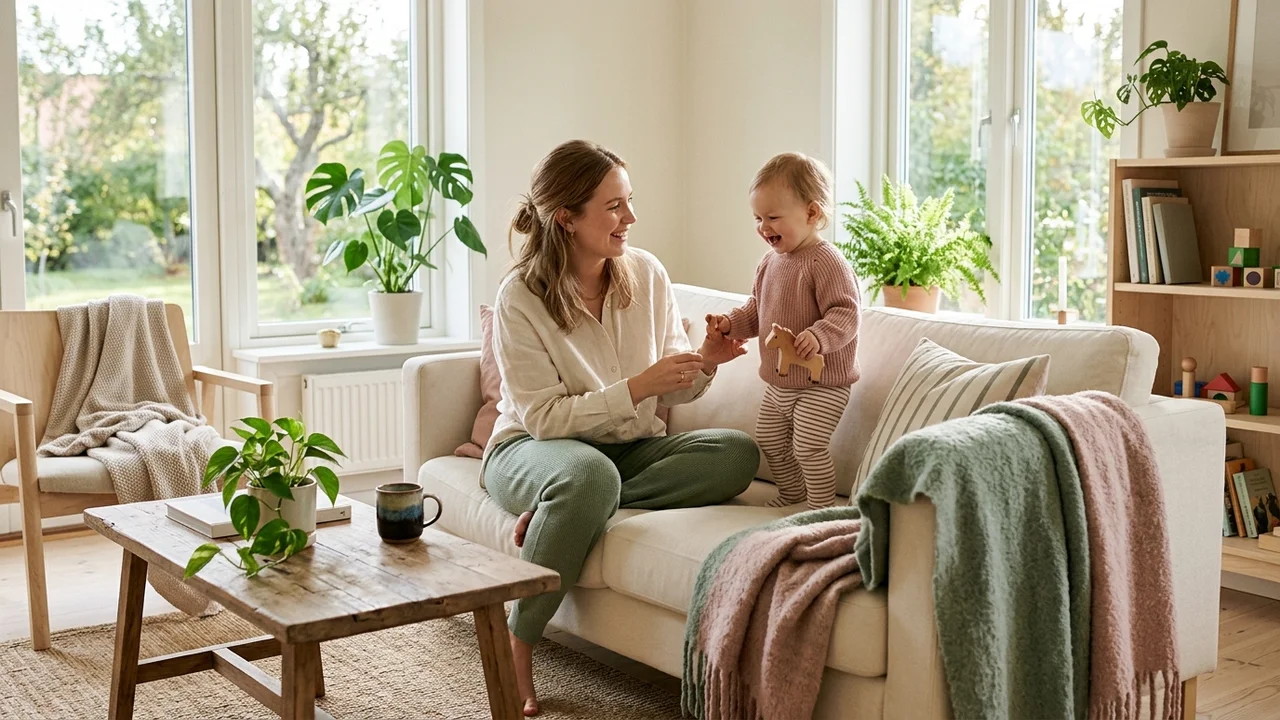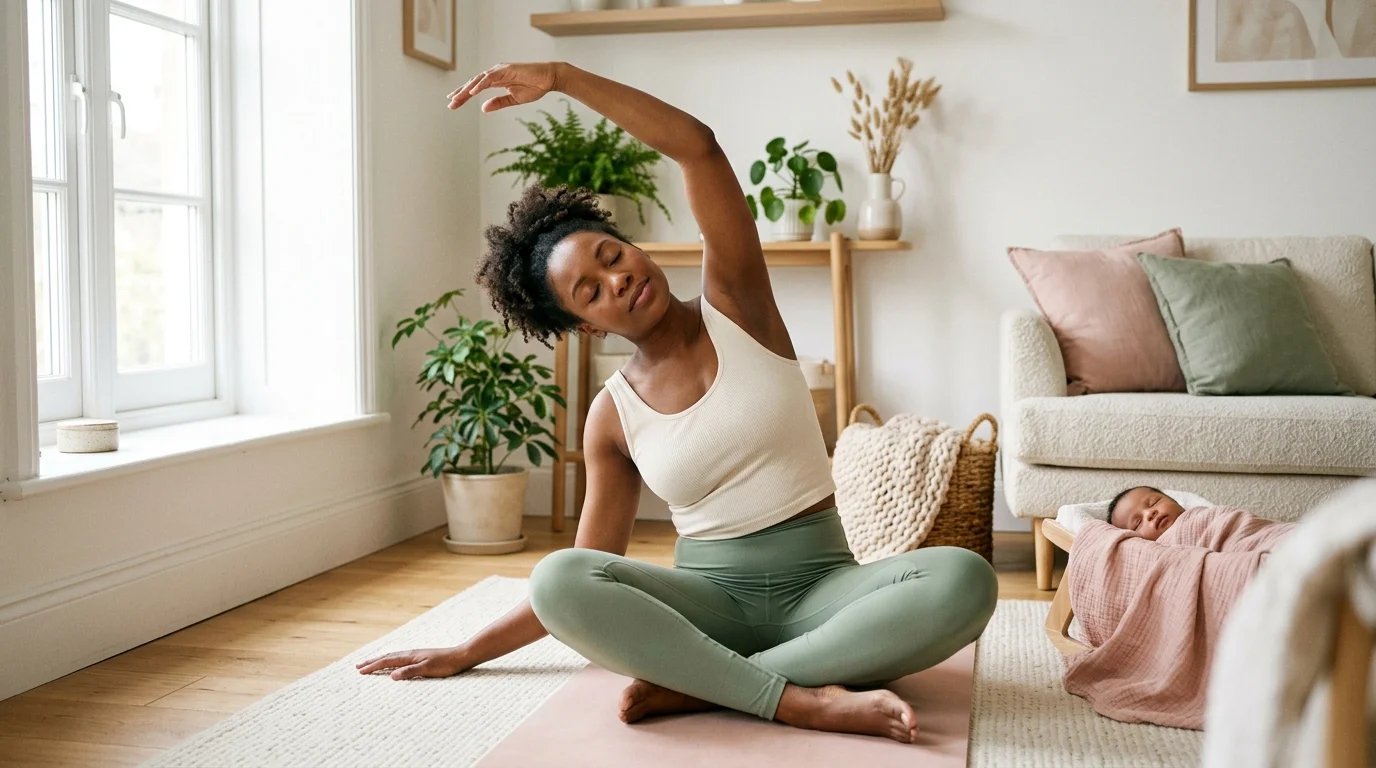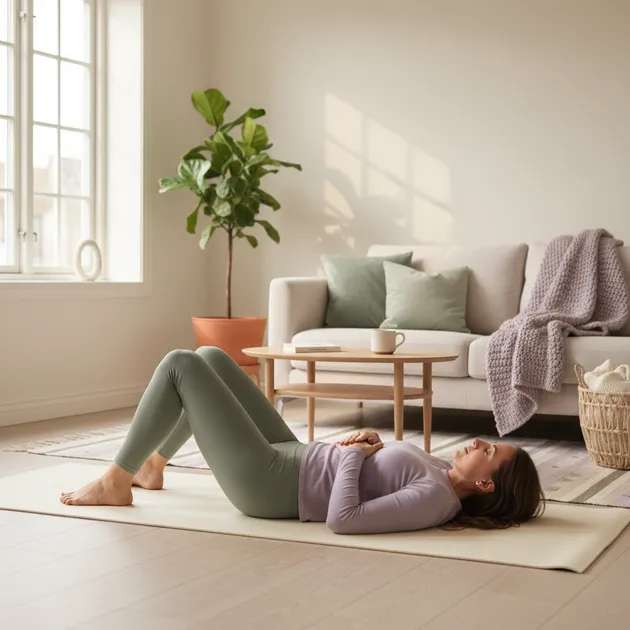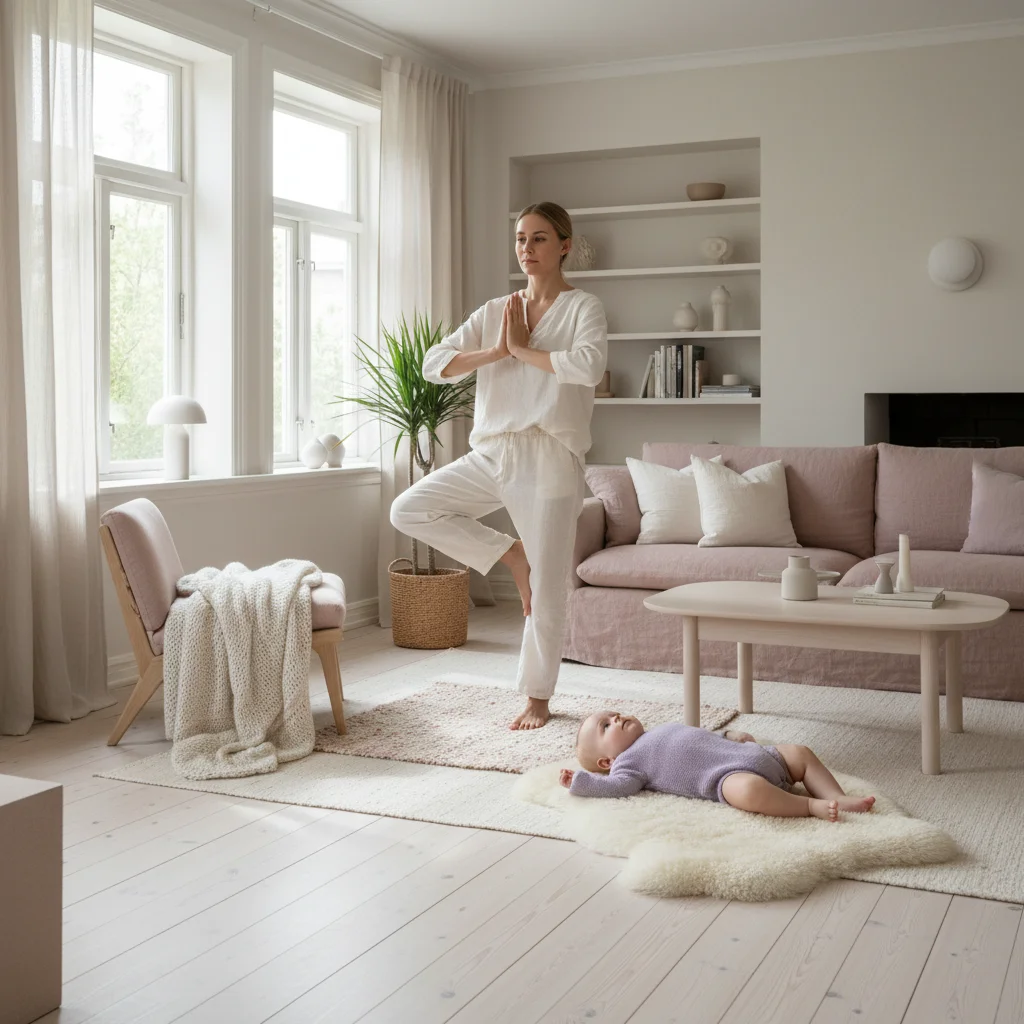
The first months after birth are a time of constant change, short nights, limited time to yourself, and a body that's still recovering. Yoga with your baby solves several problems at once: you gently rebuild your strength, your baby is right there with you, and you get connection and play woven into the session.
You don't need to be an experienced yoga practitioner. All you need is a mat, comfortable clothes, and a baby who's happy on the floor.
When can you start?
Most people can begin gentle yoga 6–8 weeks after giving birth, after their postpartum checkup with a midwife or doctor. That appointment matters because it can catch any complications that need to be considered before you start exercising.
After a vaginal birth
After an uncomplicated vaginal birth, you can usually start gently from 6 weeks. Begin with breathing techniques, pelvic floor exercises, and careful movements. Build intensity gradually over time.
After a cesarean section
After a C-section, wait longer, at least 8–10 weeks, and closer to 12 weeks for more demanding poses. The incision needs to be fully healed, and you should not feel any pain in the scar during movement.
Check for diastasis first
Before doing any abdominal work in yoga, check for diastasis recti, a separation of the rectus abdominis muscles that is common after pregnancy. Your midwife or doctor can assess this at your 6-week checkup, or you can learn to self-check.
Avoid classic sit-ups, plank, and deep twists in the early months. These can worsen diastasis recti. Focus instead on deep breathing activation and pelvic floor exercises.
Benefits of yoga with your baby
For you
- Gentle strength training that gradually rebuilds the body after pregnancy and birth
- Better posture, counteracts the forward-hunching position of nursing
- Stress reduction through focused breathing and presence
- Pelvic floor activation integrated naturally into the poses
- Social connection if you join a group class
For your baby
- Closeness and interaction with you during the session
- Sensory stimulation through movement, touch, and eye contact
- Routine and predictability, babies thrive with familiar, repeated activities
- Gentle physical stimulation through age-appropriate movements
Safe exercises for you and your baby
Here are exercises you can do at home with your baby. Start with 10–15 minutes and build up to 30–45 minutes over time.
Breathing with baby on your chest
Lie on your back with knees bent. Place your baby on your chest. Inhale deeply through your nose and feel your belly rise (and your baby with it). Exhale slowly through your mouth. Repeat 10 times.
This exercise activates the deep core muscles and gives your baby a calming experience of gentle movement and closeness.
Cat-cow with baby beneath you
Come onto all fours with your baby lying on the mat underneath you. Round your back toward the ceiling like a cat (exhale) and let it drop down (inhale) while you hold eye contact with your baby. Repeat 8–10 times.
Your baby sees your face from below and gets sensory stimulation from the movement and eye contact.
Bridge pose with baby on your hips
Lie on your back with knees bent. Seat your baby on your hips and hold them securely. Lift your hips toward the ceiling while squeezing your glutes and activating the pelvic floor. Hold for 3–5 seconds, lower slowly. Repeat 10–12 times.
Your baby gets a little ride that many babies find delightful.
Talk, sing, or make funny sounds while you exercise. Your baby responds to your voice, and it turns the session into play rather than just a workout.
Warrior pose with baby in a carrier
Stand in a wide-legged stance with your baby in a front-facing-in carrier. Slowly bend one knee into a warrior pose while keeping your upper body upright. Hold for 5 breaths, switch sides. Repeat 3 times per side.
Your baby is secure in the carrier, and the extra weight provides moderate strength training for your legs.
Gentle seated twist
Sit cross-legged with your baby in your lap. Gently rotate your upper body to one side (keeping hold of the baby). Hold for 3 breaths, rotate to the other side. Repeat 5 times per side.
Avoid deep twists in the first 3 months, keep the movement mild and comfortable.
Legs-in-the-air with baby
Lie on your back and lift your legs with knees bent so your shins are parallel to the floor. Place your baby on your shins (hold securely) and rock gently forward and back. This is the "airplane" game that babies tend to love, and it engages your core.
Always keep a firm hold on your baby during every exercise. Place a soft mat underneath you both in case the baby shifts. Stop immediately if you feel pain in the pelvis, abdomen, or back.
Practical tips for making it work
Timing is everything
Exercise when your baby is fed, rested, and in a good mood. Right after feeding or nursing (wait 20–30 minutes to allow for burping) is often a good window. Keep expectations low, some days you'll get five minutes, other days half an hour.
Equipment you need
- Yoga mat, preferably a thick one that's comfortable for the baby to lie on
- Comfortable clothes you can move freely in
- Baby carrier for standing exercises (ergobaby, Stokke, Manduca, or similar)
- Baby blanket or play mat as an alternative if your baby doesn't want to lie on the yoga mat
Expect interruptions
The baby cries, needs a diaper change, or loses interest. Completely normal. Yoga with your baby isn't about perfect sequences, it's about moving your body a little, breathing, and spending good time together.
Adapt to your baby's age
- 0–3 months: Baby lies on the mat or on you. Slow, calm movements only
- 3–6 months: Baby can sit in your lap with support. More interaction possible
- 6–9 months: Baby may crawl around the mat. Let it happen, work out between exploration breaks
- 9–12 months: Baby participates more actively. Use toys to maintain interest
Don't compare yourself to others. Your body created a human being, it deserves patience and respect. Start where you are, not where you think you should be.
Group classes and courses
Many areas offer baby yoga classes. Look for:
- Community centers and recreation programs, often affordable
- Pediatric clinics or birth centers, some offer free groups for new mothers
- Private yoga studios, many have dedicated postnatal and mom-and-baby classes
- Gyms and fitness centers, some offer postpartum group classes with yoga elements
Group classes give you social connection with other parents in the same situation, which can be just as valuable as the exercise itself.
Online resources
If you prefer to work out at home, there are excellent videos on YouTube and apps with baby yoga programs. Search for "postnatal yoga with baby" to find a wide range of options for all levels.
Progression over time
Yoga with your baby is a starting point. As your body gets stronger and your baby grows, you can:
- Increase session length (30–45 minutes)
- Add more challenging poses
- Move on to general yoga or other forms of exercise
- Combine with dedicated pelvic floor training and strength programs
Remember that the pelvic floor is the foundation. Always include pelvic floor exercises in your routine, especially throughout the first year after birth.
Summary
Yoga with your baby is safe, rewarding, and practical. You rebuild your body, your baby gets closeness and stimulation, and you build healthy routines together. Start gently after your 6-week checkup, adjust to how you feel each day, and enjoy the process.
Frequently asked questions
Can I do yoga with my baby from 2 weeks old? Gentle breathing and very mild stretching can start early, but wait for active yoga until after your 6-week postpartum checkup. Your body needs time to heal, and any complications should be ruled out by a doctor or midwife.
What do I do if the baby cries during yoga? Stop, comfort your baby, and try again later. Yoga with your baby should be enjoyable for both of you. Some days it works, other days it doesn't. Both are completely fine.
Is baby yoga the same as stretching the baby? No. Yoga with your baby is primarily about your own workout while your baby participates. Baby massage and gentle infant stretching is a separate practice that you can learn from your pediatrician or a dedicated infant massage class.
Read more
- Yoga after birth
- Exercise after birth, complete guide
- Diastasis recti after birth
- Pelvic floor exercises after birth
Sources
🔧 Helpful Tools
- Pelvic Floor Trainer. Guided pelvic floor exercises for pregnancy and postpartum
- All Baby Tools. Browse all free tools for pregnancy and baby care
📖 Related Articles
- Diastasis Recti After Birth: Exercises, Self-Test, and Treatment. Do you have diastasis recti after giving birth? Learn how to check yourself, which exercises help, and when to see a physical therapist. Based on current evidence.
- Pilates After Birth - Gently Rebuild Your Body. Pilates is ideal for rebuilding core muscles and pelvic floor after birth. Learn when you can start, safe exercises, and what to avoid.
- Exercise After Birth. Week-by-Week Guide. Complete guide to exercise after birth. Learn when you can start, which exercises are safe, and how to build strength week by week, including after cesarean.