When your belly feels like an empty balloon and your back aches from carrying the baby, it's tempting to throw yourself into intense exercise. But the body after birth needs something different. It needs to be built up from the inside out. That's exactly what pilates does.
Pilates is designed to strengthen the core muscles, the deep muscles around the abdomen, back, and pelvis that keep the body stable. After birth, these muscles are weakened and stretched. Pilates rebuilds them systematically, layer by layer.
Why Pilates Is Perfect After Birth
Pilates differs from other exercise in several important ways:
Focus on deep muscles. Where sit-ups work the outer abdominal muscles, pilates works the deep stabilizing muscles, transversus abdominis and multifidus. These are crucial for regaining stability in the abdomen and back.
The pelvic floor is integrated. In pilates, the pelvic floor is activated as part of every exercise. You don't train it in isolation, you learn to use it together with the rest of the core musculature. That's how the body is designed to work.
Controlled movement. Pilates is about quality, not quantity. Slow, controlled movements with proper breathing patterns. This reduces the risk of injury and ensures you're working the right muscles.
Scalable difficulty. The same exercise can be done at beginner or advanced level. You start where you are and build up gradually.
When Can You Start Pilates?
After vaginal birth: Most people can start basic pilates exercises from 4–6 weeks after birth, provided their doctor or midwife has given the go-ahead at the postpartum check-up. The simplest breathing exercises can be started within the first few days.
After c-section: Wait until 6–8 weeks and your postpartum appointment. Begin with breathing exercises and pelvic floor activation first. Avoid exercises that stress the scar for the first 3 months. Read more in our guide to exercise after c-section.
If you have diastasis recti: Pilates is actually one of the best forms of exercise for diastasis, but you must avoid exercises that push the abdominal muscles outward (like sit-ups and plank in the early stages). Check our diastasis guide for more information.
Stop the exercise and contact a physiotherapist if you experience pelvic pain, pressure downward in the pelvis, leaking of urine or gas, or if your abdomen bulges outward ("domes") during the exercise.
Core Principles in Postnatal Pilates
Before starting exercises, you need to understand the four pillars of pilates after birth:
1. The Breath
Correct breathing is the foundation of everything in pilates. Breathe in through your nose and let the ribcage expand to the sides. Breathe out through your mouth and activate the pelvic floor and deep abdominal muscles.
This breathing rhythm teaches the body to connect the breath to the core musculature. It's the difference between doing exercises, and doing pilates.
2. Pelvic Floor Activation
Think of gently lifting the pelvic floor upward and inward, as if you're stopping the flow of urine (but don't actually do this on the toilet, it's just a visualization). Activate the pelvic floor on the out-breath and release gently on the in-breath.
3. Neutral Spine
Lie on your back with knees bent. Find the position where the lower back has a natural small curve, not pressed flat against the floor and not exaggerated. This is the neutral position, and it's the starting point for most exercises.
4. Control Over Tempo
Every movement should be slow and controlled. If you lose control, make the exercise easier. Quality trumps quantity in pilates.
10 Pilates Exercises for After Birth
Phase 1: The First 6–8 Weeks
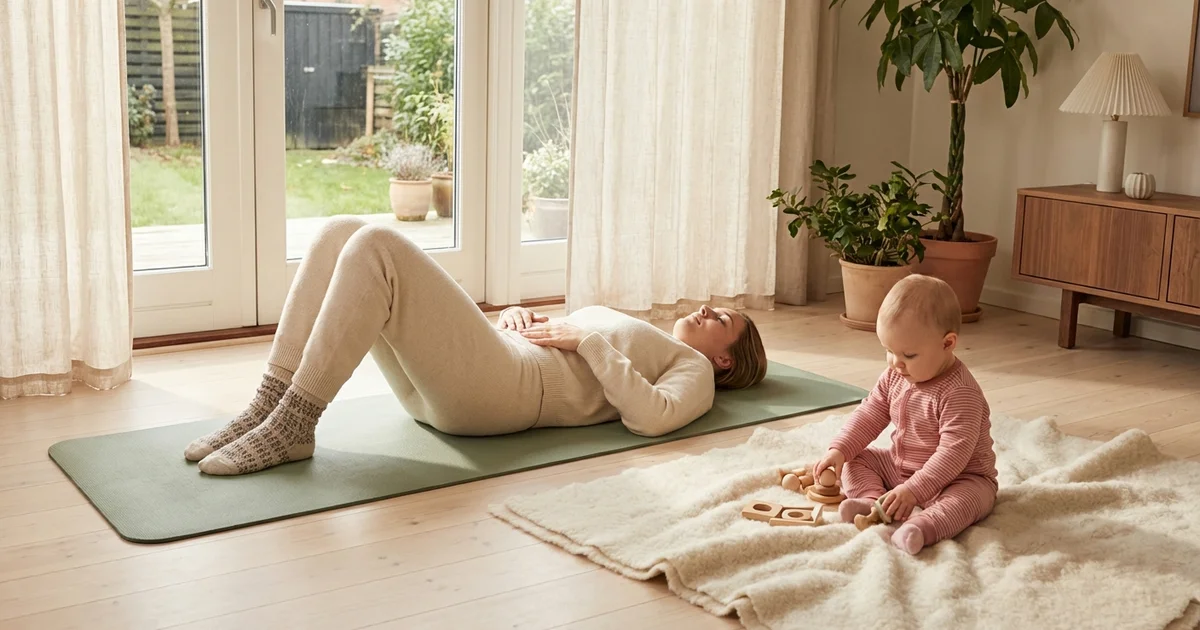
1. Diaphragmatic Breathing
- Lie on your back with knees bent
- Place hands on your ribs
- Breathe in through your nose, feel the ribs expand to the sides
- Breathe slowly out through your mouth, feel the ribs draw together
- Do 10 breaths, 2–3 times daily
2. Pelvic Floor Lift with Breath
- Lie on your back with knees bent
- Breathe in and relax
- Breathe out and gently lift the pelvic floor upward and inward
- Hold for 3–5 seconds
- Release slowly and breathe in
- Repeat 10 times, 3 sets
3. Heel Slides
- Lie on your back with knees bent
- Activate the pelvic floor and deep abdominal muscles
- Slowly slide one foot out along the floor until the leg is almost straight
- Slowly return
- Switch sides
- 8 repetitions per side, 2 sets
Phase 2: 6–12 Weeks
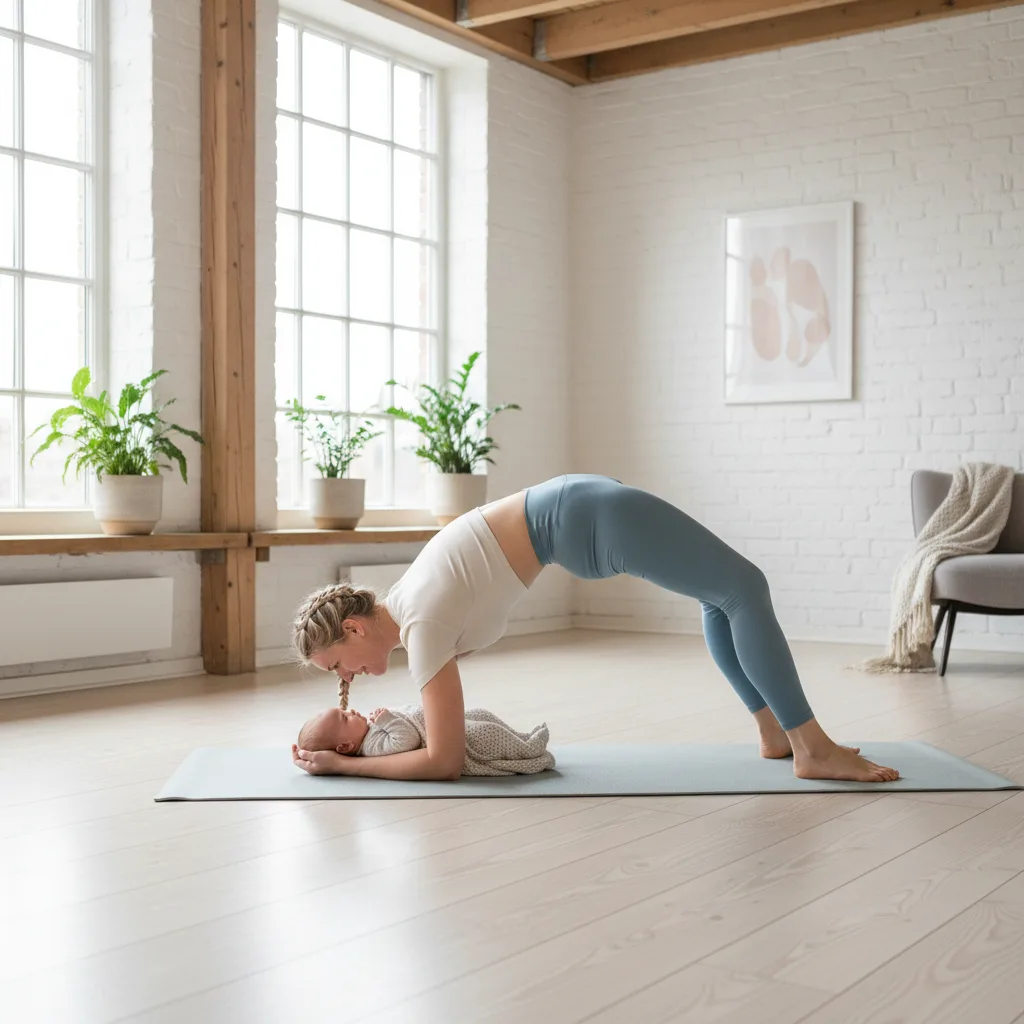
4. Bridge
- Lie on your back with knees bent, feet hip-width apart
- Breathe out, activate pelvic floor, and lift hips up
- Hold at the top for 3–5 seconds
- Lower slowly, vertebra by vertebra
- 10 repetitions, 3 sets
5. Knee Lift (Tabletop)
- Lie on your back with knees bent
- Activate the core
- Lift one knee up to 90 degrees (tabletop position)
- Hold for 5 seconds, lower slowly
- Switch sides
- 8 repetitions per side, 2 sets
6. Cat-Cow
- On all fours with wrists under shoulders and knees under hips
- Breathe in and let the back gently sway down (cow)
- Breathe out, round the back up and draw navel in (cat)
- Slow and controlled
- 10 repetitions, 2 sets
7. Side-Lying Clamshell
- Lie on your side with knees bent at 90 degrees
- Keep feet together and open the top knee like a clamshell
- Keep the pelvis stable, don't roll backward
- Lower slowly
- 12 repetitions per side, 2 sets
Phase 3: From 12 Weeks
8. Bird-Dog
- On all fours
- Extend right arm forward and left leg back simultaneously
- Hold for 3–5 seconds with a stable back
- Return to start
- Switch sides
- 8 repetitions per side, 3 sets
9. Side Plank on Knees
- Lie on your side with forearm on the floor
- Knees bent, lift hips up
- Hold for 15–30 seconds
- Switch sides
- 3 sets per side
10. Roll-Up (Modified)
- Sit with knees bent and feet on the floor
- Hold arms in front of you
- Roll slowly backward, vertebra by vertebra, until shoulder blades touch the floor
- Roll slowly back up
- If this is too difficult: use hands behind thighs for assistance
- 6–8 repetitions, 2 sets
What to Avoid
Some popular exercises are not safe in the early postpartum period:
Avoid for the first 3–4 months:
- Sit-ups and crunches, push the abdominal muscles apart, worsen diastasis
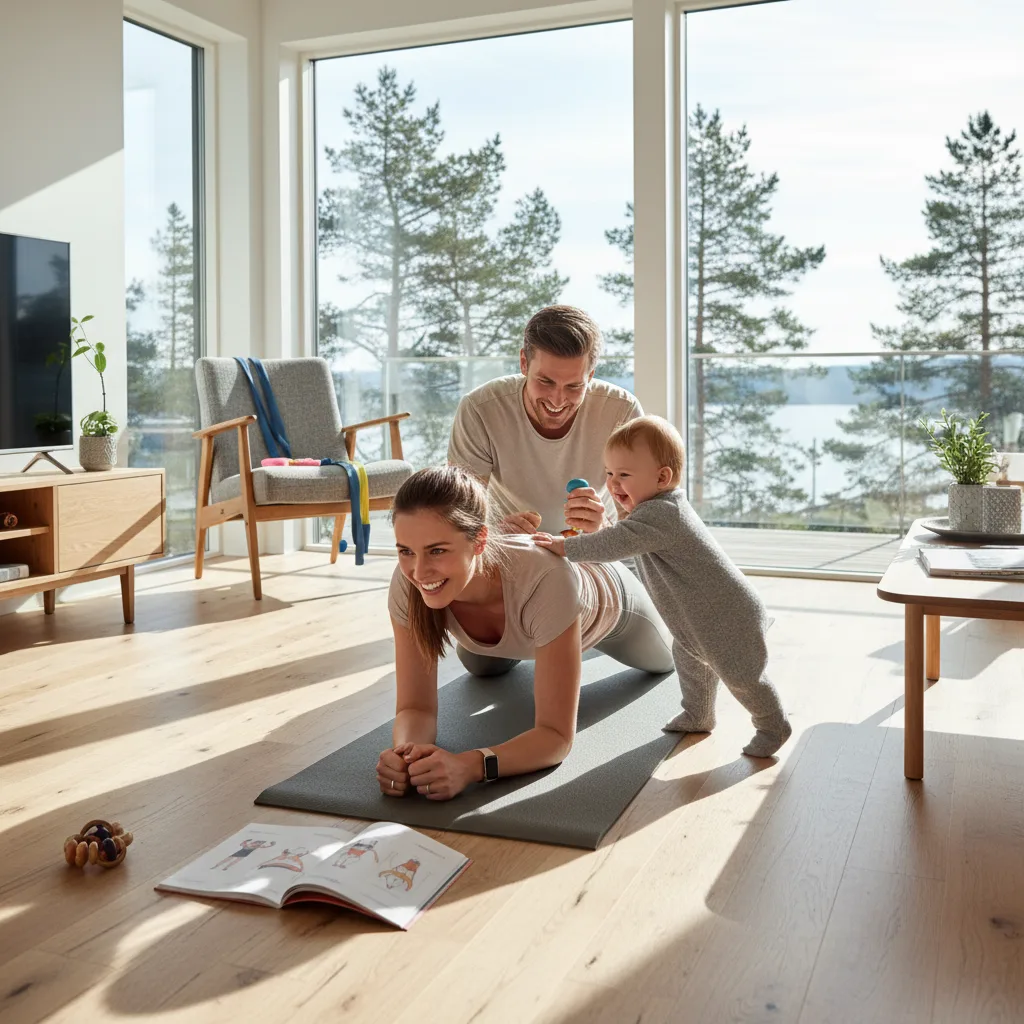
- Full plank, too much pressure on a weakened abdominal wall
- Double leg raises, puts too much strain on the lower back
- Heavy twisting, can worsen diastasis
Signs an exercise is too challenging:
- Your abdomen bulges out or "domes" along the midline
- You hold your breath to complete the exercise
- You feel pressure downward in the pelvis
- You leak urine
If any of these occur, go back to an easier version of the exercise.
Pilates at Home vs. In a Class
At Home:
- Free and flexible
- Can be done while baby sleeps
- Only needs a mat and floor space
- Challenge: hard to know if you're doing exercises correctly
With an Instructor:
- Individual technique correction
- Social connection with others at the same stage
- Motivating with set times
- Many offer postnatal-specific classes
Online Classes:
- Combines the flexibility of home exercise with guidance
- Less expensive than physical classes
- Can be done when it suits you
If you can, it's recommended to take a few sessions with a physiotherapist who specializes in postpartum fitness. They can assess your diastasis and pelvic floor function, and tailor a program to your body.
Combine Pilates with Other Exercise
Pilates is excellent for rebuilding, but works best in combination with other exercise:
- Pelvic floor training, daily sessions that complement pilates
- Walking for cardiovascular fitness and fresh air, see our walking guide for new parents
- Strength training for upper body and legs, once you're ready for more intensity
- A good weekly plan might look like:
- Monday: Pilates 30 min
- Tuesday: Walk 30–45 min
- Wednesday: Pilates 30 min
- Thursday: Walk or stroller workout
- Friday: Pilates 30 min
- Weekend: Longer walk or activity with the family
Pelvic floor training is done daily, independent of other exercise.
Progression Over Time
A common mistake is staying at beginner level too long. The body adapts, and you need to increase the challenge to keep getting stronger.
Signs you're ready for the next level:
- You complete all repetitions without losing control
- The exercises no longer feel challenging
- You can maintain pelvic floor activation throughout the whole exercise
- You have none of the warning signs mentioned above
How to increase difficulty:
- More repetitions
- Longer hold time
- Adding resistance (light weight or resistance band)
- Moving from modified to full version of the exercise
- Combining movements (e.g., bridge with leg extension)
Frequently Asked Questions
What's the difference between pilates and yoga after birth?
Pilates focuses more on strength, stability, and controlled movements. Yoga emphasizes flexibility, breath, and mindfulness. Both are good after birth, but pilates is more directly aimed at rebuilding core musculature. Many combine both, see our yoga after birth guide.
Can I do pilates with diastasis recti?
Yes, pilates is one of the best forms of exercise for diastasis, but you must avoid exercises that push the abdominal muscles outward. Stick to the exercises in phase 1 and 2 above, and avoid sit-ups, crunches, and full plank. A physiotherapist can help you tailor the program.
Do I need equipment for pilates at home?
A mat is all you need to start. Later, a resistance band and small ball can add variety. But the 10 exercises above require no equipment beyond a mat or soft surface.
How long does it take to see results?
Most people notice better posture, less back pain, and better pelvic floor control after 4–6 weeks of regular pilates (3 times per week). Visible changes in abdominal musculature take longer, usually 3–6 months.
Is pilates enough exercise, or do I need more?
Pilates is excellent as the main exercise in the first few months. Eventually you should combine it with cardiovascular exercise (walking, running) and possibly strength training for a complete fitness program.
Read More
- Postpartum Exercise. Complete Guide
- Yoga After Birth
- Diastasis Recti After Birth. Exercises and Treatment
- Pelvic Floor Training After Birth
Sources
- WHO. Physical activity recommendations for postpartum women
- American College of Obstetricians and Gynecologists. Exercise after pregnancy
- Bø K et al.. Evidence-based physical therapy for the pelvic floor
- Groom T, Donnelly G, Brockwell E. Returning to running postnatal guidelines
🔧 Helpful Tools
- Pelvic Floor Trainer. Guided pelvic floor exercises for pregnancy and postpartum
- All Baby Tools. Browse all free tools for pregnancy and baby care
📖 Related Articles
- Exercise After Birth. Week-by-Week Guide. Complete guide to exercise after birth. Learn when you can start, which exercises are safe, and how to build strength week by week, including after cesarean.
- Diastasis Recti After Birth: Exercises, Self-Test, and Treatment. Do you have diastasis recti after giving birth? Learn how to check yourself, which exercises help, and when to see a physical therapist. Based on current evidence.
- Yoga with Baby: Exercises for You and Your Little One. Get started with yoga with your baby. Safe postnatal exercises, when to begin, and tips for working out together with your newborn or infant.