Your body after birth feels like one you do not quite recognize. Your belly is soft. Your back aches. And that energy you had before, where did it go?
This is completely normal. And there is a way back.
When can you exercise after birth?
The short answer: earlier than you might think, but more gently than you want.
Current guidelines recommend starting light activity as soon as you feel ready after an uncomplicated vaginal birth. This means walking, pelvic floor exercises, and gentle breathing work, not HIIT or weightlifting.
General timeline:
- Weeks 0–2: Walking and pelvic floor exercises
- Weeks 2–6: Gradually increase walks, light strength exercises
- Week 6+: After your six-week checkup: more varied training
- Week 12+: Running and high-intensity training (with an approved readiness test)
These timelines apply to uncomplicated births. Always speak with your doctor or midwife if you are unsure.
Exercise after cesarean
A cesarean is major abdominal surgery. The scar goes through several layers of muscles and connective tissue.
The first six weeks are about allowing the body to heal. This does not mean staying completely still, but you must respect the wound healing process.
Safe after cesarean:
- Light walks from day 1–2 (when you can stand)
- Pelvic floor exercises from week 1
- Gentle diaphragmatic breathing
- Scar mobilization after the scar has healed (week 6+)
Wait with:
- Plank and sit-ups (at least 8–12 weeks)
- Lifting over 5 kg (beyond the baby)
- Running (at least 12–16 weeks)
- Jumping and high-intensity training
Scar mobilization is important for good healing. Gentle massage around the scar (not over it) can start after 6 weeks. Direct mobilization of scar tissue after 8–10 weeks.
The pelvic floor, the foundation for everything else
Whether you had a vaginal birth or cesarean, the pelvic floor has been supporting a baby for 9 months. It needs rehabilitation.
The pelvic floor supports the bladder, uterus, and bowel. When it is weakened, you may experience:
- Urinary leakage when coughing, sneezing, or jumping
- A feeling of heaviness in the pelvic area
- Pain during intercourse
Start with this:
- Find the muscles. Imagine stopping the flow of urine (but do not do this while urinating).
- Squeeze and hold. Hold for 5 seconds, release for 5 seconds. Repeat 10 times.
- Quick squeezes. Squeeze quickly and release. 10 repetitions.
- Train daily. 3 sets, 3 times a day.
After 4–6 weeks of daily training, most people notice clear improvement.
Postpartum abs, what actually works
"How do I get my belly back?" is the question everyone is thinking about.
The truth is that the belly needs time. The uterus alone takes 6–8 weeks just to shrink back. And many women have diastasis recti (separated abdominal muscles) that require specific exercises.
Check for diastasis first:
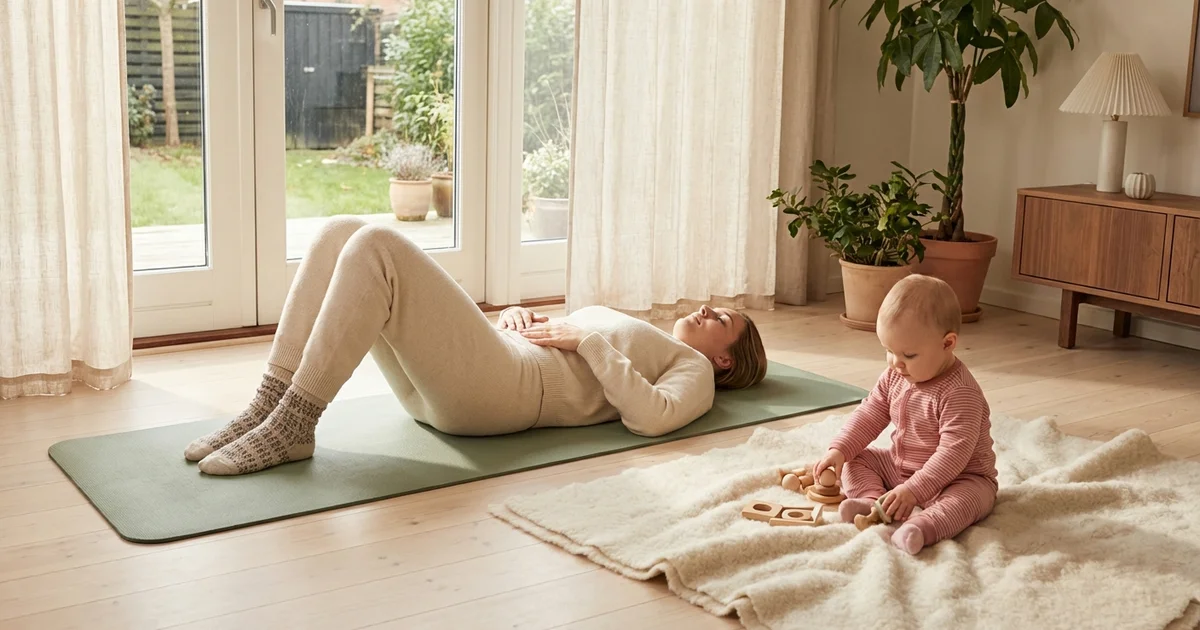
- Lie on your back with knees bent
- Place your fingers on the midline, just above the navel
- Gently lift your head, can you feel a gap between the muscles?
- A gap of more than 2 finger-widths indicates diastasis
Safe abdominal exercises for the first 12 weeks:
- Deep breathing (diaphragm activation)
- Pelvic tilts lying on your back
- Heel slides (slide the heel along the floor)
- Dead bug (modified, feet on the floor)
Avoid these:
- Traditional sit-ups and crunches
- Plank (before core is stable)
- Heavy twisting exercises
Diastasis often closes on its own in the first 8 weeks. If the gap is more than 2 finger-widths after 8 weeks, speak with a pelvic floor physiotherapist.
Week by week: Your exercise plan
Weeks 1–2: Rebuilding begins
- Daily walks (start with 10 minutes, gradually increase)
- Pelvic floor exercises 3 times daily
- Deep diaphragmatic breathing
- Gentle stretching of neck and shoulders
Weeks 3–4: A little more movement
- Walks 20–30 minutes
- Pelvic tilts and heel slides
- Light arm exercises using bodyweight
- Balance exercises
Weeks 5–6: Building the foundation
- Walks 30–45 minutes
- Modified squats (not deep)
- Wall push-ups
- Glute bridges
- Check with doctor at six-week appointment
Weeks 7–8: Gradual strength
- Begin with light weights (1–2 kg / 2–4 lbs)
- Bodyweight squats
- Lunges
- Knee plank (30 seconds)
- Swimming (when bleeding has stopped)
Weeks 9–12: Serious progression
- Gradually increase weights
- Full plank (start with 20 seconds)
- Step-ups
- Light HIIT sessions (without jumping)
- Complete a running readiness test
Week 12+: Return to normal training
- Running (start with walk/run intervals)
- Group fitness classes
- Heavier strength training
- Jumping and plyometrics (gradually)
Many communities offer free postpartum exercise groups. Check with your pediatrician's office or local health center.
5 signs you are doing too much
Your body gives clear signals. Stop and take a step back if you experience:
- Leakage during exercise (urine or feces)
- A feeling of heaviness in the pelvis after exercise
- Pain in the pelvis, back, or scar
- Increased bleeding after exercise
- The belly bulges outward during exercises (sign of diastasis strain)
None of these are "normal just because you have given birth." They are signals that the body needs more time, or that you should adjust your training approach.
From walks to running
When the body is ready for running (typically after 12 weeks), you need a plan.
A postpartum running return program built on the research of Goom et al. (2019), the first evidence-based guidelines for postpartum running, can guide you safely.
Readiness test before running:
- Can you walk briskly for 30 minutes without pain?
- Can you jog on the spot for 10 times without leakage?
- Can you stand on one leg for 10 seconds?
If yes, your body is ready to start running.
Frequently asked questions
When can you exercise after birth?
You can start with walks and pelvic floor exercises in the first days. Light strength training after 2–4 weeks. More intensive training after your six-week checkup. Running and jumping after 12 weeks with a passed readiness test.
Is it safe to exercise with diastasis?
Yes, but you must choose the right exercises. Avoid sit-ups, crunches, and planks until the muscles have closed. Focus on deep breathing, pelvic tilts, and gentle core exercises. A physiotherapist can help with the right program.
Can exercise affect milk supply?
Moderate exercise does not affect milk supply or quality. Drink enough water and eat enough. Some prefer to nurse or pump before exercise for comfort.
How quickly can I get back in shape?
This varies enormously. Most people notice a big difference after 3–6 months of consistent training. Full recovery can take 12–18 months. Focus on progress, not perfection.
Read more
Sources
- ACOG. Exercise After Pregnancy
- Goom et al. 2019. Returning to Running Postnatal. British Journal of Sports Medicine. doi:10.1136/bjsports-2018-100130
- APTA. Pelvic Physical Therapy Guidelines
🔧 Helpful Tools
- Pelvic Floor Trainer. Guided pelvic floor exercises for pregnancy and postpartum
- All Baby Tools. Browse all free tools for pregnancy and baby care
📖 Related Articles
- Pilates After Birth - Gently Rebuild Your Body. Pilates is ideal for rebuilding core muscles and pelvic floor after birth. Learn when you can start, safe exercises, and what to avoid.
- Diastasis Recti After Birth: Exercises, Self-Test, and Treatment. Do you have diastasis recti after giving birth? Learn how to check yourself, which exercises help, and when to see a physical therapist. Based on current evidence.
- Yoga with Baby: Exercises for You and Your Little One. Get started with yoga with your baby. Safe postnatal exercises, when to begin, and tips for working out together with your newborn or infant.