"Mommy, I need to go!" The day your child says that on their own feels like a real victory. But the road there requires patience, timing, and a good plan.
Potty training is not about following a fixed script. Every child is different, and there is no "right" age. Here you will find a complete step-by-step guide based on recommendations from the AAP and pediatric guidelines.
When Is Your Child Ready for Potty Training?
Most children are ready between 18 months and 3 years. According to the AAP, there is no set age to start. What matters most is your child's readiness, not their age.
Some children show interest before they turn two. Others are not ready until well past three years old. Both are completely normal. Pediatric guidelines recognize wide variation in when children are ready to stop wearing diapers.
Do not compare your child to others. Your child has their own timeline, and pressure rarely produces good results.
Checklist: Is Your Child Ready?
Start potty training when your child shows several of these signs. The more signs you can check off, the more likely your child is ready.
Physical signs:
- Diaper is dry for 2 hours or more
- Child can walk to and sit on the potty on their own
- Child can pull down their pants with a little help
- Child has predictable times for bowel movements (for example, after breakfast)
- Child can sit still for at least 2–3 minutes
Signals and communication:
- Shows interest in the toilet or others' bathroom trips
- Communicates verbally or with body language when urinating or having a bowel movement
- Understands simple instructions like "sit on the potty"
- Can express needs with words or signs
Behavior and motivation:
- Shows discomfort with a wet or full diaper
- Goes away or hides when having a bowel movement
- Wants to be "big" and do things independently
- Shows pride when mastering new things
- Is generally cooperative (not in the middle of a defiance phase)
Wait if your child has recently: Gotten a new sibling, started daycare, moved, or experienced other major changes. Start potty training when daily life is stable.
Potty Training Age: What Do Experts Say?
According to pediatric guidelines, there is wide normal variation:
| Age | What is typical |
|---|---|
| 18–24 months | Some children begin showing interest. Can start gentle introduction |
| 2–2.5 years | Many children are physically and mentally ready for potty training |
| 2.5–3 years | Most common age to become diaper-free during the day |
| 3–3.5 years | Completely normal to start here. Many boys are ready a bit later |
| 3.5–4 years | Still within normal range. Talk to your pediatrician if concerned |
According to the AAP, there is no single right approach, and parents should follow their child's signals rather than focus on age alone.
Preparation: Before You Start
Good preparation makes the transition easier for the whole family. Take 1–2 weeks to prepare before the actual training begins.
Choose a Potty or Toilet Insert
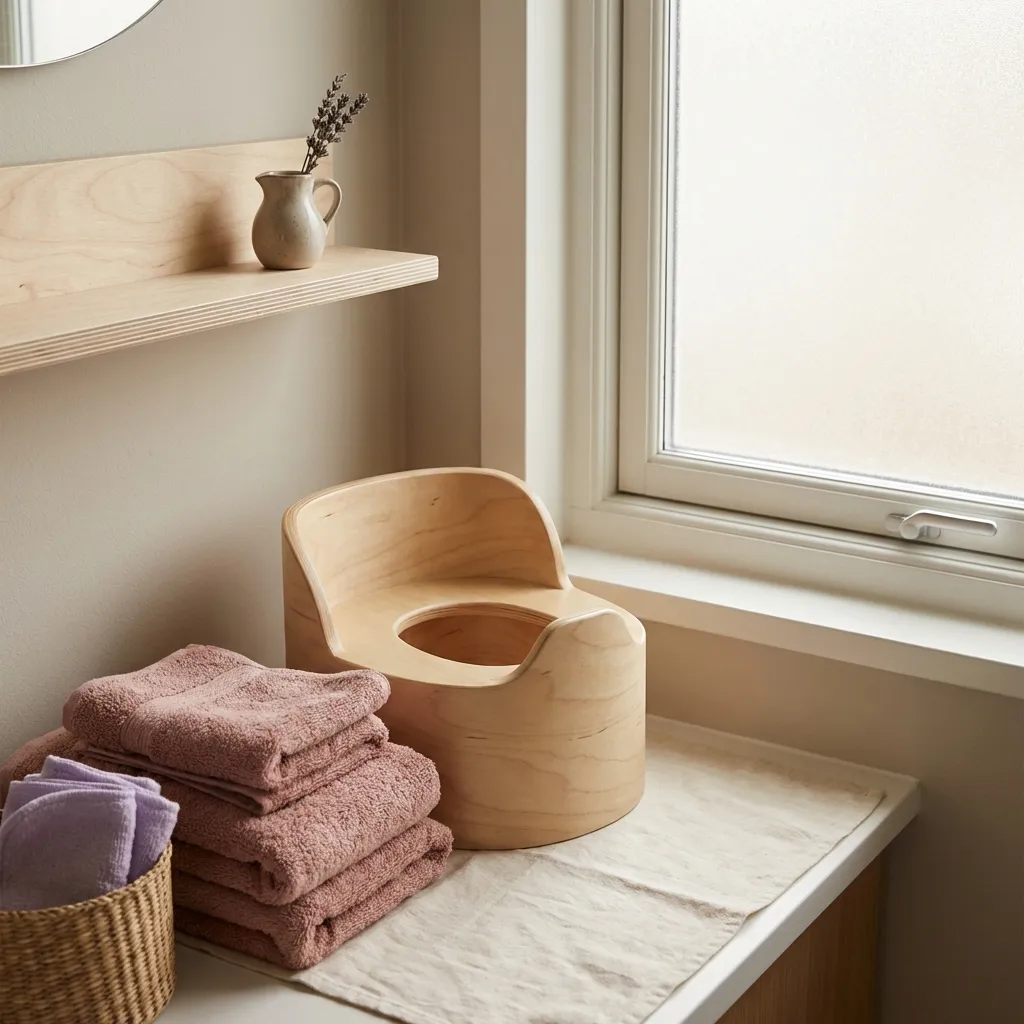
A standalone potty gives the child independence, they can sit down without help. A toilet training seat teaches the child to use the regular toilet directly. Let your child choose if possible, or have both available.
A potty works best if:
- The child is small and cannot reach the toilet
- The child is afraid of the big toilet
- You want the child to be able to go independently
A toilet insert works best if:
- The child thinks a potty is too "babyish"
- You want to skip the transition from potty to toilet
- You have limited bathroom space
Let Your Child Get Familiar
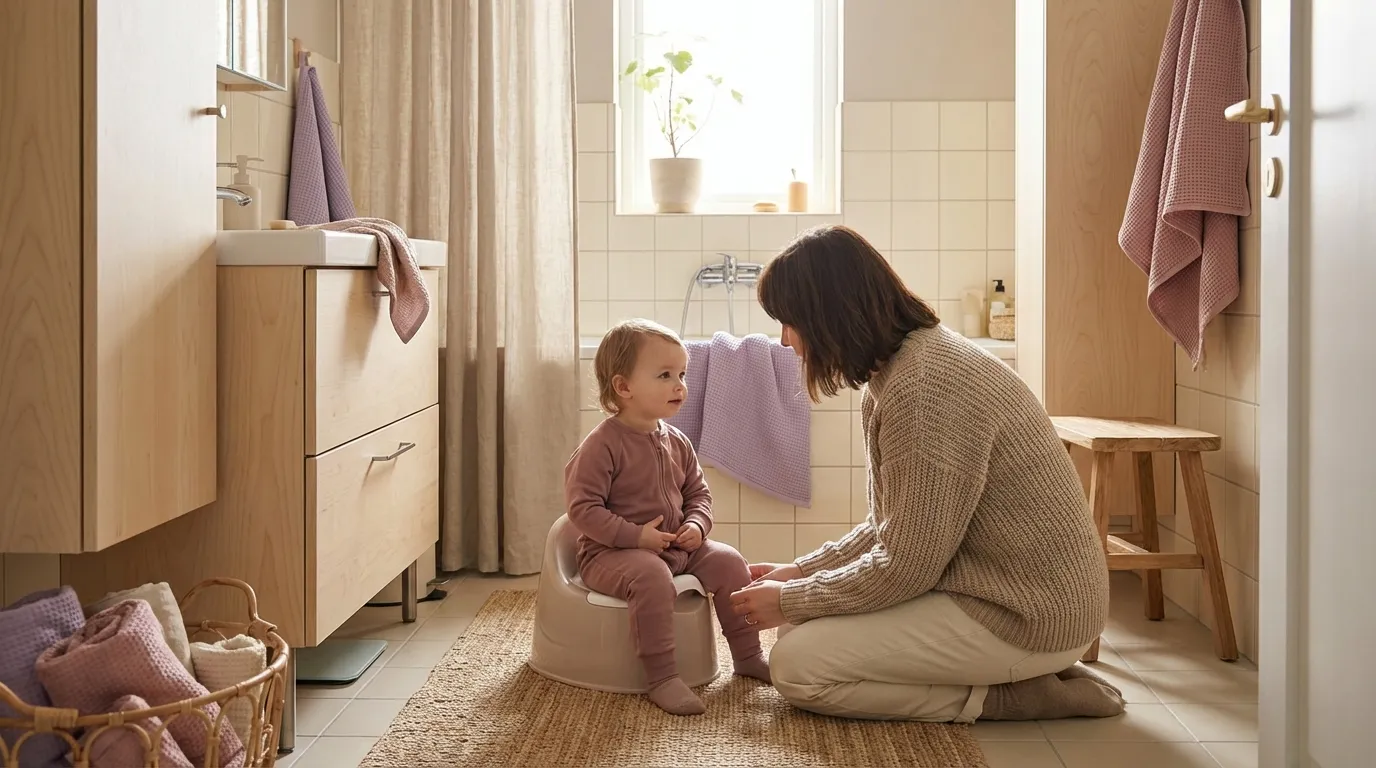
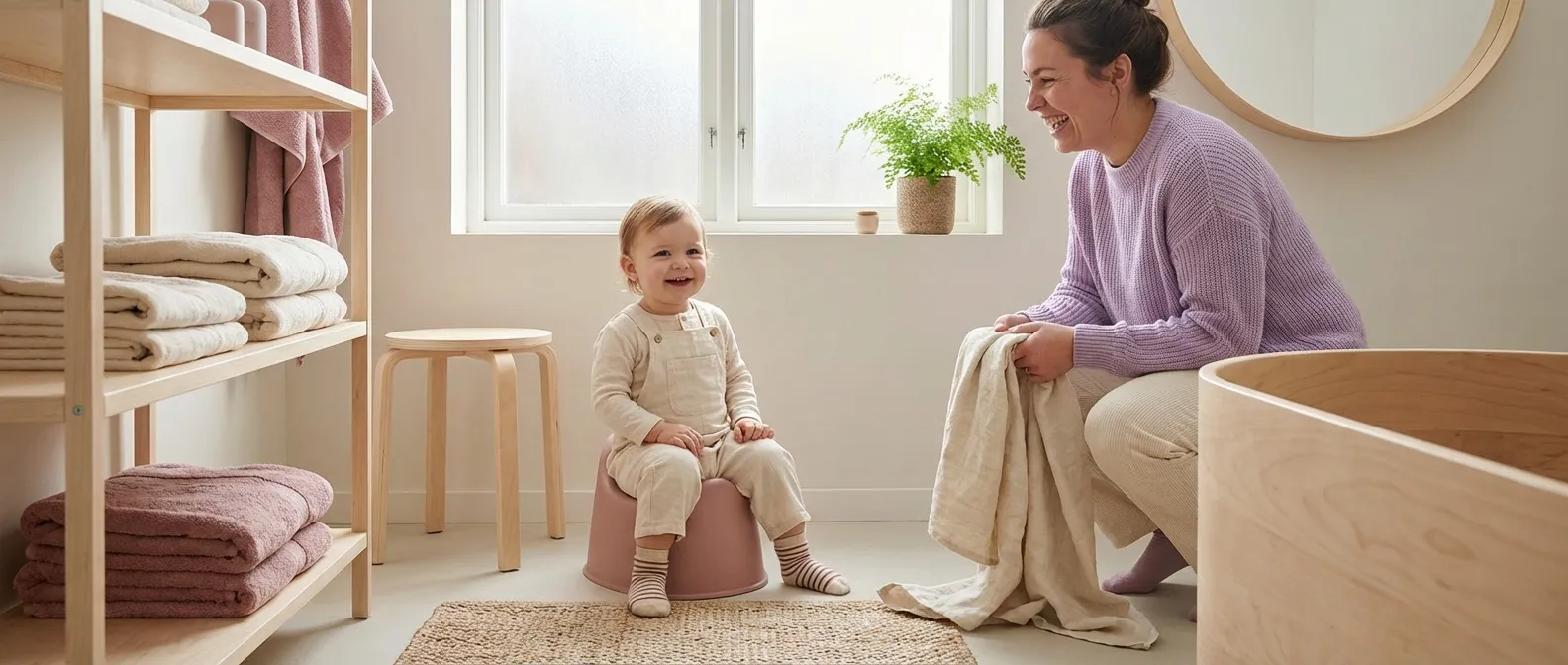
Place the potty in the bathroom a few weeks before you start. Let your child sit on it with clothes on, with no expectations. Explain simply what it is for. Make the potty a natural part of the bathroom routine.
Read Books About Potty Training
Children's books about potty training make the topic concrete and fun. "Everyone Poops" by Taro Gomi and "Potty" by Leslie Patricelli are popular choices. Recognition helps children feel safe.
Involve Daycare
Talk to daycare staff before you start. Agree on a shared approach: use the same words, same routines, same reward system. Consistency between home and daycare is key to success.
Step-by-Step: How to Do It
Step 1: Introduction (Days 1–7)
Let your child sit on the potty with clothes on. Keep it informal and relaxed. Talk about how big kids use the potty, and make it entirely voluntary. This phase may last a few days to a week.
Goal: Your child is comfortable sitting on the potty, without stress or expectations.
Step 2: Regular Potty Times (Weeks 1–2)
Offer the potty at set times:
- Right after waking up in the morning
- After meals (most children need a bowel movement shortly after eating)
- Before bath time
- Before bedtime
Keep sessions short, no more than 5 minutes. Never force your child to sit. Praise the attempt regardless of the outcome.
Goal: Your child understands the connection between the potty and urinating/having a bowel movement.
Step 3: Training Pants and Underwear (Weeks 2–4)
When your child uses the potty regularly, switch to training pants or regular underwear for a few hours at a time. Gradually extend to full days. Keep extra clothes available everywhere.
Expect accidents. They are a natural part of the learning process, not a sign that something is wrong.
Goal: Your child feels the difference between dry and wet, and prefers using the potty.
Step 4: Diaper-Free During the Day (Weeks 4–12)
When your child has fewer than two accidents a day over a week, you can consider dropping the diaper completely during the day. Always bring extra clothes on outings and to daycare.
Goal: Your child is reliably dry during the day with only occasional accidents.
Step 5: Nighttime Diapers Are a Separate Process
Staying dry at night is governed by a different biological maturity than daytime. Keep the nighttime diaper until your child wakes up with a dry diaper several nights in a row. This may take months or years after daytime is handled. See the section on nighttime diapers below.
Summer is a great time to start. Fewer clothes make it easier, and accidents dry quickly.
Realistic Timeline
Most families take 3–6 months from start to when the child is reliably dry during the day. Here is what to expect:
| Phase | Duration | What happens |
|---|---|---|
| Preparation | 1–2 weeks | Getting familiar with the potty, reading books, talking about it |
| Active training | 2–4 weeks | Regular potty times, increasing independence |
| Consolidation | 4–12 weeks | Gradually fewer accidents, diaper-free during the day |
| Mastery | 3–6 months total | Child remembers on their own and communicates needs |
Some children do it faster, others need more time. Both are normal.
Potty Training Tips That Work
Praise Progress, Never Punish Accidents
Say "Great job trying!" or "You did it!" with enthusiasm. For accidents: "That's okay, we'll try again next time." Punishment and scolding create fear and delay the process.
Sticker Reward Chart
A sticker chart in the bathroom is a simple and effective tool. Your child gets a sticker for each potty visit. After a certain number, they can choose an activity, a trip to the playground, a new book, or something similar.
Avoid food as a reward. Verbal praise is often enough on its own.
Make It Fun
Let your child choose their own potty at the store, place it themselves, and even give it a name. Some children are motivated by wearing "big kid underwear" with their favorite characters. Make it a positive thing, never a chore.
Let Daycare Support the Process
Talk to daycare staff early. Most daycares have good routines for potty training. Agree on a shared approach: use the same words for pee and poop, and ask for daily feedback during the first weeks. Always send 2–3 sets of extra clothes.
Dress Your Child Smartly
Use clothing that your child can easily take on and off: pants with elastic waistbands, no overalls or complicated buttons. The easier it is to get to the potty quickly, the fewer accidents.
Common Mistakes Parents Make
Avoid these pitfalls that can delay potty training:
- Starting too early. Starting before your child is ready creates frustration and extends the process. Wait for the signs.
- Using force. Forcing your child to sit on the potty creates negative associations. Always keep it voluntary.
- Reacting negatively to accidents. Sighing, scolding, or frustration makes the child afraid to try. Stay neutral.
- Being inconsistent. Alternating between diapers and underwear without a system confuses the child.
- Comparing to other children. Every child has their own timeline. Pressure never helps.
- Starting during an unstable period. A new sibling, moving, or starting daycare is the wrong time.
- Giving too much attention to toilet visits. Excessive cheering can make the child self-conscious.
Common Challenges
Child Refuses the Potty
Refusal is common, especially during the toddler defiance phase. Here is what you can do:
- Take a 2–4 week break and start again without pressure
- Let the child decide more, which potty, where it goes, whether they want to sit
- Offer choices, "Do you want to sit on the potty now or after we read a book?"
- Use role models. Dolls or stuffed animals that "use the potty"
- Do not make it a power struggle. Your child has control over their own body
Force always has the opposite effect. The child must want it themselves.
Regression After Progress
A new sibling, illness, moving, or changing daycare can trigger regression. This is completely normal and does not mean training has failed.
How to handle regression:
- Go back to diapers without drama or negative comments
- Continue to offer the potty, but without pressure
- Keep the routines that worked
- Most regressions resolve within 1–2 weeks when daily life stabilizes
- Do not start completely from scratch, the child remembers the skills
Works at Home but Not at Daycare
The child needs time to transfer the skill to new environments. Close cooperation with daycare and consistent routines in both places helps. Other children using the potty is often the best motivation.
Manages Pee but Not Poop
Many children master peeing on the potty before they manage bowel movements. This is normal. Pooping requires more control and relaxation. Some children are afraid of the feeling.
Tips:
- Do not pressure your child to poop on the potty
- Let your child poop in a diaper if needed, it is better than constipation
- Offer books or a calm activity on the potty to encourage relaxation
- Make sure your child has foot support (feet should reach the floor or a step stool)
Nighttime Diapers. A Separate Biological Process
Nighttime dryness is biologically governed and has nothing to do with laziness or lack of training. The brain's ability to wake from a full bladder develops independently of daytime training.
What Is Normal?
According to pediatric guidelines:
- Most children are dry at night between ages 3 and 5
- About 15 percent of 5-year-olds are still wet at night
- About 5 percent of 10-year-olds still experience bedwetting
- Boys typically take longer on average than girls
When Is Your Child Ready for Dry Nights?
Keep the nighttime diaper until your child has several dry nights in a row without you doing anything active. Signs that the child is ready:
- Diaper is dry several mornings in a row
- Child wakes up on their own to use the toilet at night
- Child says they want to try sleeping without a diaper
Tips for Dry Nights
- Limit drinks in the last hour before bedtime (but never refuse a thirsty child water)
- Have your child use the toilet right before going to bed
- Use a waterproof mattress protector
- Gently wake your child to use the toilet before you go to bed yourself (optional)
- Keep extra bedding available for quick changes at night
Bedwetting After Age 5
Nighttime wetting that continues past age 5–6 is called nocturnal enuresis and should be discussed with a pediatrician. There are effective treatments:
- A bedwetting alarm, the most effective method according to pediatric guidelines
- Desmopressin (medication that reduces urine production at night)
- Combination treatment
It is important to know that your child is not doing this on purpose. Support and understanding are essential.
Potty Training and Sleep
Potty training can temporarily disrupt sleep patterns. Your child may wake more often at night because they are more aware of their bladder.
Tips:
- Keep bedtime routines stable, do not change them during potty training
- Include a potty sit as a fixed part of the evening routine
- Be patient, sleep disturbances related to potty training are temporary
Frequently Asked Questions
When should you start potty training?
Most people start between 18 months and 2.5 years. According to the AAP, there is no set age. Start when your child shows signs of readiness, a dry diaper for stretches of time, interest in the toilet, and the ability to communicate needs. The signs matter more than the age.
How long does potty training take?
Anywhere from a few weeks to several months is normal. Most children are reliably dry during the day after 3–6 months of training. Boys often take a little longer than girls, but there is wide individual variation.
Is a potty or toilet insert better?
Both work well. A potty offers independence, while a toilet insert teaches use of the regular toilet. Many families have both. Let your child try and choose what feels best.
What do I do when my child is afraid of the toilet?
The flushing mechanism and large opening can seem scary. Try a potty instead, or let your child flush after they have stepped off. Never force your child to sit, it reinforces the fear. Some children prefer the toilet with a nightlight on.
Is regression normal?
Yes, regression is very common and completely normal. Major changes like a new sibling, illness, or starting daycare are typical causes. Stay calm, return to the routines, and give it time. Most regressions resolve within 1–2 weeks.
What do I do when my child refuses the potty?
Do not make it a power struggle. Take a 2–4 week break and try again later. Your child may have started too early, or it may be part of normal defiance behavior. Give the child control and offer choices: "Do you want to sit on the red or the blue potty?"
Can I potty train while still using diapers?
Yes, it is common to use a diaper during the transition, especially at night and on longer outings. Use training pants or regular underwear at home, and a diaper when accidents are impractical. Be clear with your child: "We use underwear at home and a diaper when we're out."
When should I contact a pediatrician?
Contact your pediatrician if your child shows no interest in potty training past 3.5 years, has regular accidents past age 4 during the day, or has pain when urinating.
Read More
- Toddler Defiance Phase. Guide
- Starting Daycare: Preparation and Tips
- Sleep Problems in Toddlers: Fixing Bedtime
Sources
Last updated: March 2026
🔧 Helpful Tools
- Baby Milestones Tracker. Track your baby's developmental milestones
- Development Leaps. Understand your baby's developmental leaps
- All Baby Tools. Browse all free tools for pregnancy and baby care
📖 Related Articles
- Potty Training: Complete Guide for Parents. Complete guide to potty training. When to start, signs of readiness, step-by-step method, nighttime dryness, and handling regression. Based on pediatric guidelines.
- Biting and Hitting: How to Handle It. Does your child bite or hit? Get safe, research-based advice for handling aggression in toddlers aged 1–3.
- Delayed Speech Development: When Should You Act?. Is your two-year-old saying very little? Here's how to evaluate whether speech development is delayed and when to contact your pediatrician.