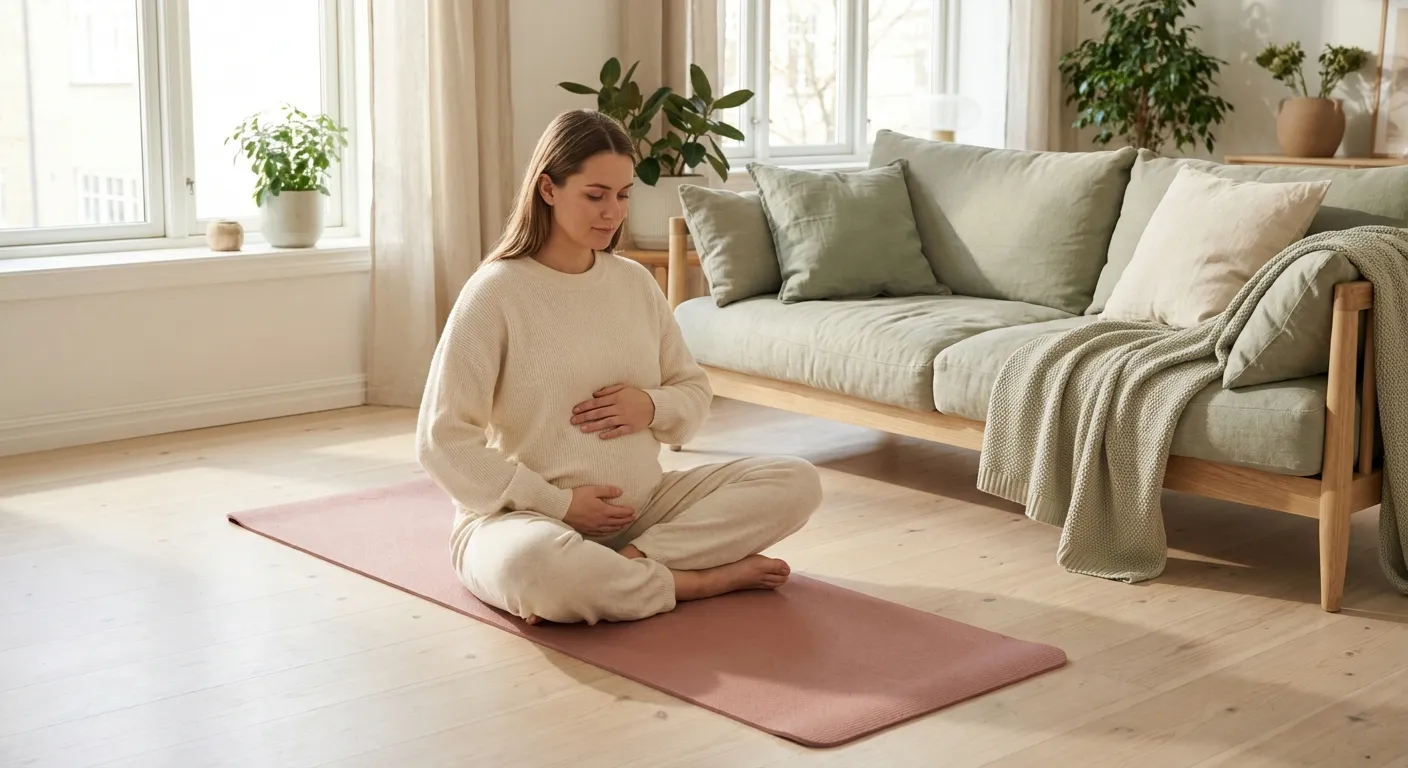
Leaking when you laugh, cough, or jump? You're not alone. Research shows that up to 50% of pregnant and postpartum women experience this. The good news: there's a simple solution, pelvic floor exercises.
In this guide you'll learn how to do Kegel exercises correctly, how often to train, and how to use your pelvic floor effectively throughout pregnancy and after birth.
What is the pelvic floor? Understanding the anatomy
The pelvic floor is a layer of muscles that sits like a hammock between the pubic bone and the tailbone. These muscles have three important jobs:
- Support your organs, uterus, bladder, and bowel
- Control urine and stool, holding in and releasing
- Contribute to a healthy sex life, improving sensation
Pelvic floor anatomy, the three layers
The pelvic floor actually consists of three layers of muscles, and all three are trained with Kegel exercises:
Outer layer: The outermost muscle layer surrounds the vaginal opening, urethra, and anal opening. This layer provides rapid closure at sudden pressure (coughing, sneezing).
Middle layer: A thin muscle layer that gives extra support to the urethra. Important for preventing stress incontinence.
Inner layer (levator ani): The deepest and most important layer. The levator ani is a hammock-shaped muscle that carries the weight of the organs and provides the main support. This is the muscle you feel most when doing Kegel exercises correctly.
Why does the pelvic floor weaken?
During pregnancy, pressure on the pelvic floor increases significantly. The growing uterus places ever more weight on the musculature. The hormone relaxin softens muscles and ligaments to prepare for birth. After delivery, the muscles may be stretched and weakened. This is why pelvic floor training matters for all pregnant and postpartum women.
Factors that weaken the pelvic floor:
- Pregnancy (increased weight, hormones)
- Vaginal birth (muscles are stretched)
- C-section (muscles still weaken from pregnancy)
- Chronic coughing (e.g., asthma, smoking)
- Heavy lifting
- Obesity
- Aging
- Chronic constipation
When should you start pelvic floor training?
Short answer: The sooner, the better.
For pregnant women: Start in the first trimester if possible. Regular training throughout pregnancy can reduce the risk of urinary leakage both during pregnancy and after birth.
After birth: You can begin gently within a few days of birth, unless you have a lot of pain or significant stitches. Start softly and increase gradually.
Never trained before? It's never too late to start. Research shows women of all ages can strengthen the pelvic floor with proper training.
Did you know that regular pelvic floor training during pregnancy can give you better control during the pushing phase? Being able to relax the pelvic floor is just as important as being able to squeeze it.
How to do Kegel exercises correctly
Many people do Kegel exercises incorrectly without knowing it. Here's the step-by-step:
Find the right muscles
- Think about stopping your urine flow mid-stream
- Or holding in gas
- You should feel a lift inward and upward
Alternative method: Place a finger inside the vagina and squeeze. You should feel the muscles tighten around your finger and pull inward and upward.
Important: Don't actually stop your urine stream as practice, only use that as a way to identify the muscles. Regularly stopping urine can disrupt bladder function.
Perform the exercise
- Gently squeeze around vagina and anus
- Lift inward and upward
- Hold for 6–8 seconds
- Fully relax for the same amount of time
- Repeat 8–12 times
Check that you're doing it right
- Abdomen should be relaxed
- Thighs should be relaxed
- Glutes should be relaxed
- Breathe normally, don't hold your breath
Don't press downward! You should be lifting upward. Pressing can worsen problems and further weaken the pelvic floor.
Progressive 8-week training program
Here's a detailed program that gradually builds strength. The program works for both pregnant women and new mothers (adjust the starting point to your situation).
Weeks 1–2: Foundation (Find the muscles)
Goal: Learn to feel and activate the pelvic floor
| Exercise | Sets | Reps | Hold | Rest |
|---|---|---|---|---|
| Long squeeze | 3 | 5 | 3–4 sec | 4 sec |
| Quick squeeze | 2 | 5 | Short | 2 sec |
Positions: Lying on your back (pregnant up to week 16), sitting, or standing Frequency: 2–3 times daily
Weeks 3–4: Building (Increase strength)
Goal: Longer holds and more reps
| Exercise | Sets | Reps | Hold | Rest |
|---|---|---|---|---|
| Long squeeze | 3 | 8 | 5–6 sec | 6 sec |
| Quick squeeze | 2 | 8 | Short | 2 sec |
| Staircase squeeze | 1 | 3 | 3+3+3 sec | 10 sec |
Positions: Sitting, standing, on all fours Frequency: 3 times daily
Weeks 5–6: Endurance (Longer holds)
Goal: Build endurance strength
| Exercise | Sets | Reps | Hold | Rest |
|---|---|---|---|---|
| Long squeeze | 3 | 10 | 8 sec | 8 sec |
| Quick squeeze | 3 | 10 | Short | 2 sec |
| Staircase squeeze | 2 | 5 | 3+3+3 sec | 10 sec |
Positions: Standing, walking, during daily activities Frequency: 3 times daily
Weeks 7–8: Functional training (Integration)
Goal: Use the pelvic floor in daily life
| Exercise | Sets | Reps | Hold | Rest |
|---|---|---|---|---|
| Long squeeze | 3 | 12 | 10 sec | 10 sec |
| Quick squeeze | 3 | 10 | Short | 1 sec |
| "Brace before lift" | , | Every time | Before lifting/coughing | , |
| Bridge with squeeze | 2 | 8 | 5 sec | 10 sec |
Positions: All positions, integrated into daily activities Frequency: 3 times daily
How long does it take to train up the pelvic floor?
Most people notice the first signs of improvement after 4–6 weeks of daily training. Full strength effect typically requires 3–6 months of regular training.
The key is to train every day. Short sessions (2–3 minutes) several times a day are better than one long session a week.
| Time | Expected progress |
|---|---|
| 2 weeks | Better muscle control |
| 4–6 weeks | Less leakage |
| 3 months | Significant strength |
| 6 months | Optimal effect |
Pelvic floor training during pregnancy, trimester by trimester
The pelvic floor is under extra pressure throughout pregnancy. The growing uterus places ever more weight on the musculature. Regular training during this period has several benefits:
- Reduces the risk of urinary leakage during and after pregnancy
- Better control during pushing, you learn to both squeeze and relax the muscles
- Faster recovery after birth, trained muscles heal faster
- May prevent prolapse (descent of the uterus, bladder, or bowel)
First trimester (weeks 1–12)
Focus on learning correct technique. Do 8–12 squeezes, hold for 6–8 seconds, 3 times daily. All positions work, lying, sitting, and standing.
Special tip: This is a great time to establish the habit. Link training to something you already do: squeeze while brushing your teeth, while waiting in line, or while sitting in a meeting.
Second trimester (weeks 13–27)
Increase to 10–15 squeezes per set. Add quick squeezes (squeeze and release quickly 10 times). Avoid lying flat on your back from week 16, train sitting, standing, or on all fours.
Special tip: Start practicing relaxation of the pelvic floor. During birth, you need to relax the muscles to let the baby through. Take deep breaths and focus on releasing the tension between squeezes.
Third trimester (weeks 28–40)
Continue regular training, but listen to your body. Place extra emphasis on relaxation exercises, you'll need to be able to relax the pelvic floor during birth.
Special tip: Practice in positions you may use during labor (on all fours, squatting, side-lying). These positions also activate the pelvic floor differently.
Pelvic floor training after birth, phase by phase
After birth, the pelvic floor is stretched and weakened, whether you had a vaginal birth or C-section. Recovery takes time, but training makes a big difference.
Phase 1: The first weeks (0–6 weeks)
- Start gently 1–2 days after vaginal birth (unless your provider advises otherwise)
- After C-section: wait until you're comfortable, typically 2–4 weeks
- Do gentle squeezes with short holds (3–4 seconds)
- Focus mostly on feeling the muscles and re-establishing the connection
- It's normal to feel little or nothing in the first days, the connection returns gradually
Phase 2: Rebuilding (6 weeks to 3 months)
- Gradually increase to 8–12 squeezes with 6–8 second holds
- Add quick squeezes to train reactivity
- Squeeze before coughing, lifting, or laughing ("brace before effort" technique)
- This is the most important period for preventing long-term incontinence
Phase 3: Strength building (3–6 months)
- Work toward 12–15 squeezes with 10 second holds
- Integrate pelvic floor training with other exercise
- Start gradually with exercises that load the pelvic floor (jogging, jumping), only if you're not leaking
Phase 4: Maintenance (6 months+)
- Continue daily training (can reduce to 1–2 times daily)
- Maintain "brace before effort" as a habit
- Remember pelvic floor activation before jumping, running, or heavy loading
The "brace before lift" rule is golden: squeeze the pelvic floor before lifting your baby, carrying groceries, or coughing. This protects the muscles and prevents leakage.
Five effective pelvic floor exercises
Here are five exercises that cover different aspects of pelvic floor training:
Exercise 1: Basic squeeze (long hold)
- Sit or lie comfortably
- Gently squeeze around vagina and anus
- Lift inward and upward
- Hold for 6–8 seconds
- Fully relax for 6–8 seconds
- Repeat 8–12 times
Goal: Builds endurance strength in the muscles.
Exercise 2: Quick squeezes
- Squeeze as hard as you can
- Release immediately
- Repeat 10 times in quick succession
- Rest for 10 seconds
- Do 3 sets
Goal: Trains the muscles' quick reaction time, important for preventing leakage when coughing and sneezing.
Exercise 3: Staircase squeeze
- Squeeze lightly (30% strength), hold for 3 seconds
- Squeeze a little harder (60% strength), hold for 3 seconds
- Squeeze fully (100% strength), hold for 3 seconds
- Release gradually in reverse order
- Repeat 5 times
Goal: Better control over different strength levels.
Exercise 4: Bridge with squeeze
- Lie on your back with bent knees, feet on the floor
- Squeeze the pelvic floor
- Lift your hips into a bridge while holding the squeeze
- Hold for 5 seconds
- Lower hips slowly and release the squeeze
- Repeat 8–10 times
Goal: Combines pelvic floor training with core muscles. Don't do this after week 16 of pregnancy.
Exercise 5: Standing squeeze
- Stand with feet hip-width apart
- Bend your knees slightly
- Squeeze the pelvic floor and hold for 8 seconds
- Release
- Repeat 10 times
Goal: Trains the pelvic floor in a functional position, the way you use it in everyday life.
Common mistakes to avoid
Many people make these errors:
- Holding their breath, breathe normally throughout the exercise
- Tensing the abdomen, keep abdominal muscles relaxed
- Squeezing the glutes, only the pelvic floor should be working
- Forgetting to relax, relaxation is just as important as the squeeze. An overactive pelvic floor can cause pain
- Training too infrequently, daily training produces results
- Pressing downward, you should be lifting upward, never pressing down
- Giving up too soon, it takes 4–6 weeks to notice a change. Be patient
Pelvic floor training and incontinence
Urinary leakage (incontinence) affects many women, especially after birth. Pelvic floor training is the first-line treatment for stress incontinence.
Stress incontinence
The most common type after birth. You leak when coughing, sneezing, laughing, jumping, or lifting. The cause is a weakened pelvic floor that can't hold when there's a sudden pressure increase.
Pelvic floor training is the first-line treatment for stress incontinence. 60–70% of women experience significant improvement or complete resolution with proper training.
Urge incontinence
A sudden, strong urge to urinate that makes it difficult to reach the toilet in time. Pelvic floor training can help by giving better control over the closing mechanism.
Mixed incontinence
A combination of stress and urge incontinence. Treated with pelvic floor training and possibly bladder training.
Urinary leakage is common, but it's not something you just have to live with. Up to 50% of new mothers experience leakage, but the vast majority can fully recover with proper training. Don't let embarrassment prevent you from seeking help.
When should you seek help from a physical therapist?
Contact your doctor or a pelvic floor physical therapist if you:
- Have significant pelvic pain
- Experience heavy leakage despite 3–6 months of daily training
- Feel something "bulging" from the vagina (may be a sign of prolapse)
- Are unsure whether you're doing the exercises correctly
- Have pain during sex after birth
- Have trouble fully emptying your bladder
A pelvic floor physical therapist can provide individual guidance and check that you're training correctly. Many insurance plans cover pelvic floor PT.
What does a pelvic floor PT do?
- Assesses your muscle strength with an internal examination
- Checks that you're squeezing correctly (many people use wrong muscles without knowing)
- Creates an individual training program
- Can use biofeedback (electronic measurement) to show you your muscle activity
- Can use electrical stimulation as a supplement to training
Frequently asked questions
How often should I do pelvic floor exercises?
For best results, 3 times daily is recommended. Each session should include 8–12 long squeezes (6–8 seconds) and 10 quick squeezes. It only takes 2–3 minutes per session. Consistency is more important than quantity, short daily sessions beat long infrequent ones.
What are Kegel exercises?
Kegel exercises are another name for pelvic floor training. You squeeze the pelvic floor muscles (the same ones you'd use to stop urine flow), hold for a few seconds, and release. There are different types: long holds for endurance, quick squeezes for fast reaction, and staircase squeezes for control.
Can men also do pelvic floor exercises?
Yes, men have a pelvic floor too. Pelvic floor training can help men with urinary leakage, for example after prostate surgery. The techniques are the same: squeeze, hold, release.
Does pelvic floor training help with prolapse?
Yes, pelvic floor training is an important part of treatment for mild to moderate prolapse. Stronger muscles provide better organ support. For significant prolapse, other treatments may be needed in addition, talk to your doctor.
Can I do too much pelvic floor training?
It's possible, but rare. Signs of overtraining are pelvic pain, difficulty fully emptying your bladder, or pain during sex. Follow recommended amounts (3 sets of 8–12 squeezes per day) and remember that relaxation between squeezes is just as important as the squeeze itself.
Does pelvic floor training actually work?
Yes, research shows it works. 60–70% of women with stress incontinence experience significant improvement or complete resolution after 3–6 months of daily training. Pelvic floor training is the recommended first-line treatment for stress incontinence.
Can I train the pelvic floor throughout my entire pregnancy?
Yes, pelvic floor training is safe throughout pregnancy. Adapt exercises by trimester: avoid lying flat on your back from week 16, and place extra emphasis on relaxation exercises in the third trimester.
Get started today
Pelvic floor training doesn't have to be complicated. Start with a few Kegel exercises today, and build up gradually.
Three simple steps to start:
- Try to find the right muscles (mentally think about stopping urine flow)
- Do 8–12 squeezes with a 6–8 second hold
- Repeat 3 times daily
Read more
- Pelvic Floor Exercises After Birth: Week-by-Week Program
- Pelvic Girdle Pain During Pregnancy
- Exercise After Birth: Complete Guide
Sources
- Bø, K. et al. (2017). Evidence-based physical therapy for the pelvic floor. Elsevier.
- Woodley, S.J. et al. (2020). Pelvic floor muscle training for prevention and treatment of urinary and fecal incontinence. Cochrane Database.
- American Physical Therapy Association. Pelvic health physical therapy. apta.org
- International Continence Society. ics.org
🔧 Helpful Tools
- Baby Milestones Tracker. Track your baby's developmental milestones
- Pelvic Floor Trainer. Guided pelvic floor exercises for pregnancy and postpartum
- All Baby Tools. Browse all free tools for pregnancy and baby care
📖 Related Articles
- Kegel Exercises: Complete Pelvic Floor Training Guide. Learn the correct technique for Kegel exercises. Training program with sets and reps, based on WHO and medical guidelines.
- Kegel Exercises: Complete Training Guide for Your Pelvic Floor. Learn the correct technique for Kegel exercises. Training program with sets and reps, based on expert recommendations.
- Pelvic Floor Exercises After Birth: A Week-by-Week Program. A complete week-by-week pelvic floor training program after birth. Exercises based on AAP and WHO recommendations for faster recovery.