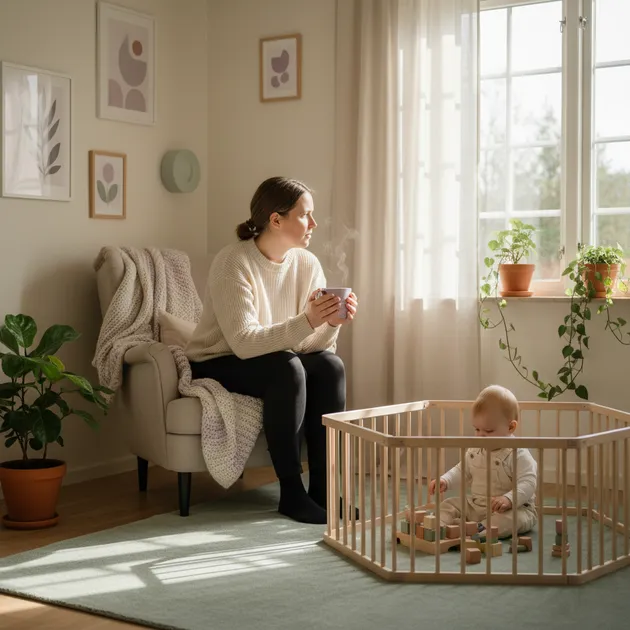
You check whether the baby is breathing. Again. For the third time in ten minutes. You Google symptoms at three in the morning. Your heart races when you hear about accidents involving children in the news.
Some degree of worry is normal as a parent. Your brain is wired to protect your child. But sometimes worry crosses a line into something that takes over.
What Is Parenting Anxiety?
Parenting anxiety is persistent, excessive worry about your child's safety, health, or development. It's more than ordinary parental concern, it's an anxiety that interferes with your daily life.
Common Signs
- Repeatedly checking whether the baby is breathing, eating enough, or has a fever
- Catastrophic thoughts: "What if the baby stops breathing?" "What if something happens?"
- Avoidance behaviors: unable to let others watch the child, afraid to travel, unable to sleep
- Physical symptoms: racing heart, muscle tension, nausea, sleep problems
- Excessive Googling of symptoms and illnesses
- A feeling that you never do enough to protect your child
When Is It Normal, and When Is It Too Much?
All parents worry. It's part of the job. But when worry prevents you from functioning, sleeping, or enjoying time with your child, it has gone too far.
A useful question to ask yourself: Am I in control of my worries, or are my worries in control of me?
Research suggests that around 10–15% of new mothers experience anxiety in the perinatal period (pregnancy and the first year after birth). Many fathers are affected too. Anxiety is often underdiagnosed because the focus has traditionally been on postpartum depression.
Why Does It Happen Now?
Several factors make the parenting period particularly vulnerable to anxiety.
Hormonal Changes
After birth, estrogen and progesterone drop dramatically. These hormones influence mood regulation in the brain. At the same time, oxytocin increases, strengthening attachment, but also the protective instinct.
Sleep Deprivation
Chronic sleep deprivation disrupts the brain's ability to regulate emotions. The threat center (amygdala) becomes overactive, while the rational part (prefrontal cortex) functions less effectively.
Read more: Sleep deprivation as a new parent
Information Overload
Never before have parents had access to so much information about everything that can go wrong. The internet, parenting forums, and news serve up worst-case scenarios around the clock.
Personal History
Have you experienced anxiety before? Loss, birth complications, or traumatic events? These increase the risk of parenting anxiety.
What You Can Do on Your Own
1. Put It into Words
Anxiety thrives in the dark. When you say out loud, "I'm scared something will happen to my baby," the thought loses some of its power. Tell your partner, a friend, or your pediatrician.
2. Limit Googling
Set a rule: one search per worry, maximum. After that, call your pediatrician or health line if you're still unsure. Google always serves up the worst-case outcome. Your healthcare provider gives you answers that apply to your situation.
3. Recognize the Pattern
Anxiety follows a pattern: a thought appears → you interpret it as dangerous → you do something to reassure yourself (check the baby, Google) → anxiety briefly eases → the thought comes back stronger.
Recognizing this pattern is the first step toward breaking it.
Try the "thought check": When a worry pops up, ask yourself three things: 1. Is this thought based on facts or fear? 2. What would I say to a friend who had this thought? 3. What is the most likely outcome?
4. Breathe and Ground Yourself
When anxiety hits physically: try 4-7-8 breathing. Breathe in for four seconds, hold for seven, breathe out for eight. Repeat four times. It activates the parasympathetic nervous system and calms the body.
Grounding: Name five things you can see, four you can touch, three you can hear, two you can smell, one you can taste. It brings the brain back to the present.
5. Move Your Body
Physical activity is one of the most effective anxiety reducers we have. A brisk walk with the stroller, yoga at home, or some core exercises. Your body needs to burn off the stress hormones.
6. Sleep Is Medicine
Yes, it's hard with a baby. But prioritize sleep over everything that isn't strictly necessary. Sleep is the single most important factor for mental health.
Track your baby's sleep patterns to find windows for your own rest.
When You Need Professional Help
Self-help has its limits. Seek professional support if:
- Anxiety has been present daily for more than two weeks
- You're avoiding normal activities out of fear
- You can't sleep even when the baby sleeps
- You're having panic attacks
- Anxiety is affecting your relationship with your baby or your partner
- You're having intrusive, frightening thoughts you can't stop
Where to Get Help
- Your pediatrician or family doctor: can screen for anxiety and depression, and refer you onward. Be honest in the conversation
- A therapist or psychologist: cognitive behavioral therapy (CBT) is well-documented for anxiety disorders
- Postpartum Support International: postpartum.net, helpline and resources for new parents
- Crisis lines: if you're struggling right now, reach out to a mental health crisis line in your country
The Edinburgh Postnatal Depression Scale (EPDS) is used by many healthcare providers to screen for anxiety and depression after birth. It includes questions about anxiety. If you haven't been asked, you can request it, or find the questionnaire online to get a sense of where you stand before your appointment.
Treatments That Work
- Cognitive behavioral therapy (CBT): helps you identify and change the thought patterns driving the anxiety
- Medication: SSRIs can be used, including while breastfeeding. Talk to your doctor about what's safe
- Group therapy: meeting other parents with similar experiences can be enormously helpful
- Couples therapy: anxiety affects the whole family. Sometimes you need support together
For the Partner: How You Can Help
If your partner is struggling with parenting anxiety:
- Don't dismiss their worries with "it'll be fine", acknowledge the feeling first
- Offer to take over so they can take a real break
- Encourage them to speak with a doctor or midwife
- Be patient, anxiety isn't something you can simply decide to stop
- Take care of your own wellbeing too
Frequently Asked Questions
Is it normal to have frightening thoughts about the baby dying?
Yes. Intrusive thoughts are very common in new parents. They don't mean you're a bad parent or that something is wrong with you. Thoughts are just thoughts. If they're significantly distressing or persistent, speak with your healthcare provider.
Can anxiety affect my child?
Children are resilient, and short-term stress doesn't affect development. But long-term, untreated anxiety can make it harder to be present and responsive. That's why seeking help is worthwhile, for your own sake and for your child's.
Does parenting anxiety get better with time?
For many parents, it eases as the baby grows and you become more confident. But for some, it persists or intensifies. Don't wait it out, seek help early.
Worry means you care. But you deserve to enjoy parenthood without drowning in fear. Help is available, and you deserve to take it.
Read also: Parental burnout | Postpartum depression | Identity after having a baby | Perfectionism as a parent
Sources
- Postpartum Support International
- CDC. Mental health among mothers
- WHO. Mental health during pregnancy and beyond
🔧 Helpful Tools
- All Baby Tools. Browse all free tools for pregnancy and baby care
📖 Related Articles
- Reducing Birth Anxiety: 7 Methods That Help. Anxious about giving birth? Here are 7 evidence-based methods that reduce birth anxiety and help you feel more prepared and confident.
- Exercise and Mental Health for New Parents. Exercise can prevent and ease postpartum depression, anxiety, and exhaustion. Here's how to get started, with realistic goals and routines that fit life with a baby.
- Good Enough Is Perfect: Let Go of Parenting Perfectionism. Parenting perfectionism is exhausting. Learn why good enough is the best thing you can give your child, and how to release the pressure.