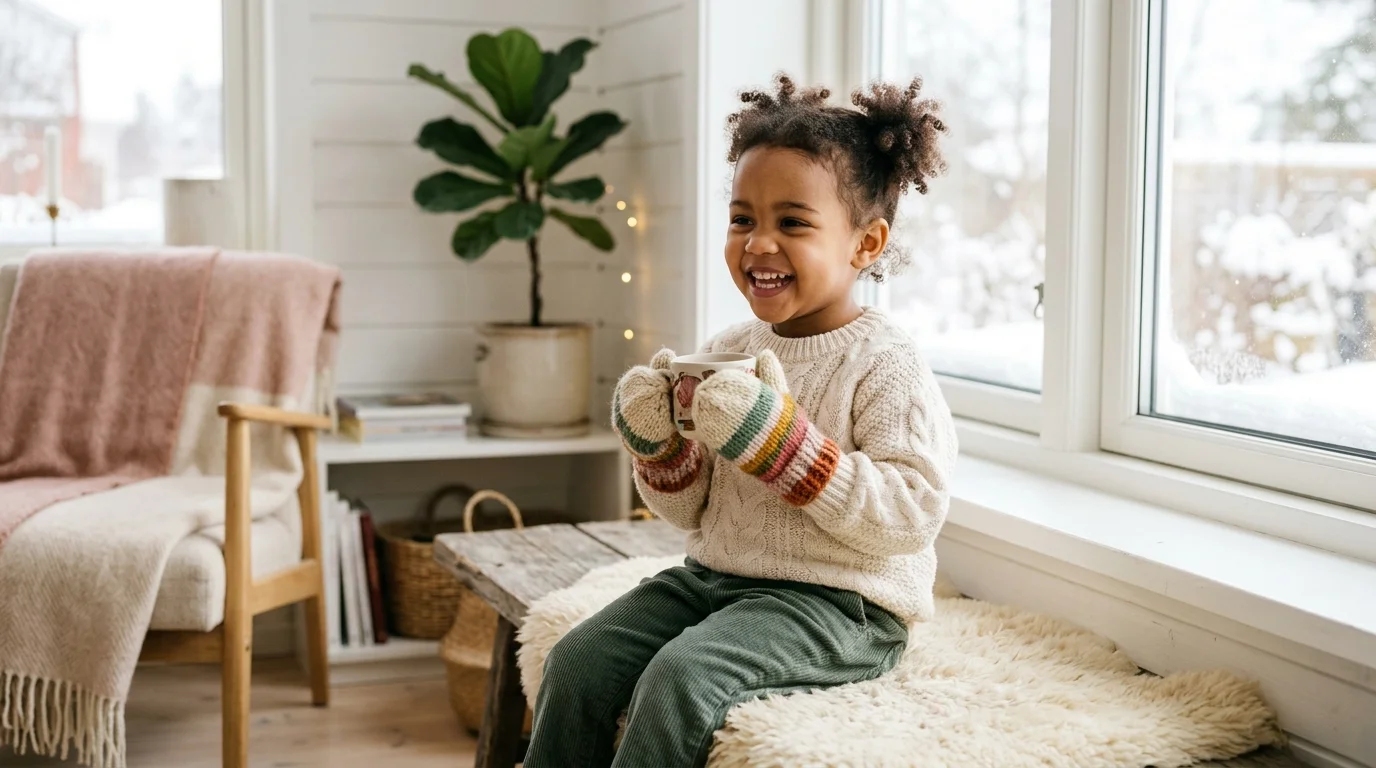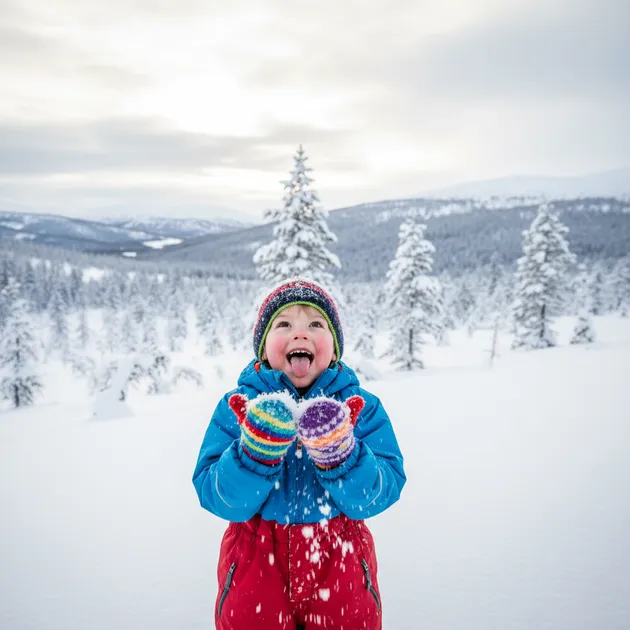
Cold little hands are one of the most common winter frustrations for parents. Children lose a lot of heat through their hands, and the wrong mittens mean frozen fingers within minutes.
This guide helps you choose the right mittens for your child, whether they're a baby in a stroller, a toddler playing in the snow, or an active child out on skis.
Mittens, gloves, or lobster mitts?
There are three main types of hand coverings for children. Which type works best depends on your child's age, activity level, and need for dexterity.
Mittens (thumbless or thumb-only)
Mittens keep all the fingers together in one compartment and are the warmest option. The fingers warm each other, and there's less surface area losing heat. For children under 3–4 years, mittens are the best choice.
The advantage is easy on and off. The downside is limited dexterity, your child can't grip as precisely.
Gloves (fingered)
Gloves give full finger dexterity and suit older children who need to grip ski poles, do up buttons, or handle small objects. Most children can't manage gloves before age 4–5 because it's hard to get each finger into the right slot.
Gloves are colder than mittens because each finger is insulated separately. Compensate with thicker insulation or a wool liner underneath.
Lobster mitts (three-finger mitts)
Lobster mitts are a compromise between mittens and gloves. The thumb has its own compartment, the index finger has its own compartment, and the three remaining fingers share a compartment. This gives better grip than mittens and more warmth than gloves.
Lobster mitts are popular as ski mittens for children from around 4–5 years. Your child can grip ski poles well without getting cold hands.
Rule of thumb: Under 3, use mittens. Ages 3–5, mittens or lobster mitts. Over 5, let your child choose between mittens, lobster mitts, and gloves.
Materials, what keeps hands warmest?
Wool
Wool is the natural first choice for baby and toddler handwear. Merino wool is soft, regulates moisture, and stays warm even when damp. Wool mittens work excellently as the only layer on mild winter days, or as a liner beneath waterproof outer mitts.
The downside is that wool alone isn't waterproof. Wool mittens become soaked in minutes if your child plays in wet snow.
Gore-Tex and waterproof membranes
Mittens with Gore-Tex or a similar membrane keep hands dry in wet snow and slush. They breathe well, releasing moisture from inside while keeping water and wind out. For daycare use, waterproof mittens are almost essential.
Thinsulate and synthetic insulation
Thinsulate is a thin insulation material that provides good warmth without bulk. Mittens with Thinsulate are soft and flexible, making it easier for children to grip things. 100–200 grams of Thinsulate is common in children's mittens.
Leather
Leather mittens have natural wind resistance and excellent durability. They mold to the child's hand over time. Some models have a wool lining inside. Leather mittens require more maintenance than synthetic alternatives.
Best combination for cold winters: Thin wool mittens as a liner and waterproof Thinsulate-insulated mittens on the outside. This gives your child warmth, dryness, and breathability.
Mittens by age
0–12 months, baby mittens
Babies don't need dexterity, but they need warmth. Baby mittens should be soft, easy to put on, and difficult to pull off. Look for models that fasten with velcro around the wrist or attach to the sleeve of a snowsuit.
For stroller use, wool or fleece mittens are sufficient, hands are protected by the footmuff. For baby carriers on cold days, use thicker, windproof mittens.
Size: Baby mittens typically come in sizes 0–6 months and 6–12 months.
1–3 years, the toddler years
This is the age when mittens disappear fastest. Toddlers need waterproof, warm mittens that can handle rough play. Choose models with a long cuff that extends well up the forearm, this makes it much harder for your child to pull them off.
Mittens with an elastic or velcro wrist stay on better than loose-fitting models. Some mittens have a long zipper that makes it easier to get the hand inside.
Size: Size 1–2 years (approx. 4.5–5 inches / 11–13 cm hand length) and 2–3 years (approx. 5–5.5 inches / 13–14 cm).
3–6 years, the active child
At this age, children can start trying lobster mitts or gloves for activities that require grip. For everyday use, regular mittens are still the warmest. Many parents keep two pairs, regular mittens for daycare and ski mittens or lobster mitts for skiing and sledding.
Size: Size 4–5 years (approx. 5.5–6 inches / 14–15 cm) and 5–6 years (approx. 6–6.5 inches / 15–16 cm).
Finding the right size
Wrong size is the most common reason children end up with cold hands. Mittens that are too large provide poor insulation because the air pocket is too big. Mittens that are too small squeeze the fingers and restrict circulation.
How to measure:
- Place your child's hand flat on a piece of paper
- Measure from the wrist crease to the tip of the middle finger
- Measure around the widest part of the hand (across the knuckles)
| Age | Hand length | Mitten size |
|---|---|---|
| 0–12 months | 3.5–4.5 in (9–11 cm) | 0–1 |
| 1–2 years | 4.5–5 in (11–13 cm) | 1–2 |
| 2–4 years | 5–6 in (13–15 cm) | 2–4 |
| 4–6 years | 6–7 in (15–17 cm) | 4–6 |
Don't buy too large. It's tempting to size up for an extra season, but oversized mittens insulate poorly and make it difficult to grip. One size up at most.
Winter mittens for daycare
Daycare puts specific demands on mittens. Your child is outdoors in all kinds of weather, and staff need to help many children get dressed. Here's what to consider:
Waterproof is non-negotiable
Daycare children sit in the snow, dig with their hands, and make snowballs. Wool mittens become soaked in minutes. Always choose waterproof outer mittens for daycare.
Label the mittens with your child's name
Mittens are the piece of clothing most often lost at daycare. Label both mittens clearly with your child's name. Use mitten clips or a mitten string attached to the jacket to prevent loss.
Have two pairs
One pair in use and one pair drying. Wet mittens in the morning make for a miserable start to the day, for everyone.
Choose simple designs
Staff need to help many children. Mittens with a long cuff and a simple opening are easier to put on than models with multiple buttons or cords.
Ski mittens for sledding and skiing
Ski mittens need to be waterproof, warm, and provide good grip. For sledding, regular winter mittens work fine, but for skiing with poles your child needs mittens or lobster mitts that allow some dexterity.
Good ski mittens have:
- Waterproof outer layer (Gore-Tex or equivalent)
- Reinforced palm for grip
- Long cuff that goes over the jacket sleeve
- Elastic or velcro wrist closure
- At least 150 grams of Thinsulate insulation
For alpine skiing, there are specialized ski gloves with extra protection and grip. These are rarely necessary for children under 6–7 years.
Recommended brands
Reima
A leading Nordic brand designed for northern climates. Known for durable, functional mittens at a reasonable price point.
Polarn O. Pyret
Scandinavian brand famous for quality that lasts through multiple children. Excellent fit and construction.
Didriksons
Solid waterproof mittens at a fair price. Function over fashion.
Hestra
A Swedish mitten specialist with over 80 years of experience. Makes some of the best ski mittens for children, particularly known for leather mittens with excellent insulation.
Joha
Danish brand known for wool products. Joha's merino wool mittens are soft and warm, perfect as liners or for mild winter days.
Price guide
| Type | Price range | Best for |
|---|---|---|
| Wool mittens (basic) | $15–30 | Mild days, liners |
| Waterproof mittens | $30–60 | Daycare, snow play |
| Ski mittens | $45–90 | Skiing, sledding, longer outings |
| Premium leather/Gore-Tex | $60–110 | Active children, extreme cold |
Tips for keeping mittens on
Every parent knows the frustration: you put the mittens on, and two seconds later they're in the snow. Here are some tried-and-true tricks:
Mitten clips: Attach an elastic cord between the mittens running through the jacket sleeves. Your child can take the mittens off without losing them.
Long cuffs: Mittens with a long cuff covering the wrist are much harder to pull off than short-cuffed models.
Velcro: Fasten the velcro snugly around the wrist. Your child shouldn't be able to flip the mitten off with the other hand.
Let your child choose: Children who get to pick the color and pattern of their mittens are more motivated to keep them on.
Don't give up: Most children stop pulling off their mittens once they discover how cold it is without them. Some just need a little time.
Washing and care
- Wool mittens: Hand wash in lukewarm water with wool detergent. Don't wring, gently press out the water. Dry flat.
- Waterproof mittens: Machine wash at 86–104°F (30–40°C). Hang to dry. Re-treat with a DWR spray once per season.
- Leather mittens: Air dry naturally, never on a radiator. Use leather conditioner or balm to keep the leather supple.
Drying tip: Wet mittens should dry with the opening facing down so air can circulate inside. Avoid placing them directly on heaters or radiators, this can damage the insulation and membrane.
Checklist for children's mittens
Here's a quick overview of what you need:
- ✅ Waterproof mittens for daycare and snow play
- ✅ Wool mittens as liners or for mild days
- ✅ A spare pair drying while the other is in use
- ✅ Mitten clips or a cord to prevent loss
- ✅ Labeled with your child's name
- ✅ Correct size, not too big
More on winter clothing:
- Winter snowsuit for kids, complete guide
- Winter boots for kids
- Layering for a winter baby
- Baby clothing by season
Frequently asked questions about children's mittens
What are the best mittens for daycare?
Waterproof mittens with a long cuff and good insulation are best for daycare. Choose models that are easy to put on and off, with velcro or elastic at the wrist. Always have two pairs so your child has dry mittens every day. Reima, Didriksons, and Polarn O. Pyret all make excellent daycare mittens.
How do I keep mittens on a baby?
For babies under one year, choose mittens that fasten to the snowsuit sleeve, or use models with a long, snug cuff. Mitten clips that attach mittens to the jacket work well for older babies. Some snowsuits have integrated mittens that can't be removed.
Mittens or gloves, which is warmer?
Mittens are warmer than gloves because all the fingers share warmth in one compartment. Gloves insulate each finger separately, which means more heat loss. For children under 4–5 years, mittens are recommended. Older children who need dexterity can try lobster mitts as a compromise.
When does my child need ski mittens?
Your child needs dedicated ski mittens when they start skiing with poles, usually from around 4–5 years. Ski mittens have a reinforced palm for grip and extra insulation. For sledding and general snow play, regular winter mittens are fine.
How many pairs of mittens does my child need?
A minimum of two pairs of waterproof mittens and one pair of wool mittens. If your child goes to daycare, three pairs of waterproof mittens means you always have a dry pair available. Add a pair of ski mittens if your child skis.
Sources
- AAP. Infant and toddler nutrition guidelines
- WHO. Global infant feeding recommendations
- CDC. Infant and toddler nutrition resources
🔧 Helpful Tools
- All Baby Tools. Browse all free tools for pregnancy and baby care
📖 Related Articles
- Mittens for Kids - Guide to Warm Little Hands All Winter. Complete guide to children's mittens. Types, materials, sizing by age, and tips for keeping mittens on. Find the best mittens for your child.
- Snowsuit for Kids - How to Choose the Right One for Winter. Complete guide to snowsuits for babies and children. Materials, waterproofing, sizing, and top brands. Find the best snowsuit for your child.