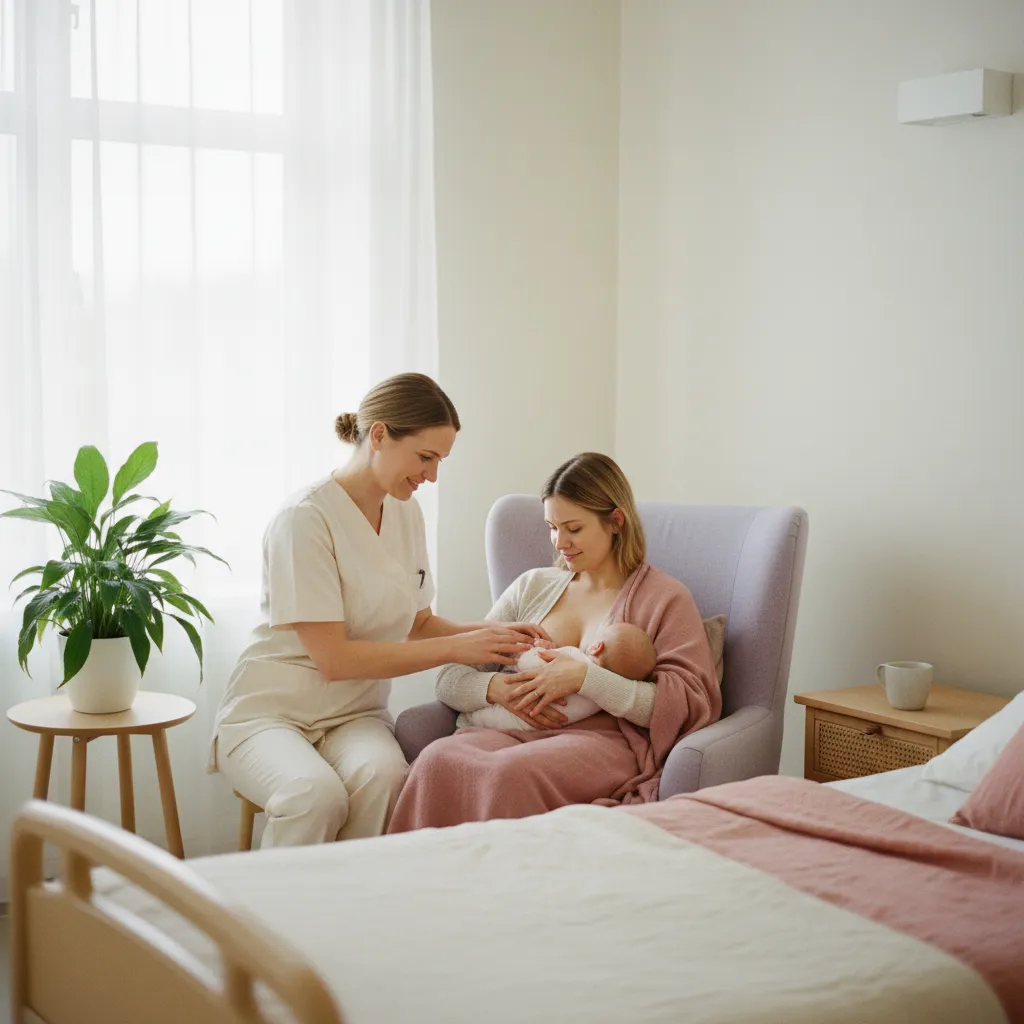
Your baby is finally here. The birth is over. But what happens now? The first hours and days in hospital are a mix of euphoria, exhaustion, and a steep learning curve.
Here is an honest walkthrough of what to expect on the postnatal ward, so you can prepare and focus on what matters most: getting to know your little one.
The first hour, the golden hour
The first hour after birth is called the "golden hour." It's reserved for you, your partner, and your baby.
What happens
- Skin to skin. Your baby is placed directly on your chest. Physical contact regulates the baby's temperature, breathing, and heart rate
- First feeding. Your midwife helps the baby find the breast. Most babies attempt to latch within the first hour
- Apgar score. The midwife assesses the baby at 1 and 5 minutes: breathing, heart rate, skin color, muscle tone, and reflexes
- Cord clamping. Your partner is often offered the chance to cut the cord. Many hospitals now delay clamping until the cord stops pulsing (2–3 minutes)
- Vitamin K. The baby receives a vitamin K injection to prevent bleeding disorders
Tip: Write in your birth plan that you want uninterrupted skin-to-skin during the first hour. Prepare your birth plan well before your due date.
The first 24 hours
For your baby
- Pediatrician examination. A thorough check of the heart, hips, reflexes, and organs. Usually within 24 hours
- First bath. Some hospitals bathe the baby; others recommend waiting 24–48 hours. The vernix (white coating) protects the skin
- Newborn screening. A heel-prick blood test after 48 hours, checking for rare metabolic and genetic conditions (the specific panel varies by country)
- Hearing test. A quick, painless test done before discharge
For the birthing parent
- Afterpains. The uterus contracts as it shrinks back. These can be intense, especially with subsequent births. Acetaminophen and ibuprofen help
- Postpartum bleeding (lochia). Normal in the first days. Your midwife or nurse will check it's within normal range
- Stitches check. If you had stitches after a tear or episiotomy, these will be checked
- Rest. You have just done something extraordinary. Rest as much as you can
Did you know? Many hospitals now offer private family rooms where your partner can stay overnight. Check with your hospital in advance, availability is limited.
Types of postnatal accommodation
Many hospitals offer different types of postnatal stays:
Shared postnatal ward
- Shared room with other new mothers (typically 2–4 per room)
- Midwives and nurses available around the clock
- Support with feeding and newborn care
- Partner visiting hours vary by hospital
Private/family room
- Private room for you, your partner, and baby
- Quieter environment
- Partner can stay overnight
- Slightly less staffing than the main ward
- Not available at every hospital
What should you choose?
First-time parents who are establishing breastfeeding often benefit most from the shared ward with close support. Parents who feel confident with newborn care may prefer the privacy of a family room.
Breastfeeding in the first days
The first days are about establishing feeding. Here's what to expect:
Day 1
Colostrum (first milk) comes in small quantities. It is enough, your baby's stomach is about the size of a cherry.
Days 2–3
Your baby is often more awake and feeds frequently. This stimulates milk production. Many parents experience sore nipples.
Days 3–5
The milk "comes in." Your breasts may become full, firm, and tender. Frequent feeding and a cold compress help.
Ask for help. The midwives and nurses on the postnatal ward are experts at supporting you in the early days of feeding. Don't hesitate to press the call button, that's what it's there for.
Your right: In many countries, all new mothers are entitled to breastfeeding support in hospital. Ask your care team what lactation support is available. Many hospitals have UNICEF Baby-Friendly accreditation.
What to pack in your hospital bag
For the birthing parent
- Comfortable clothes (loose trousers, nursing-friendly top)
- Toiletries (toothbrush, shampoo, moisturiser)
- Maternity pads for postpartum bleeding
- Nursing bra and breast pads
- Phone charger
- Snacks and drinks
For your baby
- 2–3 bodysuits and sleepsuits
- Hat
- Socks
- A warm outer layer for the journey home
- Diapers/nappies (hospital usually provides some, but bring your own as backup)
For your partner
- Change of clothes if staying overnight
- Toothbrush and toiletries
- Snacks
- Camera/phone with charger
Use our hospital bag checklist to tick things off as you pack.
When can you go home?
Normal vaginal birth
Most families go home after 1–3 days. Some choose early discharge and go home after 6–24 hours with midwife follow-up at home.
Cesarean section
Usually 2–4 days, depending on recovery.
Criteria for discharge
- The birthing parent is in good general health
- Postpartum bleeding is within normal range
- Feeding is established or thorough guidance has been given
- The baby has passed all examinations
- Newborn screening blood test has been taken (after 48 hours)
- Hearing test has been completed
- Discharge plan agreed with midwife or care team
Don't rush to go home. Use your time in hospital to ask questions, practice newborn care, and get feeding support. It's much easier to get help here than at home.
After you go home, follow-up care
After discharge, follow-up typically includes:
- Midwife or home health visit. Within 1–3 days after discharge to check on parent and baby
- Pediatrician visit. First appointment usually within 7–10 days. Regular well-baby checks follow from there
- Postpartum checkup. Around 6 weeks, to check on the birthing parent's physical recovery
Frequently asked questions
Can my partner stay overnight?
It varies by hospital. Many offer family rooms where partners can sleep. Call your hospital and ask in good time.
What if breastfeeding isn't working?
Ask for help from your midwife or a lactation consultant. All hospitals have support available. Formula is available if needed, no baby should go hungry.
What if the baby has jaundice?
Mild jaundice is very common (around 60% of newborns). The hospital will take a blood test and provide light therapy (phototherapy) if levels are high. It is harmless and resolves within days.
Summary
Your hospital stay after birth is an intense and beautiful time. Prepare practically, but keep your expectations flexible. Nobody does everything right in the first few days, and you don't need to.
Prepare your birth plan with your wishes and check our hospital bag checklist so you have everything ready.
Further reading
- The stages of labor, from contractions to birth
- Your first week home with a newborn
- Breastfeeding positions, finding what works
- The postpartum period, a complete guide
Sources
- WHO. Recommendations on postnatal care of the mother and newborn
- AAP (American Academy of Pediatrics). Newborn care guidelines
- NHS. Your postnatal care
🔧 Helpful Tools
- Due Date Calculator. Calculate your estimated due date
- Contraction Timer. Track your contractions during labor
- All Baby Tools. Browse all free tools for pregnancy and baby care
📖 Related Articles
- Postnatal Hotels and Birth Centers. A Calm Start for the Whole Family. Everything about postnatal hotels and family-centered birth centers: what they are, what they offer, what to pack, and how to prepare. Complete guide for new parents.
- Afterpains: Painful Contractions After Birth. Afterpains are painful contractions after giving birth. Learn why they occur, how long they last, and what relieves the pain.
- The Postpartum Period: What Happens to Your Body After Birth. Everything you need to know about the postpartum period, bleeding, hormones, breastfeeding, pelvic floor, and the 6-week checkup. An honest guide for new mothers.