
Struggling to find a comfortable breastfeeding position? You are not alone. Many new mothers try several positions before finding the one that works.
In this guide we go through the most common breastfeeding positions, from laid-back nursing to side-lying. You will learn when each position works best and how to achieve a good latch.
Key Takeaways
- No single position works for everyone, most mothers use two or three different positions throughout the day depending on the situation; La Leche League recommends varying positions to prevent blocked ducts and nipple soreness.
- Laid-back breastfeeding (Biological Nurturing) is recommended as the first-choice position by many lactation consultants, especially for newborns, it activates over 20 innate feeding reflexes in babies.
- The side-lying position is ideal for nighttime nursing and recovery after a cesarean section, allowing you to rest while your baby feeds.
- A good latch is the foundation of every position: the baby's mouth should cover a large portion of the areola, not just the nipple, with the lower lip flanged outward.
- After a cesarean section, positions that avoid pressure on the incision (football hold, laid-back, side-lying) are most comfortable and equally effective for milk transfer.
Which Breastfeeding Position Is Right for You?
Not all positions work in every situation. Here is a quick overview of which position works best when:
| Situation | Best Position | Alternative |
|---|---|---|
| Newborn (first weeks) | Laid-back breastfeeding | Cross-cradle |
| Nighttime nursing and rest | Side-lying | Laid-back in bed |
| After cesarean section | Laid-back breastfeeding | Football hold |
| Nursing in public | Cradle hold | Cross-cradle |
| Twins (both at once) | Double football hold | Side-lying + laid-back |
| Sore nipples | Laid-back breastfeeding | Vary positions often |
| Oversupply | Laid-back breastfeeding | Side-lying |
| Baby struggling with latch | Laid-back breastfeeding | Cross-cradle |
| Large breasts | Football hold | Side-lying |
| Premature baby | Cross-cradle | Laid-back breastfeeding |
| Blocked milk duct | Position with baby's chin toward the lump | Vary positions |
Many mothers use several breastfeeding positions throughout the day. It is completely normal to vary, your body and baby have different needs at different times.
Why the Right Position Matters
A good breastfeeding position is about more than comfort. The right position:
- Prevents sore nipples
- Helps the baby achieve a good latch
- Allows milk to flow more easily
- Lets you relax while nursing
- Reduces the risk of blocked ducts and mastitis
There is no single "correct" position that suits everyone. Try different ones until you find what works for you and your baby. According to La Leche League, varying positions is one of the best things you can do to prevent breastfeeding difficulties.
Laid-Back Breastfeeding (Biological Nurturing)
Laid-back breastfeeding, also called Biological Nurturing (BN), is the most natural nursing position. The method was developed by midwife and researcher Suzanne Colson, who showed that this semi-reclined position activates over 20 innate reflexes in babies that make breastfeeding easier.
Many lactation consultants and midwives recommend laid-back nursing as the first choice, especially for new mothers who are struggling to get started. The WHO and AAP both emphasize finding a position where both mother and baby are relaxed, and laid-back nursing fulfills exactly this.
How to Do Laid-Back Breastfeeding. Step by Step
- Find a comfortable semi-reclined position, lean back in a chair, sofa, or bed at about a 30–45 degree angle. You should feel relaxed, not lying completely flat.
- Support yourself well, use pillows behind your back, under your arms, and optionally under your knees. You should be able to sit like this for a long time without stiffening up.
- Place your baby on your chest, tummy to tummy, with the baby's head between your breasts or slightly to one side.
- Let the baby rest just below the breast, gravity will naturally guide the baby toward the nipple.
- Let the baby seek the breast themselves, do not push the baby's head toward the breast. Just rest a hand lightly on the back for support.
- Wait patiently, it may take a few minutes for the baby to find the breast. This is completely normal.
Why Laid-Back Nursing Works. The Science Behind It
Laid-back nursing is built on the principle of Biological Nurturing, an approach that uses the baby's innate reflexes. When the baby lies on your chest in this semi-reclined position, a series of reflexes that are present from birth are triggered:
- Rooting reflex, baby turns head toward the breast and opens mouth
- Sucking reflex, baby begins to suck when the nipple touches the palate
- Grasping reflex, baby grabs the breast with their hands
- Crawling reflex, baby uses their legs to push forward toward the breast
Gravity plays an important role. When the baby lies on top of you, gravity helps hold the baby close to the breast, which creates a deeper and better latch. You do not need to guide the baby, just support and hold.
According to La Leche League, laid-back nursing is one of the most effective positions for resolving latch problems, precisely because the baby gets to use their natural reflexes.
Laid-Back Nursing for Different Situations
Laid-back nursing with a newborn (0–6 weeks): The position stimulates the innate reflexes that are strongest in this period. Place the baby tummy to tummy right after birth, this is the natural position for the first feeding. Skin-to-skin contact in a laid-back position promotes both nursing and bonding.
Laid-back nursing with oversupply: When you are semi-reclined, gravity works against the milk flow rather than with it. This means milk does not flood uncontrolled into the baby's mouth, but flows slowly downward. The baby can more easily control the flow and drink at their own pace without choking.
Laid-back nursing with a strong letdown: Many mothers find that milk sprays powerfully when the letdown reflex kicks in. In a laid-back position the baby can more easily handle this because the milk flows upward toward the baby's mouth, not downward with gravity. The baby can pull back, breathe, and re-latch without stress.
Laid-back nursing for mothers with larger breasts: Gravity helps the breast fall naturally, and the baby can lie on your chest with good support. You do not need to hold the breast up with your hand, freeing both hands to support the baby.
Laid-back nursing is especially beneficial for newborns, babies who have difficulty latching, and mothers who have had a cesarean section.
When Should You Choose Laid-Back Nursing?
Laid-back nursing works in many situations, but is especially useful for:
- Newborns (0–6 weeks), the position stimulates innate reflexes that are strongest in this period
- After cesarean section, the baby does not put pressure on the incision, and you can lie comfortably
- Oversupply, gravity slows the milk flow so the baby does not get overwhelmed
- When the baby struggles with latching, the baby controls the attachment themselves, at their own pace
- Strong letdown, the baby can more easily manage a forceful milk flow in this position
- Skin-to-skin after birth, the perfect position for the first feeding in the delivery room
- When other positions cause pain, many find this position pain-free even when others hurt
Cradle Hold (Classic Nursing Position)
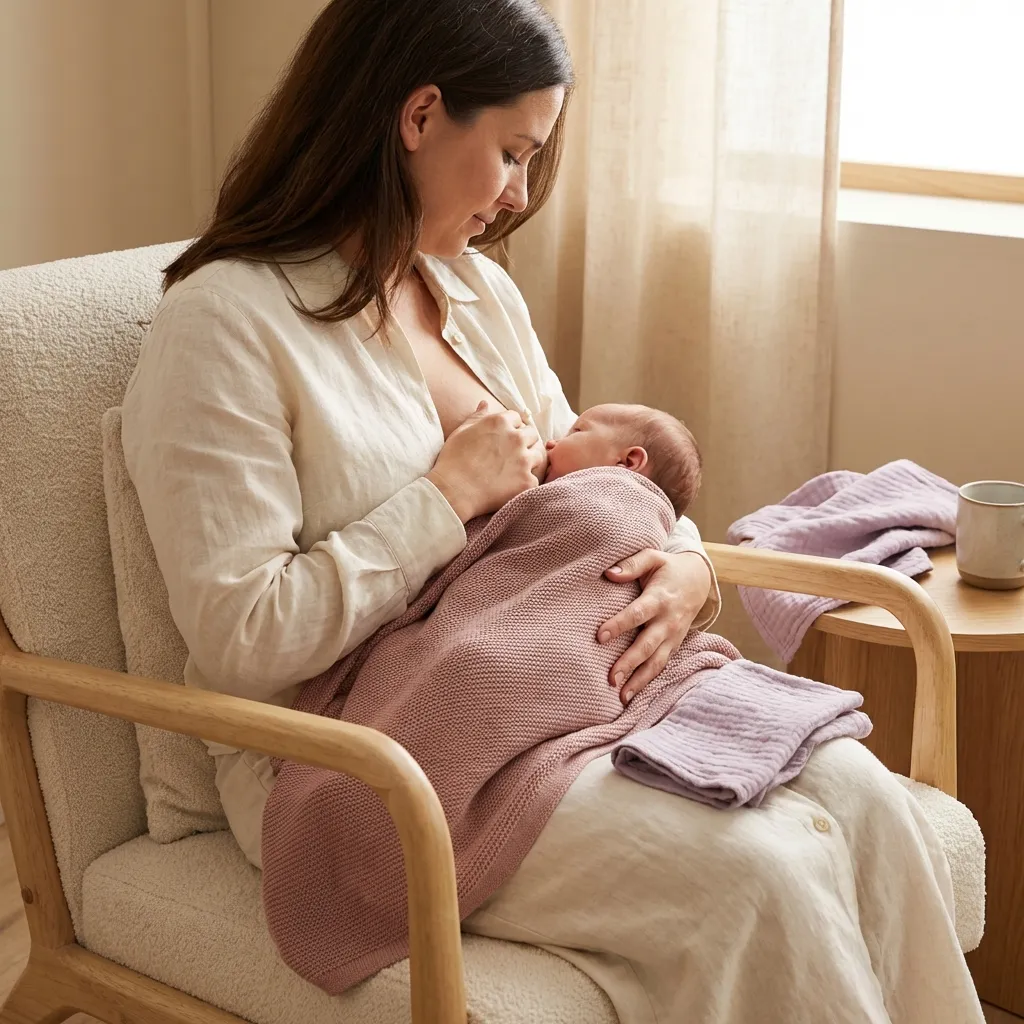
The cradle hold is the classic nursing position most people picture. The baby lies in the crook of your arm while you sit upright.
How to Do It
- Sit comfortably and upright with relaxed shoulders
- Place a pillow in your lap for support
- The baby rests in the crook of your arm with their head toward the breast
- The baby's tummy is facing your tummy
- The baby's nose should be level with your nipple
Tips for the Cradle Hold
- Use a nursing pillow to lift the baby to the right height
- Do not lean forward, bring the baby toward you instead
- Keep your shoulders relaxed
The cradle hold provides less control over the baby's head than the cross-cradle hold. It works best once the baby has learned to nurse and latches on independently.
Cross-Cradle Hold (Modified Cradle)
The cross-cradle hold is similar to the cradle hold, but you switch which arm holds the baby. This gives you better control over the baby's head and neck.
How to Do It
- The baby lies on a pillow in front of you
- If the baby will nurse on the left breast, you hold with the right arm
- Support the baby's neck and shoulders with your hand
- Use the other hand to shape and support the breast
When to Choose the Cross-Cradle Hold
The cross-cradle hold is especially good for:
- Newborns who need extra support
- Premature babies with weaker muscle tone
- When you need control over the latch
Side-Lying Position
Side-lying nursing is perfect for nighttime feeds and rest. You and the baby lie on your sides, face to face. This position is a lifesaver for tired parents, and many lactation consultants recommend it as a standard position for nighttime nursing.
According to La Leche League, side-lying nursing can be a great position for mothers who need rest, especially in the first weeks after birth. The position is also useful after a cesarean section because you do not need to sit upright.
How to Do Side-Lying Nursing. Step by Step
- Lie on your side with a pillow under your head. Do not have the pillow too high, your shoulder should rest against the mattress.
- Bend your knees slightly and have a slight "break" at the hip for stability. You can place a pillow between your knees for extra comfort.
- Lay the baby on their side close to you, tummy to tummy. The baby's nose should be level with your nipple.
- Use the lower breast, it is most accessible. Your lower arm can rest under your head or be stretched over the baby's head.
- Support the baby's back with your upper hand, or place a rolled-up towel behind the baby's back.
Detailed Technique for Side-Lying Nursing
Arm placement: Your lower arm can be positioned in three ways:
- Under your head (most comfortable for long sessions)
- Stretched out over the baby's head (provides stability)
- Bent under your pillow (keeps the pillow in place)
Baby's position: The baby should lie completely close to you with their face toward the breast. The nose should be level with the nipple so the baby has to tilt their head slightly back to latch, this creates a deep latch. The baby's body should be straight, not with the head twisted toward the breast while the body points another way.
Using pillows: Place a pillow between your knees to relieve your hip. A rolled towel behind the baby's back prevents rolling backward. A pillow at your back keeps you stable in the side-lying position.
Tips for Side-Lying Nursing
- A pillow at your back gives you support so you do not roll backward
- Larger breasts? Place a folded towel or small pillow under the breast to lift it to the right height
- Switching breasts without turning over: Lean slightly forward so the upper breast hangs over the baby, or turn you both to the other side
- Keep the bed simple, remove loose pillows and blankets that can cover the baby's face
Side-Lying Nursing for Newborns vs. Older Babies
Newborns (0–3 months):
- The baby needs extra support and should lie completely close to you
- Keep a hand on the baby's back to make sure they lie stably on their side
- It may take some practice, try it during the day when you are awake and alert first
- Some lactation consultants recommend waiting until nursing is well established (2–4 weeks) before trying it at night
Older babies (3+ months):
- The baby is stronger and can adjust their own position
- You can more easily relax and doze while the baby nurses
- Baby can often latch on themselves without help
- Perfect for babies who wake frequently at night
Side-Lying Nursing at Night. Practical Tips
Nighttime nursing in the side-lying position is one of the most effective ways to get more sleep as a new mother. Here are some tips:
- Nursing in the dark? Use a soft nightlight so you can check the latch without fully waking the baby
- Keep the baby close, a bedside bassinet makes it easy to lay the baby back down after nursing
- Don't sit up unless you have to. The less you move, the easier it is for both you and the baby to fall back asleep
- Let your partner take over burping, you nurse, your partner does the burp, and you can sleep on
Side-lying nursing is ideal for cold winter nights, you and your baby keep warm together. Many mothers find this position turns nighttime feeding into a peaceful moment rather than a stressful wake-up.
Benefits of Side-Lying Nursing
- You rest while you nurse, you do not need to sit up, which makes an enormous difference at night
- Good after birth when you are sore, especially after stitches or a cesarean section
- Perfect for nighttime nursing, the baby can nurse without either of you fully waking
- Baby can fall back asleep after the feeding without being disturbed by being put down
- Prevents back pain, no strain on neck and shoulders as in a sitting position
- Good for long nursing sessions, especially during growth spurts when the baby wants to nurse for extended periods
- Frees your hands, you can read, look at your phone, or stroke another child
Side-Lying Nursing After a Cesarean Section
Side-lying nursing is one of the best positions after a cesarean section. Benefits:
- You do not need to sit up, which can be painful in the first days
- No weight or pressure on the incision
- You can have pillows around your abdomen for extra protection
- The position is gentle on abdominal muscles that need to heal
Tip after a cesarean: Place a soft pillow in front of your abdomen between you and the baby. This acts as a buffer against unexpected kicks or movements from the baby.
Follow safe sleep guidelines from the AAP and other infant safety organizations. Avoid bed-sharing if you smoke or vape, have consumed alcohol, are extremely tired due to medication, or if the sleep surface is soft or unsafe.
Football Hold (Clutch Hold)
In the football hold, the baby lies along your side under your arm, like a football. This position is also called the clutch hold.
How to Do It
- Sit upright with pillows in your lap
- The baby lies on the pillow with their body under your arm
- The baby's feet point backward toward your back
- Support the baby's neck with your hand
- Use the other hand to shape the breast
Who Is the Football Hold Best For?
- Nursing twins, you can nurse both simultaneously
- After a cesarean section, the baby is not over the abdomen
- Larger breasts, better control and visibility
- Flat breast or inverted nipples, easier to shape the breast
Breastfeeding Positions for Twins. Complete Guide
Nursing twins is absolutely possible, but it requires some planning and practice. Many mothers of twins nurse exclusively, and many more combine nursing with formula. La Leche League offers specific support for parents of multiples.
Double Football Hold
The most common position for nursing two babies simultaneously:
- Sit comfortably with back support
- Use a large, firm nursing pillow (specifically designed for twins) or two regular pillows
- Place one baby under each arm with feet pointing backward
- Support both babies' necks with your hands
- Both babies lie along your sides
Parallel Hold (Cradle + Football)
A combination where one baby is in the cradle hold and the other is in the football hold:
- Place one baby in the cradle hold on one side
- Place the other baby in the football hold on the other side
- Both babies are in your lap but in different positions
Double Cradle Hold
Both babies in the cradle hold, overlapping:
- Baby 1 in standard cradle, baby 2 crossing over baby 1
- Most suitable for older babies who have good head control
Practical Tips for Nursing Twins
- Start with one at a time, learn the nursing technique with one baby at a time in the first days
- Ask for help, have someone present who can help you latch the second baby
- Track feedings, keep track of which breast each baby fed from last
- Alternate breasts, let the babies switch breasts at each feeding for even stimulation
Breastfeeding Positions After a Cesarean Section. Detailed Guide
After a cesarean section it is especially important to find a nursing position that does not put pressure on the incision. The first days can be challenging, but with the right position you can nurse comfortably from day one.
The Best Positions After a Cesarean Section
Ranked by suitability:
- Laid-back nursing, best in the first days. The baby lies over your chest, completely away from the abdomen. You can recline semi-flat in the hospital bed.
- Side-lying nursing, a good alternative, especially for nighttime nursing. Have a pillow in front of your abdomen as a buffer.
- Football hold, the baby lies along your side under your arm, without touching the abdomen.
- Cross-cradle with pillow, use a nursing pillow as a shield between the baby and the incision.
Tips for the First Days After a Cesarean Section
- Ask for help from a nurse or midwife with the first feeding, there is no shame in needing guidance
- Have pain relief available, it is easier to nurse when you are not in severe pain
- Use the bed's controls to raise yourself gradually
- Have the baby in a bedside bassinet so you do not need to stand up to pick them up
When to Choose Which Position
| Situation | Recommended Position |
|---|---|
| Newborn baby | Laid-back or cross-cradle |
| Nighttime nursing | Side-lying |
| After cesarean section | Laid-back or football hold |
| Twins | Double football hold |
| Sore nipples | Laid-back or vary positions |
| Oversupply | Laid-back |
| Baby struggling with latch | Laid-back |
| Larger breasts | Football hold or side-lying |
| Long nursing session (growth spurt) | Side-lying |
| Nursing out in public | Cradle or cross-cradle |
Signs of a Good Latch
Regardless of which position you use, a good latch is essential. Here are the signs that the baby has latched on well:
You see:
- The baby has a large amount of breast in the mouth, not just the nipple
- The chin is pressed into the breast
- The nose is clear (baby breathes easily)
- Cheeks are round, not sunken
You hear:
- Calm swallowing sounds
- No smacking or clicking sounds
You feel:
- No pain (some mild discomfort in the first seconds is normal)
- A drawing sensation, not a pinching
After nursing:
- The nipple is round, not flat or lipstick-shaped
- The baby seems full and content
Common Problems and Solutions
Baby Does Not Open Wide Enough
- Try laid-back nursing, it stimulates the gaping reflex
- Stroke the nipple from the upper to lower lip
- Give the baby time to get ready
Sore Nipples
- Check the latch, does the baby have enough breast in the mouth?
- Try a different position
- Let the nipple air dry after nursing
- The most important remedy for sore nipples is correcting the latch
Baby Falls Asleep at the Breast
- Switch breasts more often
- Try breast compression
- Talk to the baby or stroke the bottom of their feet
Milk Flows Too Fast
- Try laid-back nursing
- Let the baby take breaks
- Pump a little before nursing if needed
Baby Refuses One Breast
Some babies prefer one side. Try:
- Starting with the "unwanted" breast when the baby is hungry
- Using the same position but switching sides (for example, football hold gives the same angle)
- Nursing while in motion (walk around while nursing)

When Should You Seek Help?
Contact your pediatrician, midwife, or a lactation consultant if:
- You have strong pain during nursing
- Your nipple is damaged or bleeding
- The baby is losing weight or has few wet diapers
- You are unsure whether the baby is getting enough milk
- You feel overwhelmed or are struggling with breastfeeding
- You have signs of mastitis, red, warm breast with fever
You do not have to struggle alone! La Leche League offers free peer support. Visit llli.org to find your nearest group or leader.
Frequently Asked Questions About Breastfeeding Positions
Which breastfeeding position is best for beginners?
Laid-back nursing is the best position for beginners because it triggers the baby's innate nursing reflexes. The baby gets to find the breast themselves, and gravity helps with the latch. It is also excellent after a cesarean section. According to La Leche League, laid-back nursing resolves many common breastfeeding problems because the baby gets to use their natural reflexes.
How do I know my baby has a good latch?
A good latch is characterized by the baby having a large amount of breast in the mouth (not just the nipple), the chin pressed into the breast, round cheeks, and calm swallowing sounds. You should not feel pain after the first few seconds.
What is laid-back breastfeeding and biological nurturing?
Laid-back nursing is a semi-reclined nursing position where you lean back at about a 30–45 degree angle and let the baby lie on your chest. Biological Nurturing (BN) is the clinical term for this method, developed by midwife Suzanne Colson. The method draws on the baby's innate reflexes that are best activated in this position. Many lactation consultants and midwives recommend it as the first choice for new mothers.
How does laid-back nursing work with oversupply?
When you are semi-reclined, gravity works against the milk flow. This means milk does not flood uncontrolled into the baby's mouth, but flows slowly. The baby can more easily control the flow and drink at their own pace. This position is therefore ideal for mothers with a strong letdown reflex or oversupply, according to La Leche League.
Can I nurse lying down at night?
Yes, side-lying nursing is ideal for nighttime feeding. Lie on your side with the baby facing you, tummy to tummy. You can nurse without sitting up, which makes it easier for both of you to fall back asleep. Follow safe sleep guidelines from the AAP, and avoid bed-sharing if you smoke or have consumed alcohol.
How does side-lying nursing work with newborns?
Side-lying nursing with newborns requires some extra attention. Keep a hand on the baby's back to make sure they lie stably on their side. Some lactation consultants recommend practicing side-lying nursing during the day first, and waiting until nursing is well established (2–4 weeks) before using it at night. The baby should lie completely close to you with their nose level with the nipple.
How do I nurse lying down after a cesarean section?
Side-lying nursing is an excellent position after a cesarean section. Place a soft pillow in front of your abdomen between you and the baby as a buffer against unexpected movements. Lie on whichever side is most comfortable. You do not need to engage your abdominal muscles to sit upright, which is important in the first weeks after surgery.
Which nursing position is best after a cesarean section?
Laid-back nursing and the football hold are the best positions after a cesarean section. In laid-back position, the baby naturally rests over the chest, not over the abdomen and incision. In the football hold, the baby lies along your side under your arm, completely away from the abdomen. Avoid the cradle hold in the first weeks after a cesarean, as the baby's weight can press against the wound.
How do I nurse twins simultaneously?
The double football hold is the most common method for nursing twins at the same time. Place one baby under each arm with feet pointing backward. Use a twin nursing pillow for support. Some mothers of twins combine a cradle hold and a football hold, called the "parallel hold." It may take some time to find a good routine, and it is perfectly fine to nurse one at a time in the beginning.
What do I do if my baby does not open wide enough at the breast?
Try laid-back nursing, which stimulates the gaping reflex. You can also stroke the nipple from the baby's upper lip to the nose to encourage a wide gape. Give the baby time and do not force it. If the problem persists, contact a lactation consultant or your pediatrician for guidance.
Should I change nursing positions for a blocked duct?
Yes, it can help. Try positioning the baby so that their chin points toward the area of the breast where you feel a lump. The suction is strongest in the direction of the baby's chin. Laid-back nursing can also help because gravity supports milk flow.
How long should the baby nurse per breast in the side-lying position?
Let the baby finish on one breast before offering the other. Some babies are done in 10 minutes; others take 30–40 minutes. The WHO and AAP recommend letting the baby set the pace. In the side-lying position it is easy to relax and let the baby take the time they need.
Is it safe to fall asleep while nursing lying down?
Many mothers doze during nighttime nursing in the side-lying position. According to research, this position is safer than falling asleep sitting up with the baby in your arms, because the baby lies stably on the mattress. Follow safe sleep guidelines: firm mattress, no loose pillows or blankets over the baby, avoid alcohol, and place the baby on their back after nursing.
Read More
- Breastfeeding Challenges and Solutions
- Nursing Pillow Guide
- Preparing for Breastfeeding During Pregnancy
- Breastfeeding Twins Guide
Sources
- WHO. "Breastfeeding." Updated 2024. who.int
- La Leche League International. "Breastfeeding Positions." llli.org
- AAP. "Breastfeeding and the Use of Human Milk." Updated 2024. aap.org
- Colson, S. "Biological Nurturing: Laid-Back Breastfeeding." biologicalnurturing.com
- AAP. "A Parent's Guide to Safe Sleep." Updated September 2026. healthychildren.org
🔧 Helpful Tools
- Breastfeeding Tracker. Log feeds, track supply, and monitor nursing sessions
- Baby Food Guide. Safe foods and introduction schedule for your baby
- All Baby Tools. Browse all free tools for pregnancy and baby care