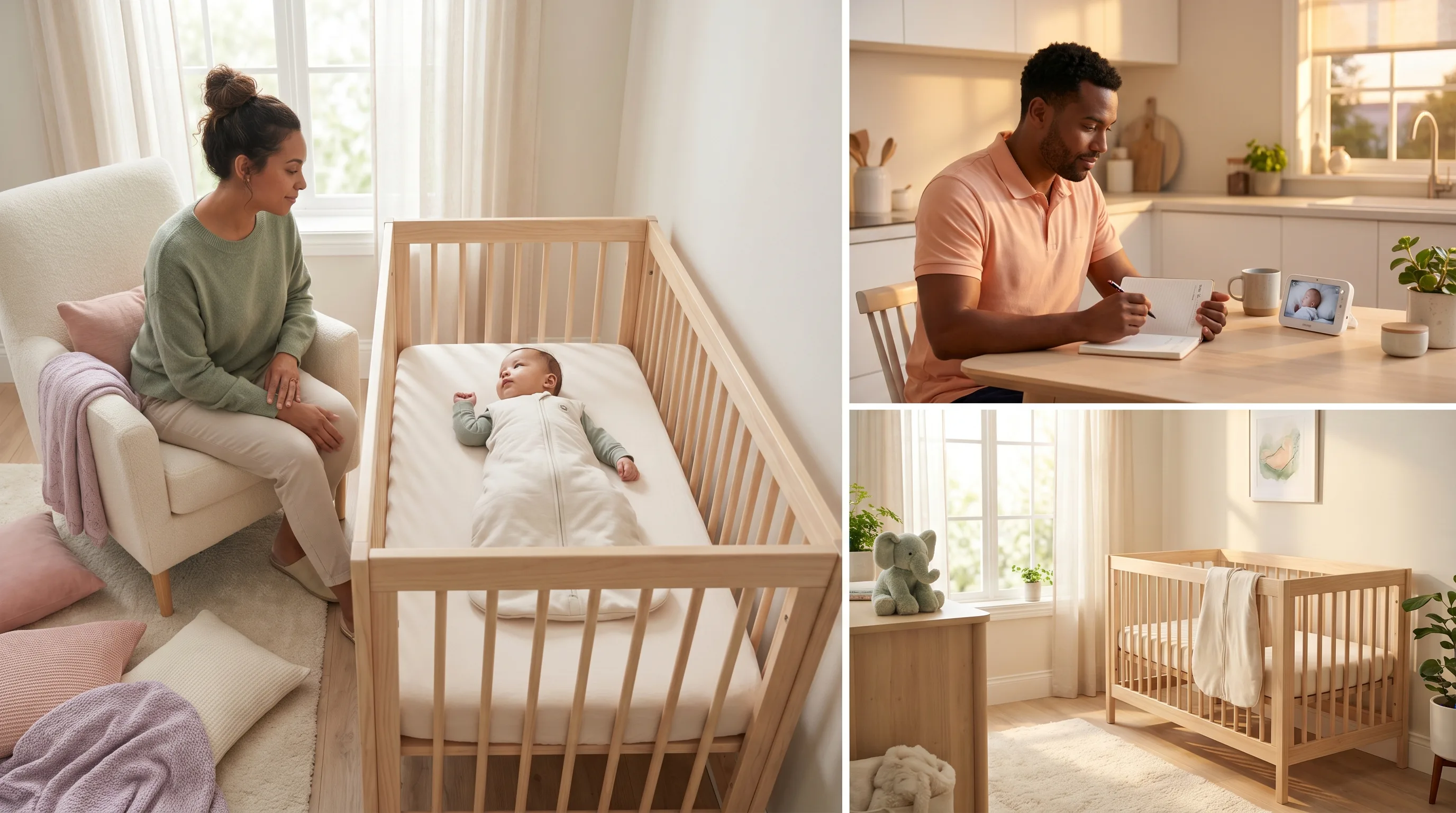
Is your baby sleeping enough? Or too much? This is one of the questions parents ask most often in the first year. Here is the complete overview of sleep needs by age, based on WHO, AAP, and international guidelines.
Sleep Needs by Age. Complete Chart
This table gives you a quick overview of recommended sleep hours per day. The figures are based on guidelines from the American Academy of Pediatrics (AAP) and the American Academy of Sleep Medicine (AASM).
| Age | Total sleep need | Night sleep | Daytime sleep | Number of naps |
|---|---|---|---|---|
| 0–3 months | 14–17 hours | 8–9 hours | 6–8 hours | 4–6 |
| 3–6 months | 12–15 hours | 9–10 hours | 3–5 hours | 3–4 |
| 6–9 months | 12–15 hours | 10–11 hours | 2–3 hours | 2–3 |
| 9–12 months | 12–14 hours | 10–12 hours | 2–3 hours | 2 |
| 1–1.5 years | 11–14 hours | 10–12 hours | 1.5–3 hours | 1–2 |
| 1.5–2 years | 11–14 hours | 10–12 hours | 1–2.5 hours | 1 |
| 2–3 years | 10–13 hours | 10–12 hours | 0–2 hours | 0–1 |
Important: The table shows the typical range. Every baby is unique, and healthy babies can fall slightly above or below these numbers. Talk to your pediatrician if you have any concerns.
Newborn 0–3 Months: 14–17 Hours
Newborns sleep the most of all, but rarely more than 2–4 hours at a stretch. Sleep is evenly distributed between day and night, because newborns haven't yet developed a circadian rhythm.
How sleep is distributed:
- Night sleep: 8–9 hours (spread across multiple periods with feeds in between)
- Daytime sleep: 6–8 hours (4–6 short naps)
- Awake window: 35–90 minutes
According to the AAP, it's completely normal for newborns not to distinguish between day and night in the first few weeks. You can help your baby by keeping things bright and active during the day, and dark and quiet at night.
What you can do:
- Don't try to establish fixed routines yet
- Let your baby sleep when they're tired
- Offer feeds on demand, including at night
- Keep night feeds calm and with dimmed light
Baby 3–6 Months: 12–15 Hours
Around 3–4 months, an important change happens. Your baby starts producing melatonin and develops more mature sleep architecture. This means longer stretches at night and more distinct daytime naps.
How sleep is distributed:
- Night sleep: 9–10 hours (some babies sleep 5–6 hours at a stretch)
- Daytime sleep: 3–5 hours (3–4 naps)
- Awake window: 1.5–2.5 hours
This is the period when many babies experience the so-called 4-month sleep regression. Your baby wakes more often because sleep cycles are maturing. It's temporary and completely normal.
Tip: This is a good time to start simple bedtime routines. Bath, feed, book, bed, keep it short and predictable.
Baby 6–12 Months: 12–15 Hours
Sleep consolidates. Most babies sleep 10–12 hours at night and take 2 naps during the day. Some sleep through the night, but wakings are still common.
How sleep is distributed:
- Night sleep: 10–12 hours
- Daytime sleep: 2–3 hours (2 naps)
- Awake window: 2–3.5 hours (see the awake window guide)
Around 8–10 months, many babies transition from 3 to 2 naps. Signs your baby is ready: they consistently refuse the third nap, or take a very long time to fall asleep for it.
Common challenges in this period:
- Separation anxiety can make falling asleep harder
- Motor development (crawling, pulling to stand) disrupts sleep
- Teething can cause restless nights

Toddler 1–2 Years: 11–14 Hours
The big transition in this period is from two naps to one. Most children make this shift between 12 and 18 months. Don't rush the transition, wait until your child consistently refuses one of the naps for at least 2 weeks.
How sleep is distributed:
- Night sleep: 10–12 hours
- Daytime sleep: 1.5–3 hours (1 nap, midday)
- Awake window: 4–6 hours
The AAP recommends 11–14 hours of sleep for children between 1 and 2 years. A consistent bedtime and a fixed evening routine are more important than ever.
Tips for the transition to one nap:
- Schedule the nap for midday (around 12–1 pm)
- Move bedtime a little earlier during the first few weeks
- Expect some extra-tired afternoons during the adjustment period
Toddler 2–3 Years: 10–13 Hours
Some 2-year-olds drop their daytime nap entirely, while others need it until age 3–4. Both are normal.
How sleep is distributed:
- Night sleep: 10–12 hours
- Daytime sleep: 0–2 hours (0–1 nap)
- Bedtime: Often between 7:00 pm and 8:00 pm
Signs your child is ready to drop the nap:
- Takes a long time to fall asleep in the evening
- Lies awake in bed during nap time without sleeping
- Functions well without a nap, no meltdowns in the afternoon
- Is older than 2.5 years
Tip: Your pediatrician will often ask about sleep at routine checkups. Bring your sleep log from Babysential, it gives a clearer picture of your child's patterns.
Signs of Too Little Sleep
Not all babies show tiredness in the same way. Here are common signs that your child may not be getting enough sleep:
- Frequent crying and irritability, especially toward the end of the day
- Difficulty falling asleep, paradoxically, overtired children have a harder time falling asleep
- Many night wakings, sleep deficit leads to more restless nights
- Short attention span, can't engage in play
- Increased clumsiness, falls more often, poorer motor control
- Difficult morning wake-up, hard to rouse, cranky and clingy
Persistent sleep deprivation can affect mood, development, and immunity. Talk to your pediatrician if you recognize several of these signs over time.
Signs Your Baby Is Getting Enough Sleep
When sleep needs are met, you can see it in your child:
- Wakes on their own, often in a good mood
- Is alert and curious during awake periods
- Falls asleep relatively easily at bedtime
- Is in a good mood for most of the day
- Is developing normally, both physically and socially
- Functions well between naps without becoming overtired
How to Track Sleep Patterns
It's not always easy to know whether your baby is actually getting enough sleep. A simple way to find out is to log sleep for a few days.
With the Babysential Sleep Tracker you can:
- Record sleep and wakings with one tap
- See total hours per day, automatically calculated
- Compare with recommendations for your baby's age
- Spot patterns, when are the best nap times, what works?
- Share with your pediatrician if needed
It takes only a few seconds to log each sleep session. After 3–5 days, you'll have a clear picture of whether your baby is within the normal range.
Start sleep tracking with Babysential, completely free.
Common Questions
How much does a newborn sleep per day?
Newborns typically sleep 14–17 hours per day, spread across many short periods. It's normal for them never to sleep more than 2–4 hours in a row during the first weeks.
When do babies start sleeping through the night?
Most babies can sleep 6–8 hours in a row around 4–6 months of age, but there are significant individual differences. Some do it earlier, others later. Night feeds may still be necessary until 9–12 months.
Should I wake my baby to feed?
During the first few weeks it may be necessary to wake newborns to feed if they sleep more than 3–4 hours in a row, especially with low birth weight. Talk to your midwife or pediatrician about what applies to your baby.
Is it dangerous if my baby sleeps too much?
Most babies regulate their own sleep. But if a baby suddenly sleeps much more than usual, is limp, and difficult to rouse, you should contact a doctor. Increased sleep need can be a sign of illness.
When do children drop the daytime nap?
Most children drop the daytime nap between ages 2.5 and 4. Some are done with napping by age 2, while others need it until they start school. Follow your child's cues.
Summary
Sleep needs change quickly during the first year of life. From 14–17 hours as a newborn, to 10–13 hours as a 3-year-old. The most important thing is not to hit an exact number of hours, but to recognize whether your child is getting enough sleep.
Use the table as guidance. Observe your child's signals. And remember that individual variation is completely normal, there is no one-size-fits-all answer.
Try the Babysential Sleep Tracker to log sleep and see whether your baby is within the recommended range for their age.
Read More
- Age-by-age tips for parents, sleep, feeding, and routines tailored to your baby's age
- Checklist: Safe sleep, make sure your sleep environment is safe for your baby
- Wake window guide by age
- Sleep routines for baby
- Baby not sleeping at night
- Safe sleep for baby
- Babysential Sleep Tracker, free baby sleep app
Sources
- American Academy of Pediatrics. Healthy Sleep
- AASM. Pediatric Sleep Duration Consensus
- National Sleep Foundation. Sleep in children
🔧 Helpful Tools
- Baby Sleep Tracker. Track and optimize your baby's sleep
- Soothing Sounds. White noise and soothing sounds to help your baby sleep
- All Baby Tools. Browse all free tools for pregnancy and baby care
📖 Related Articles
- Baby Sleep Schedule by Age. Newborn to 12 Months. Practical sleep schedules for babies by age. See sample daily routines, number of naps, and bedtimes from 0–12 months based on AAP and WHO recommendations.