It's three in the morning. The baby is awake for the fourth time. You're so exhausted you can barely keep your eyes open. It's tempting to just bring the baby into bed and sleep together. But is it safe?
Co-sleeping is a topic that stirs strong opinions. Here we look at what health authorities actually recommend, what the research shows, and what alternatives exist.
What Do We Mean by Co-Sleeping?
The term "co-sleeping" covers two different practices, and it's important to distinguish between them:
Bed-sharing: The baby sleeps in the same bed as the parents.
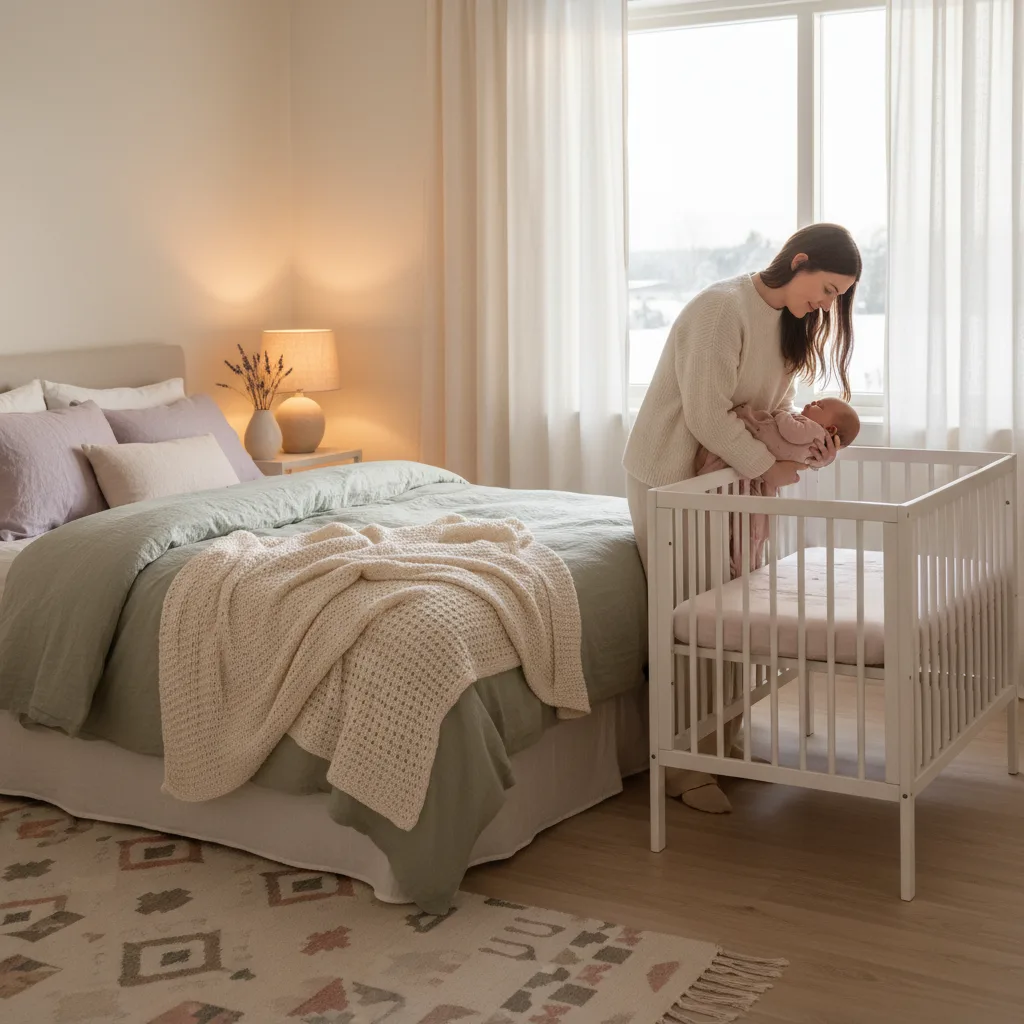
Room-sharing: The baby sleeps in their own sleep space (crib, bedside crib, bassinet) in the parents' bedroom.
The WHO and AAP recommend room-sharing. They do not recommend bed-sharing.
The WHO and the American Academy of Pediatrics (AAP) recommend that babies sleep in their own sleep space in the parents' bedroom for at least the first 6 months. Sharing a bed with your baby is not recommended because it increases the risk of SIDS (sudden infant death syndrome).
What Do the Guidelines Say?
The AAP is clear: babies should sleep in their own sleep space, a crib, bassinet, or bedside sleeper, in the same room as the parents.
Key safe sleep recommendations from the WHO and AAP:
- Always place the baby on their back to sleep
- Baby sleeps in their own sleep space in the parents' room for at least the first 6 months
- Use a firm, flat sleep surface with a fitted sheet, no loose bedding
- Do not smoke during pregnancy or after birth
- Keep the sleep environment at a comfortable temperature, not too warm
The reason room-sharing is recommended is that it makes it easier to hear and respond to your baby, without the risks that come with sharing a bed.
Why Is Bed-Sharing Discouraged?
Research shows that sharing a bed with your baby increases the risk of SIDS, particularly when combined with certain risk factors.
Risk Factors That Make Bed-Sharing Dangerous
High risk, never bed-share if:
- Either parent smokes or vapes (even if not in the bedroom), or the mother smoked or vaped during pregnancy
- Either parent has consumed alcohol
- Either parent has taken sleep medication, sedatives, or drugs
- The baby was premature (born before 37 weeks) or had a low birth weight
- Either parent is extremely exhausted (risk of sleeping more deeply than usual)
Increased risk generally:
- Soft mattresses, duvets, and pillows near the baby
- Sofa or armchair (very dangerous, never fall asleep with your baby on a sofa)
- Baby is under 3 months old
Falling asleep with your baby on a sofa or armchair is especially dangerous and carries the highest risk of SIDS. If you are tired and breastfeeding at night, sit up in bed, never on the sofa.
The Benefits of Room-Sharing
Room-sharing, where the baby sleeps in their own sleep space in the parents' bedroom, has several well-documented benefits:
- Reduced SIDS risk: Studies show room-sharing can reduce the risk of SIDS by up to 50 percent compared to the baby sleeping alone in a separate room
- Easier night feeding: You only need to reach over to your baby, not walk to another room
- Faster response: You hear immediately when the baby needs you
- Peace of mind for parents: Many new parents sleep better when they can see and hear their baby
Bedside Crib. The Best of Both Worlds?
A bedside crib (also called a bedside sleeper or side-car crib) is a baby bed that attaches to the side of the parents' bed with one open side. The baby has their own sleep space with their own mattress, but lies right next to you.
Benefits:
- Baby sleeps safely on their own firm, flat mattress
- You can reach over to your baby for feeding and comfort
- Easy transition to breastfeeding at night without getting up
- Meets the recommendation for a separate sleep surface
Remember:
- Attach the bedside crib securely to the parents' bed with no gaps
- Use the correct mattress for the bedside crib
- No pillows, duvets, or soft items in the baby's sleep area
- Baby should always be on their back
Night Feeding and Sleep Deprivation
The most common reason parents bring the baby into bed is exhaustion during night feeds. This is a real challenge that deserves a practical response.
Safer Alternatives for Night Feeding
Feed in bed with a plan: Sit up in bed with good support. Finish the feed, then place the baby back in their own sleep space. Keep a nightlight handy so you don't have to switch on the main light.
Bedside crib: The baby lies right next to you. You can feed lying down and gently move the baby back to their own space afterwards.
Share night duties: If there are two parents, take turns with night wake-ups. One takes the early part of the night, the other handles the second half.
Expressed milk: If you're breastfeeding, your partner can give expressed milk by bottle at night so you get a longer stretch of sleep.
Use a sleep tracker to monitor your baby's sleep patterns. It makes it easier to plan night duties and identify patterns in wake-ups.
If You Do End Up Bed-Sharing
Even though health authorities advise against it, many parents do end up bringing their baby into bed, whether planned or not. If it happens, it's better to do it as safely as possible than to pretend it isn't happening.
Risk-reduction steps (these do NOT replace the recommendation for a separate sleep surface):
- Place the baby on their back, between the mother and the edge of the bed (not between two adults)
- Use a firm mattress, not a waterbed
- Remove all pillows, duvets, and soft items from the baby's area
- Baby sleeps in a sleep sack, not under the adult duvet
- No pets in the bed
- Never if either parent has consumed alcohol, smokes or vapes, or has taken medication that causes drowsiness
- Never on a sofa or armchair
- Never if the baby was premature or had a low birth weight
Cultural Context
Co-sleeping is common in many cultures around the world and has been practiced for thousands of years. In Japan, for example, it is normal for the whole family to sleep together on futons side by side.
In Western countries, the trend has moved toward babies sleeping in their own sleep space, based on research showing a link between bed-sharing and SIDS, particularly in combination with smoking, alcohol, and soft bedding.
There is ongoing international debate about how large the risk is for otherwise healthy babies with no risk factors present. Some researchers argue that safe bed-sharing with all risk factors absent carries a low level of risk. Current WHO and AAP guidelines nonetheless recommend a separate sleep surface.
When Can the Baby Move to Their Own Room?
The AAP recommends room-sharing for at least the first 6 months. After that, you can consider moving the baby to their own room if you wish.
Signs your baby may be ready for their own room:
- Baby is sleeping for longer stretches at night
- You are disturbing each other's sleep (baby wakes from parents' movements)
- Baby is over 6 months old and in good health
Using a baby monitor can give you extra peace of mind during the first weeks in a separate room.
Frequently Asked Questions
Is it dangerous to fall asleep while breastfeeding?
It can be risky, especially on a sofa or armchair. If you're very tired and feeding in bed, remove pillows and duvets from around the baby beforehand. After feeding, place the baby back in their own sleep space. A bedside crib makes the transition easier.
What if my baby only wants to sleep on me?
Many newborns prefer body contact. This is normal and about feeling safe. Try placing the baby in their own sleep space when they are in deep sleep (limp arms and legs). Swaddling can give a similar sense of security. Most babies gradually learn to sleep in their own space with time.
Does co-sleeping reduce the risk of SIDS?
Room-sharing (baby in their own sleep space in the parents' room) reduces the risk of SIDS. Bed-sharing increases the risk, according to WHO and AAP guidance. This is why room-sharing is recommended.
Read More
- Safe Sleep and SIDS Prevention, guidelines and risk reduction
- Sleep Routines for Newborns, the first weeks
- Sleep Tracker, monitor your baby's sleep
- Sleep Cues in Babies, recognizing tiredness signals
- Checklists for New Parents, everything you need
Sources
- AAP (American Academy of Pediatrics). "Safe Sleep Recommendations." healthychildren.org
- WHO. "Infant and Young Child Feeding." who.int
- Moon RY, et al. "SIDS and Other Sleep-Related Infant Deaths: Updated 2022 Recommendations." Pediatrics.
- AAP (American Academy of Pediatrics). "A Parent's Guide to Safe Sleep." Updated September 2026. healthychildren.org
🔧 Helpful Tools
- Baby Sleep Tracker. Track and optimize your baby's sleep
- Soothing Sounds. White noise and soothing sounds to help your baby sleep
- All Baby Tools. Browse all free tools for pregnancy and baby care
📖 Related Articles
- Bedtime Routines That Actually Work. Better Sleep for Your Baby. Build a bedtime routine that gives your baby and toddler better sleep. Step-by-step evening routines by age, from newborn to 2 years old.
- From Co-Sleeping to Crib: A Step-by-Step Guide. Have you been nursing to sleep and co-sleeping with your baby? Here is a gentle, detailed guide for transitioning to crib sleep, without tears and without guilt.
- Baby Crying a Lot: Colic and Other Causes. Why is your baby crying so much? Learn about colic, the 3-3-3 rule, soothing techniques, and when to contact a doctor. A practical guide for new parents.