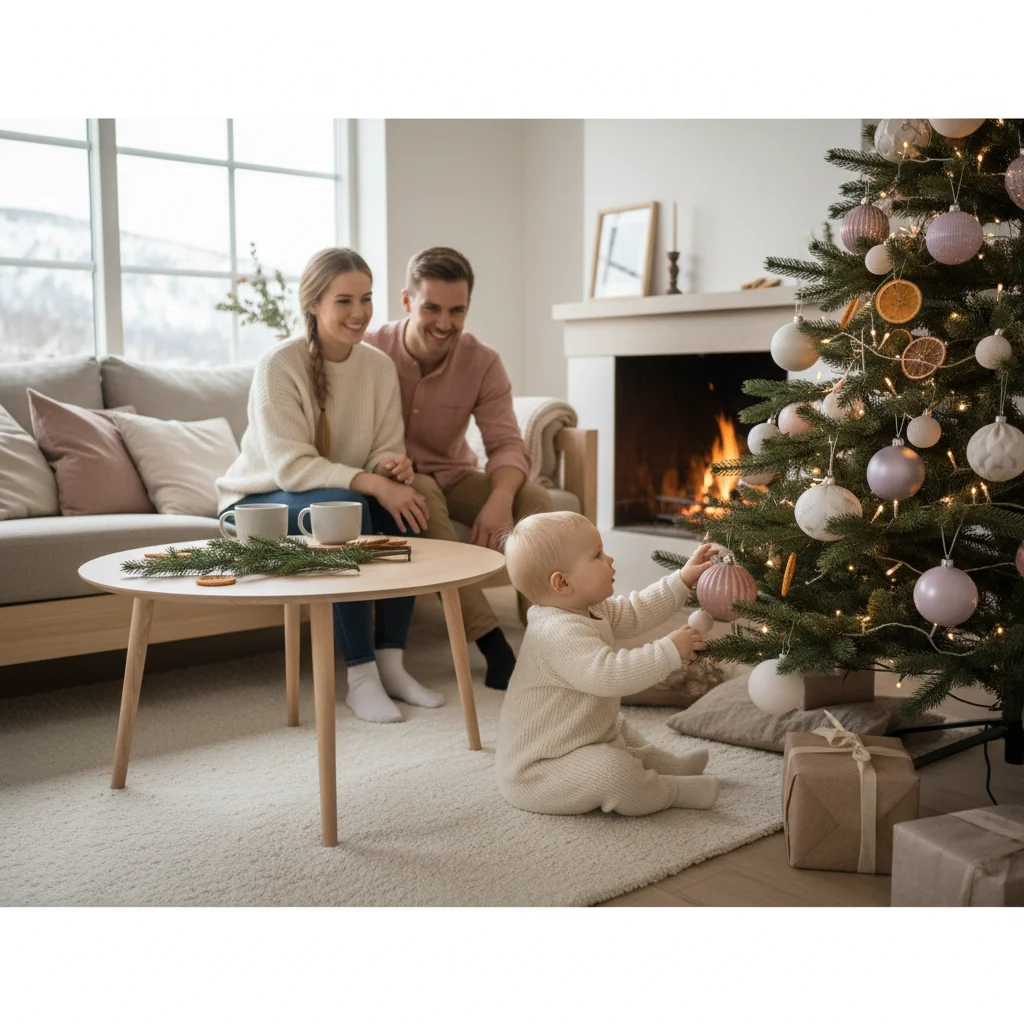
The first Christmas tree reflected in your baby's eyes. The smell of gingerbread mixed with baby shampoo. And a Christmas card with a tiny hand pressed in red paint. Baby's first Christmas isn't about the perfect celebration, it's about creating warm memories without stressing through December.
Here are practical tips for a safe, relaxed, and memorable Christmas with the littlest member of your family.
Safe Christmas Decorations with a Baby
Christmas decorations that glitter and sparkle are irresistible to little hands. A few adjustments make December safe without sacrificing the holiday spirit.
The Christmas Tree
Placement: Put the tree in a corner or behind a baby gate if your baby crawls. A falling tree can be dangerous, secure it to the wall with a cord or use a stable tree stand.
Decorate the top half: Place the nicest ornaments up high, out of reach. The bottom half can have soft, unbreakable decorations like felt figures, fabric balls, and wooden ornaments. Skip glass baubles where baby can reach them.
Lights: Use LED lights instead of candles in and around the tree. LED lights don't get hot and are safe even if baby gets hold of them.
Choking hazard: Small decorations like glitter balls, beads, snowflake confetti, and tiny figurines are choking hazards for babies. Anything under 1.5 inches (3–4 cm) in diameter should be kept out of reach. Tinsel and lametta are also dangerous if baby puts them in their mouth.
Candles
Candles are part of holiday tradition, but they require extra attention with a baby in the house. Place candleholders high up, on a shelf baby can't reach, or use LED pillar candles that look surprisingly realistic. Never leave real candles unattended, and remember that babies develop new skills quickly. The child who couldn't reach something last week might be able to this week.
Age-Appropriate Christmas Activities
Babies don't need big experiences. The simple things make the biggest impression.
0–6 Months
- Watch Christmas lights, babies love lights and contrast. Soft lighting with Christmas lights is pure magic for little eyes
- Christmas music, play gentle holiday melodies. Babies respond to music from birth
- Handprint ornament, use baby-safe paint or a clay imprint kit for a keepsake you'll treasure forever
- A Christmas book, read a picture book with Christmas images. Baby doesn't understand the words but loves your voice and the colorful pictures
6–12 Months
- Unwrapping gifts, the rustling paper is at least as exciting as the gift inside. Let baby tear at paper under supervision
- Gingerbread baking, let baby taste the dough (after 6 months), feel the flour, and play with cookie cutters
- Mittens in the snow, if there's snow, let baby feel it for a brief moment. The surprised reaction is priceless
1–3 Years
- Decorating the tree, give your toddler some unbreakable ornaments to hang
- Gingerbread house, ready-made kits where the child can stick on candy
- Christmas songs with movements, classic children's songs with a holiday twist
- Advent calendar, simple calendar with a small surprise per day (sticker, figurine, fruit)
Memory book: Document baby's first Christmas. Take a photo of baby in front of the Christmas tree, with Santa (if baby is willing, never force it!), and of the first attempt at unwrapping a gift. These photos become invaluable.
Food and Treats at Christmas
Holiday food offers many new flavors for a baby who has started solid foods. But some traditions suit little ones better than others.
Safe Christmas Food for Babies Over 6 Months
- Cooked potatoes and root vegetables, perfect finger food
- Tender roasted meat without bones, soft, flavorful pieces (avoid salty crust)
- Rice pudding, warm, soft, and filling (cow's milk as a taste from 10 months, full portions from 12 months)
- Fruit and berries, clementine, banana, blueberries
- Gingerbread cookies. OK as a taste after 6 months, but contains sugar
Avoid for Babies Under 1 Year
- Whole nuts and almonds, choking hazard (nut butter is OK from 6 months)
- Honey, risk of botulism in children under 1 year
- Marzipan with whole almonds, choking hazard
- Salty food, ham and cured meats have high salt content
- Candy, sugar, choking hazard, and no nutritional value
Allergens in Christmas food: Many holiday dishes contain common allergens like nuts, eggs, milk, and gluten. If baby hasn't tried these before, introduce them one at a time in the days before Christmas Eve, not in the middle of the holiday dinner. Check age-appropriate food recommendations from your pediatrician.
Christmas Gifts for Babies
Babies under one year don't care about gifts, they care about attention, closeness, and routines. Save the budget and give something simple and meaningful instead.
Good gifts for babies:
- A book with textures and flaps
- Wooden stacking blocks
- A soft cuddly toy
- Sensory ball or rattle toy
- Baby's first Christmas ornament (for the tree every year)
Gifts that last:
- Savings account for the child's future
- Framed photo from the first Christmas celebration
- A letter to baby to be opened in 18 years
The best gifts are often the simplest. A child under one year is just as happy with the wrapping paper as with the gift.
Stick to the Routines
The biggest challenge with Christmas and a baby isn't the decorations or the food, it's sleep. Family visits, traveling, new surroundings, and changed routines can turn sleep patterns upside down.
Tips for getting through Christmas with sleep intact:
- Prioritize bedtime, even if dinner isn't over, put baby down when it's sleep time
- Bring familiar things, favorite pacifier, comfort blanket, sleep sack that smells like home
- Plan quiet breaks, retreat from the gathering for quiet moments
- Say no to too much, baby doesn't need to meet all the relatives in one day
- Accept that things will be different, some nights will be worse, and that's OK
Family Celebrations and Boundary Setting
Grandparents who want to hold baby all the time. The aunt who insists on feeding the baby rice pudding. The uncle who thinks baby should stay up until midnight. Christmas brings families together, and sometimes it's necessary to set boundaries.
You know your child best. If baby is tired, needs rest, or doesn't want to be held by unfamiliar people, it's perfectly fine to speak up. A short, friendly message is enough: "They need some quiet time now, we'll be back soon."
Frequently Asked Questions
Should baby meet Santa?
Many babies under 1 year get scared of Santa. The large, unfamiliar figure with a beard can trigger stranger anxiety. Don't force your child to sit on Santa's lap for the sake of a photo. Take the photo from a distance, or wait until the child is older and can decide for themselves.
Can baby have a Christmas tree in the bedroom?
Electric Christmas lights (LED) in the bedroom are safe, but remember that light can disturb sleep. Turn off the lights at least 30 minutes before bedtime. Avoid blinking lights in the bedroom. A small tree with soft lights can provide a cozy atmosphere during evening routines and lullabies.
How do we handle traveling between families at Christmas?
Plan travel around baby's sleep schedule. Short trips go between naps. Long trips are timed with sleep time. Bring everything baby needs for sleep (sleep sack, comfort item) and be prepared to put baby down in a quiet corner at your host's home. Limit the number of visits per day.
Is it safe to have baby in cold temperatures outside at Christmas?
Yes, fresh winter air is good for baby. Dress the child in layers, protect hands, feet, and head. Check that baby isn't too warm (sweaty neck) or too cold (cold hands and bluish lips). Short outings are fine even for newborns, but avoid extreme cold below 14°F (-10°C) for the youngest babies.
Sources
🔧 Helpful Tools
- Baby Milestones Tracker. Track your baby's developmental milestones
- All Baby Tools. Browse all free tools for pregnancy and baby care
📖 Related Articles
- Christmas with Baby and Toddler: A Safe and Cozy Holiday. Complete guide to Christmas with baby and toddler. Safe gifts, holiday food for the little ones, sleep routines during the holidays, and tips for a relaxed family Christmas.
- Naming Ceremony. Complete Guide to Planning and Celebrating. Everything about a baby naming ceremony. Planning, program, food, and decorations. How to host a beautiful naming celebration.