Your baby is screaming with their legs drawn up, and nothing seems to help. Maybe the answer is in your hands, literally.
Baby massage is a simple way to soothe your baby, relieve gas pain, and strengthen the bond between you. Health organizations recommend baby massage as a measure against colic. Here's everything you need to get started.
What Is Baby Massage?
Baby massage involves gentle, rhythmic strokes and movements adapted for infants. The most widely used method was developed by Vimala S. McClure and combines Indian baby massage, Swedish classical massage, and relaxation exercises.
Courses are offered through the International Association of Infant Massage (IAIM) in many countries. Many pediatrician offices and family centers also offer classes.
When Can You Start Baby Massage?
You can begin with gentle stroking from birth. Full massage is recommended from around one month of age.
- 0–4 weeks: Light stroking and skin-to-skin contact
- From 1 month: Full massage with oil
- 2–9 months: Ideal age for classes
- After 9–12 months: Still beneficial, but your baby may not have the patience to lie still
A session doesn't need to be long. For newborns, 10 minutes is enough. Older babies may enjoy 15–20 minutes.
Benefits of Baby Massage
Research points to several benefits:
For the baby:
- Better sleep and easier settling, follow up with a Sleep Tracker to see the effect over time
- Relief from gas pain and colic
- Improved digestion and circulation
- Stimulation of skin, sense of touch, and motor skills
- Less crying
For the parents:
- Stronger bonding and interaction with the baby
- Oxytocin is released in both baby and parent
- Can help mothers with postpartum depression
A study by Onozawa et al. (2001) found that baby massage improved the interaction between mother and child in mothers with postpartum depression. Current guidelines recommend skin-to-skin contact as an evidence-based method to strengthen bonding.
Fathers who massaged their baby for 15 minutes before bedtime showed more warmth and closeness in their interactions, according to a study by Cullen and Field (2006).
How to Do It: Baby Massage Step by Step
Preparation
- Room temperature: At least 75°F (24°C)
- Surface: Soft, preferably on the floor (not a changing table, slippery hands with oil)
- Oil: Cold-pressed sunflower oil or grapeseed oil. Check with your pharmacist that the oil is safe for babies
- Have ready: Towel, clean diaper, clothes
Before You Start
Rub oil between your hands, show your baby your hands, and ask: "Would you like a massage?" Your baby will gradually learn to recognize this ritual. It teaches your child respect for their own body from an early age.
Read Your Baby's Signals
Ready for massage:
- Good eye contact
- Relaxed body
- Steady breathing
- Cooing and content sounds
Not ready:
- Avoiding eye contact
- Crying or fussy
- Tense body
- Rapid breathing or mottled skin
Basic Technique
- Legs: Stroke from hip to foot with your whole hand
- Feet: Light circular movements with your thumb on the sole
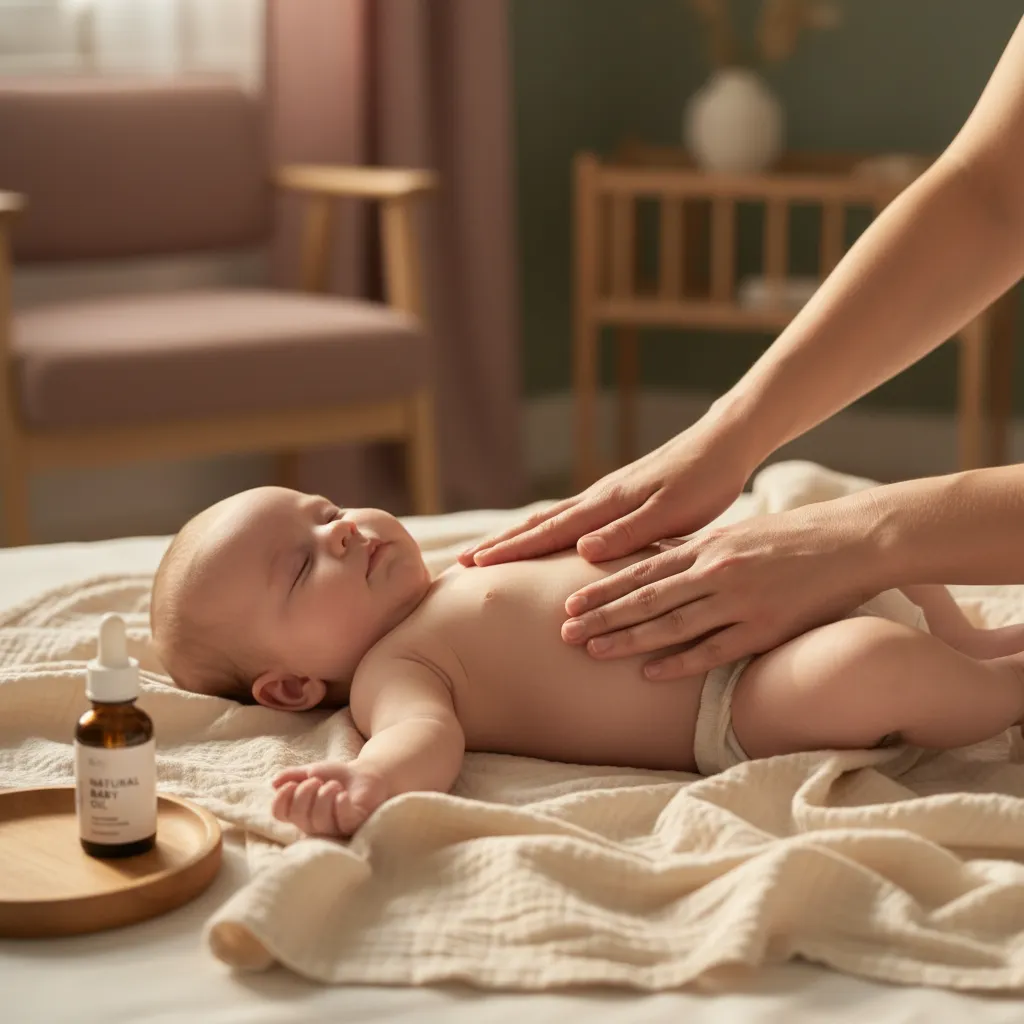
- Tummy: Soft, circular strokes clockwise (following the direction of the intestines)
- Chest: Stroke gently from the center outward
- Arms: Stroke from shoulder to hand
- Back: Place baby on their tummy, stroke from neck to bottom with flat hands
Tummy Massage for Colic
This technique is recommended by IAIM-certified instructors. The routine takes 5–10 minutes and can be done 2–3 times daily.
The Water Wheel
Place your right hand just below your baby's ribcage and gently draw it toward you, as if scooping sand. Do the same with your left hand. Continue alternating in a steady rhythm, 6 strokes with each hand.
Knees to Tummy
Gather your baby's knees and gently press them toward the tummy. Hold for 6 seconds. Release gently and shake them lightly.
Sun and Moon
Place your left hand on the lower part of the tummy. Make a full clockwise circle around the tummy (the sun). Then place your right hand on the upper part and make a half circle on the left side (the moon). Alternate between sun and moon, 6 times.
One Round of Colic Massage
- 6 water wheel strokes with each hand
- Knees to tummy
- 6 sun and moon
- Knees to tummy
- Repeat the entire round 3 times
Try to massage 30 minutes BEFORE you expect your baby to become fussy. It may take 1–2 weeks before you see results.
When Should You NOT Massage?
- When the baby is sick
- Right after vaccinations (the injection site may be sore)
- Right after feeding, wait at least 30 minutes
- When the baby clearly shows they don't want it
Where to Find Baby Massage Classes
- Pediatrician offices and family centers: Many offer baby massage as part of their services
- IAIM-certified instructors: Available in many countries worldwide
- Private clinics: Chiropractors, physiotherapists, and osteopaths
- Online courses: Several providers offer digital classes
A typical course has 5 sessions, once a week, lasting about 1 hour. The instructor demonstrates on a doll, and you practice on your own baby.

Frequently Asked Questions
How do you massage a baby's tummy?
Use soft, circular movements clockwise around the navel. This follows the natural direction of the intestines and aids digestion. See the colic massage routine above for a complete technique.
Does baby massage help with colic?
Health organizations mention baby massage as a measure parents can try for colic. Regular tummy massage can relieve gas pain and improve digestion. It may take 1–2 weeks of daily massage before you notice results.
What oil should I use?
Cold-pressed sunflower oil or grapeseed oil are safe choices. Avoid perfumed oils. Check with your pharmacist if you're unsure. Avoid oil on the face.
Summary
Baby massage is a safe, simple, and free way to strengthen the bond with your baby. You don't need a course to start, just warm hands and a little oil. But if you want to learn more, there are great courses available through IAIM instructors worldwide.
Start with short sessions and follow your baby's signals. If your baby has colic, the tummy massage routine above can provide relief. Massage is also a great complement to baby's first bath as part of a soothing bedtime routine.
Sources
- WHO - Infant and young child feeding
- AAP - Caring for Your Newborn
- International Association of Infant Massage (IAIM)
- Onozawa K, et al. (2001). Infant massage improves mother-infant interaction for mothers with postnatal depression. Journal of Affective Disorders.
- Cullen C, Field T. (2006). Massage reduces anxiety in child and adolescent psychiatric patients. Journal of the American Academy of Child & Adolescent Psychiatry.
🔧 Helpful Tools
- Baby Milestones Tracker. Track your baby's developmental milestones
- All Baby Tools. Browse all free tools for pregnancy and baby care