You do not need a basket of expensive toys to play baby games well; most babies would choose your face, your voice, and a safe spoon on the floor anyway.
This guide gives you practical baby games for the first year, sorted by age and purpose. It also explains when play should be quiet, when it can support feeding skills, and when to stop because your baby has had enough.
The best baby games are short, safe, and responsive: watch what your baby does, copy it back, then add one tiny next step. A few minutes of face-to-face play can be more useful than a full playroom of toys.
Key Takeaways
- Your face is the first toy. Newborn games work best when they use voices, expressions, touch, and closeness.
- Floor play matters. Supervised tummy time and reaching games support movement practice during the first year.
- Screens are not needed. AAP guidance recommends avoiding screen media for children under 18 months except video chatting.
- Feeding can become play around 6 months. Once readiness signs are present, soft textures, cup practice, and naming foods help babies learn.
- Stop before your baby melts down. Looking away, stiffening, hiccuping, rubbing eyes, or fussing can mean "break, please."
Quick Chooser: What Baby Game Should You Try Right Now?
| Baby's mood | Try this | Keep it short |
|---|---|---|
| Calm and alert | Face copying, singing, board book | 2-5 minutes |
| Wiggly and energetic | Tummy time toy reach, rolling helper, bicycle legs | 1-3 minutes at a time |
| Curious at meals | Name the food, spoon practice, soft finger-food pick-up | One food or skill at a time |
| Fussy but not hungry | Slow song, mirror chat, gentle rhythm game | Stop if fussing builds |
| Sleepy | Quiet cuddle, soft voice, one familiar song | Skip active play |
Babysential Team builds these guides from public-health sources, pediatric guidance, and practical parent workflows. AI-supported drafting helps organize the research.
What Games Can I Play With My Baby?
The easiest baby games are back-and-forth games. You smile, pause, and wait. Your baby blinks, coos, kicks, or looks at you. You answer with a sound, a smile, or a gentle touch.
That pattern is more powerful than it looks. CDC milestone guidance for 6 months includes responsive play such as copying sounds, reading with pictures, music, floor play, and placing toys just out of reach so a baby can practice reaching.
Start with these seven games:
- Face mirror: Hold your face 8-12 inches from a newborn and slowly change expressions.
- Copy the sound: If your baby says "ah," say "ah" back and wait.
- Slow song with pauses: Sing one line, pause, and let your baby kick or babble before the next line.
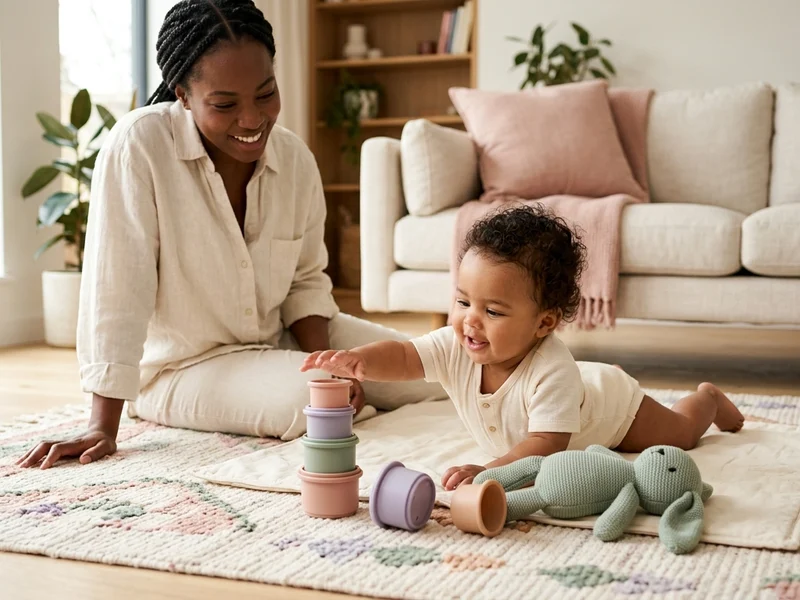
- Tummy-time target: Put a soft toy slightly to one side during awake, supervised tummy time.
- Peekaboo: Hide behind your hands or a cloth, then reappear gently.
- Texture tour: Let your baby touch a soft blanket, smooth cup, cool spoon, or crinkly cloth.
- Food naming: At solids age, say "banana," "soft," "squish," and "more" while your baby explores safely.
If you want to track which skills your baby is practicing, use Milestones to follow play, movement, and communication by age. For more context on expected ranges, read Baby Developmental Milestones by Month. For food exploration, SmartStart, our baby food guide, helps match foods to age and readiness.
How Do You Play With a Newborn?
Newborn games are tiny. A newborn is not bored because they are not stacking blocks yet; they are working hard just to look, listen, feed, sleep, and settle.
Try these newborn games during a calm, awake window:
- Voice map: Talk from one side, then the other, and watch whether your baby quiets or turns.
- High-contrast look: Show a black-and-white card or board book for a few seconds.
- Skin-to-skin song: Hold your baby close and hum one familiar tune.
- Gentle touch pattern: Stroke one arm, pause, then the other arm.
- Mini tummy time: Place your baby tummy-down on your chest while awake and supervised.
Johns Hopkins safe-sleep guidance supports awake, supervised tummy time soon after coming home, gradually increasing as tolerated. Keep sleep separate: babies should still be placed on their backs for sleep.
A newborn's stop signals matter. If your baby looks away, splays fingers, hiccups, arches, cries, or gets glassy-eyed, end the game. That is not failure; that is communication.
When Do Newborns Start to Play?
Newborns start "playing" before play looks like play. In the first weeks, play is looking at your face, hearing your voice, feeling safe contact, and practicing tiny movements.
By 2-3 months, many babies spend longer periods alert and may start smiling socially, cooing, and watching moving faces. By 4-6 months, play often becomes more active: reaching, rolling practice, mouthing safe objects, laughing, and responding to songs.
Use the age ranges as a map, not a scoreboard. A baby born early, a baby recovering from illness, or a baby who is tired after daycare may need a different pace.
Baby Games by Age
0-3 Months: Face, Voice, and Gentle Movement
At this age, your baby needs closeness more than entertainment. Choose one game, do it slowly, and stop while it is still going well.
- Eyebrow theater: Raise your eyebrows, smile, and pause. Babies often prefer slow, exaggerated expressions.
- Narrate the room: "Light. Window. Blue cup. Daddy's voice." The point is rhythm and connection, not vocabulary drills.
- Chest tummy time: Recline slightly and let your baby lift their head against your chest.
- Rattle left, rattle right: Use a soft sound toy and move it slowly, never close to the ear.
- Bath rhyme: During a normal bath, sing the same short song each time so the routine becomes predictable.
Skip loud toys, fast movement, and long sessions. A two-minute game can be plenty.
4-6 Months: Reaching, Rolling, and First Laughs
From 4 to 6 months, many babies start improving hand-eye coordination and bringing safe objects to the mouth. Mayo Clinic describes learning and play as closely linked at this stage, with talking, music, reading, peekaboo, patty-cake, and supervised tummy time as useful ideas.
Good games for this stage:
- Reach and roll: Place a toy just out of reach to one side. Let your baby try, then help if frustration rises.
- Sock surprise: Put a bright sock on one foot and let your baby discover it.
- Mirror chat: Use a baby-safe mirror and label faces: "baby," "mama," "smile."
- Pat-a-cake preview: Gently clap your baby's hands together if they enjoy it.
- Drop and return: Drop a soft toy from your hand into a basket, then give it back.
This is also a good stage to build a rhythm around sleep and awake windows. If play seems to collide with naps every day, Hush, our sleep tracker, can help you spot patterns.
6-9 Months: Sitting, Grasping, and Food Curiosity
Around 6 months, play often moves to the floor, the high chair, and your lap. Babies may sit with support, reach more accurately, pass objects between hands, and show stronger opinions. If floor play is the hard part, Tummy Time for Babies gives a focused progression.
CDC feeding guidance says solids usually begin at about 6 months, not before 4 months, when readiness signs are present. NHS guidance also frames the start of solids as getting used to eating, not eating large amounts.
Feeding games at this stage should be calm and supervised:
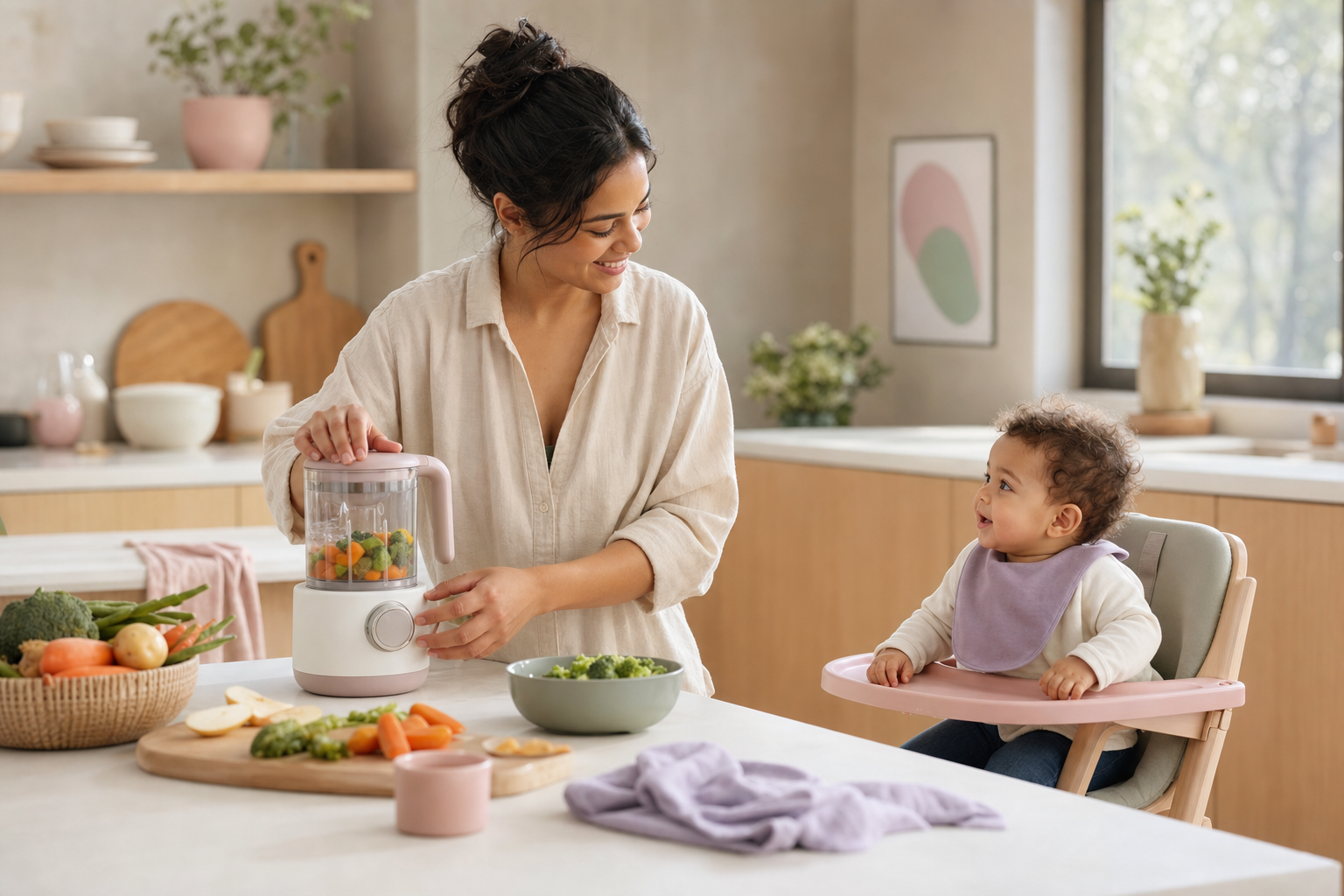
- Name and touch: Let your baby touch ripe avocado, banana, or soft cooked carrot while you name it.
- Spoon handoff: Offer an empty baby spoon to hold while you use another spoon.
- Cup hello: Let your baby hold a small open cup with help and taste a tiny sip of water if your clinician guidance allows.
- Soft pick-up: Offer safe, soft pieces that are small enough to pick up and soft enough to chew.
- More or all done: Model simple signs or words without pressure.
Avoid turning meals into performance. If your baby turns away, clamps their mouth, gags repeatedly, cries, or seems tired, pause.
9-12 Months: Cause, Effect, and Social Games
Older babies often love repetition. They may drop the spoon 12 times because they are learning cause and effect, not because they have a legal strategy.
Try:
- Container in and out: Put soft blocks in a bowl, dump them, repeat.
- Peekaboo variations: Hide behind a napkin, a doorframe, or your hands.
- Roll the ball: Sit facing each other and roll a soft ball back and forth.
- Copy the clap: Clap once, pause, then see what your baby does.
- Clean-up toss: Put soft toys into a basket together while singing the same line.
- Where did it go? Hide a toy partly under a cloth and let your baby pull it out.
Keep small parts, strings, button batteries, magnets, and hard round foods out of reach. If an object fits fully inside a toilet-paper tube, treat it as a choking risk for babies and toddlers.
How Can I Entertain My Baby Without Screens?
Screens solve adult exhaustion for a few minutes, but babies do not need screen games. AAP guidance recommends minimizing or eliminating media exposure for children under 18 months, except video chatting.
That does not mean every minute needs to be educational. Try a "rotation" with normal household items:
- Kitchen: Wooden spoon, silicone spatula, plastic measuring cups.
- Laundry: Clean socks, soft towel, crinkly washcloth.
- Books: One board book with faces, one with animals, one with high contrast.
- Music: One clapping song, one slow song, one bouncing rhyme.
- Floor: A blanket, a soft ball, a safe mirror, and one toy slightly out of reach.
The trick is to remove clutter. Too many toys can make play harder because your baby keeps switching before they can focus.
What Activities Help a Baby Develop?
Baby development is not one skill. Play can support movement, language, social connection, sensory learning, and feeding.
Use this table when you want a quick match:
| Skill | Baby game | Why it helps |
|---|---|---|
| Neck and trunk strength | Awake, supervised tummy time | Gives practice lifting the head and pushing through arms |
| Hand-eye coordination | Reaching for a toy | Connects looking, reaching, and grasping |
| Language | Songs, books, naming objects | Gives repeated sounds and words in context |
| Social connection | Copying smiles and sounds | Builds back-and-forth interaction |
| Feeding readiness | Spoon holding and texture touch | Lets baby practice safe exploration before meals become bigger |
| Object permanence | Peekaboo and hide-the-toy | Shows that people and objects still exist when hidden |
A 2020 systematic review found tummy time was positively associated with gross motor and total development in infants from 0 to 12 months. Keep it awake and supervised, and use tiny sessions if your baby dislikes it.
Is Tummy Time a Game?
Yes, tummy time can be a game. It does not have to be a grim little workout.
Make it easier:
- Start on your chest, not the floor.
- Get down face-to-face so your baby can see you.
- Put a rolled towel under the chest only if your pediatrician or physical therapist has shown you how.
- Use one toy, mirror, or song.
- End after 30-60 seconds if that is your baby's current limit.
If your baby spits up, choose a time that is not right after a full feed. If your baby has reflux, prematurity, low tone, or another medical concern, ask your pediatrician for positioning advice.
What Feeding Activities Help Babies Learn?
Feeding play is not about tricking a baby into eating. It is about letting them learn texture, smell, grip, mouth movement, and family rhythm.
WHO recommends exclusive breastfeeding for the first 6 months, then safe complementary foods from 6 months with continued breastfeeding up to 2 years or beyond. CDC and NHS guidance both emphasize readiness around 6 months.
Good feeding games:
- Texture words: "Soft banana," "cool yogurt," "smooth spoon."
- Same food, two shapes: Mashed sweet potato on a spoon and a soft strip for holding.
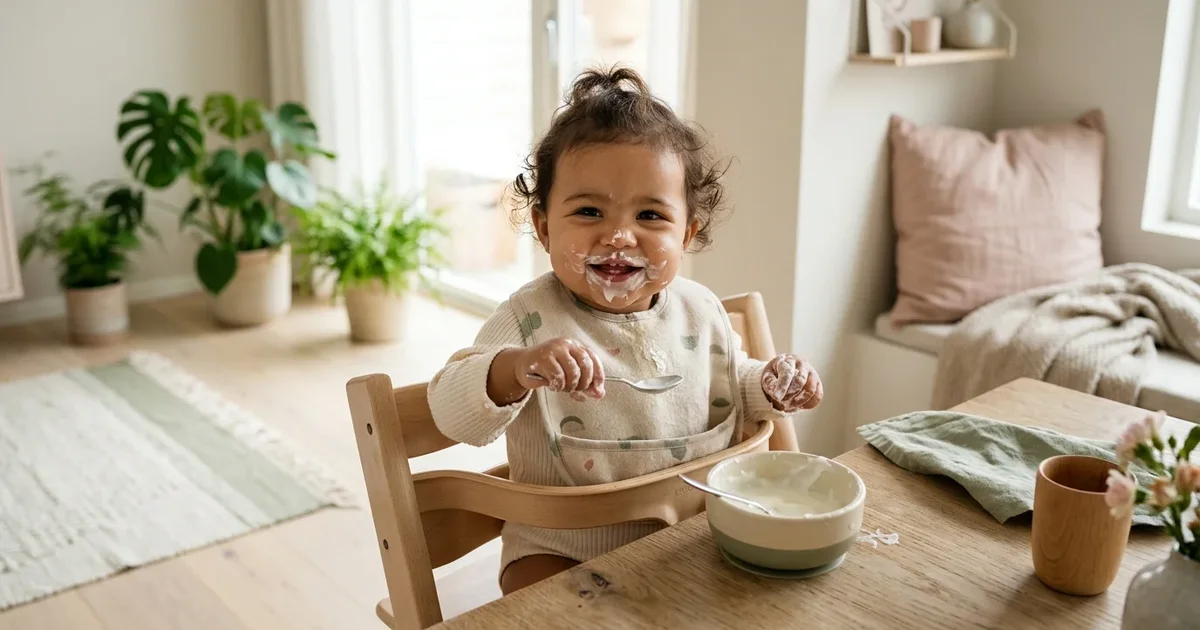
- Dip and taste: Let your baby dip a spoon in puree and bring it toward their mouth.
- Cup practice: Help your baby hold a small cup for a sip during meals.
- Family copy: Eat a safe version of the same food and let your baby watch.
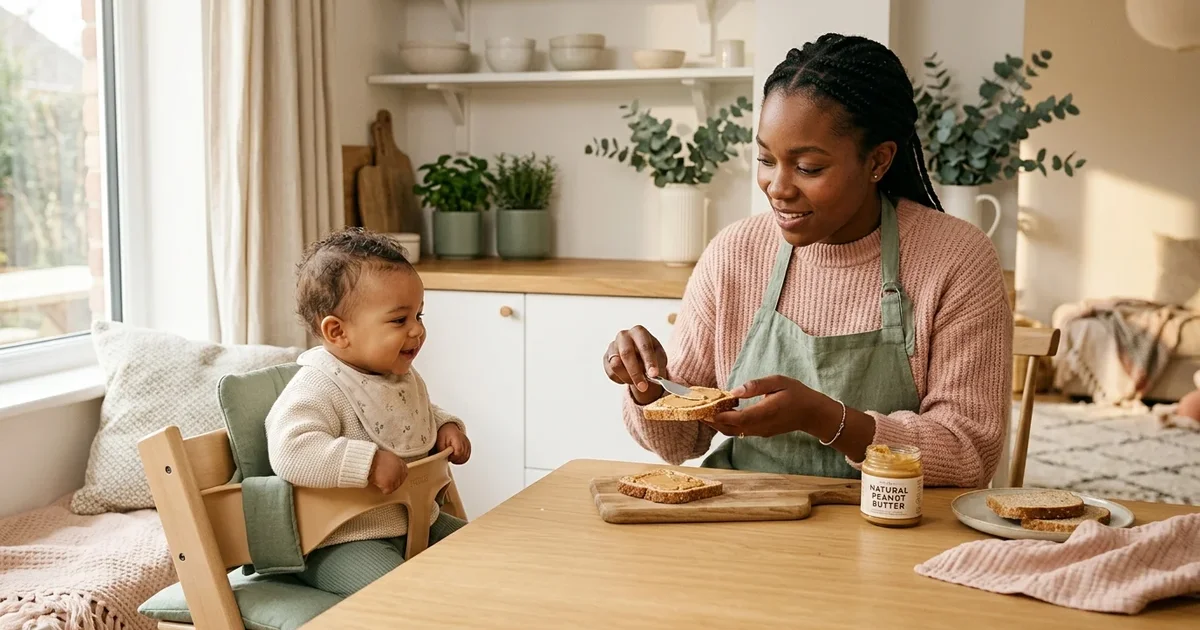
Do not use hard chunks, whole grapes, popcorn, nuts, spoonfuls of nut butter, raw apple pieces, or round coin-shaped foods for baby play. For food ideas by age, use SmartStart's food guide.
When Should You Stop a Baby Game?
Stop before the game turns into a rescue mission. Babies learn best when they feel safe and regulated.
Common stop signs:
- Looking away repeatedly
- Stiffening, arching, or pushing back
- Rubbing eyes or yawning
- Hiccups during stimulation
- Crying that builds instead of settles
- Turning away from food or keeping the mouth closed
The warmest move is often to do less. Hold your baby, change the scene, or move to a quiet routine.
Simple Safety Rules for Baby Games
Most baby games are low risk, but a few rules carry a lot of weight:
- Keep play awake and supervised, especially tummy time, water play, food play, and floor play.
- Use toys that are too large to choke on and do not have loose parts.
- Avoid strings, cords, balloons, magnets, and button batteries.
- Never leave a baby alone near water. NHS guidance notes that babies and young children can drown in less than 5 cm of water.
- Keep screens out of routine baby play unless you are video chatting with family.
- Use feeding games only when your baby is developmentally ready and seated safely.
This article is for informational purposes only and does not replace professional medical advice. Always consult your pediatrician for guidance specific to your child.
Frequently Asked Questions
What games can I play with my baby?
Start with face games, songs, reading, tummy time, reaching games, peekaboo, mirror play, and safe mealtime exploration. The best game is usually short, responsive, and matched to your baby's age.
How do you play with a newborn?
Keep newborn games simple: talk face-to-face, copy little sounds, sing, show high-contrast pictures, offer supervised tummy time, and stop when your baby looks away or fusses.
Are baby games supposed to teach milestones?
Baby games can support practice, but they are not tests. Use play to give your baby chances to look, reach, roll, babble, grasp, and connect with you.
Can feeding count as baby play?
Yes, once your baby is ready for solids. Soft finger foods, cup practice, naming foods, and texture exploration can support feeding skills when supervised closely.
Summary
Baby games work best when they feel ordinary: a song during a diaper change, a mirror on the floor, a spoon to hold at lunch, a parent who pauses long enough for a baby to answer.
Pick one game from your baby's age range today. If you want a simple next step, open SmartStart for safe first-food ideas or Milestones for age-by-age play cues, then keep the actual play small.
Sources
- CDC: Milestones by 6 Months
- CDC: When, What, and How to Introduce Solid Foods
- CDC: Fingers, Spoons, Forks, and Cups
- NHS: Baby and Toddler Play Ideas
- NHS: Your Baby's First Solid Foods
- WHO: Infant and Young Child Feeding
- HealthyChildren.org: Screen Time
- Mayo Clinic: Infant Development From 4 to 6 Months
- PubMed: Tummy Time and Infant Health Outcomes
- Johns Hopkins Medicine: Infant Safe Sleep