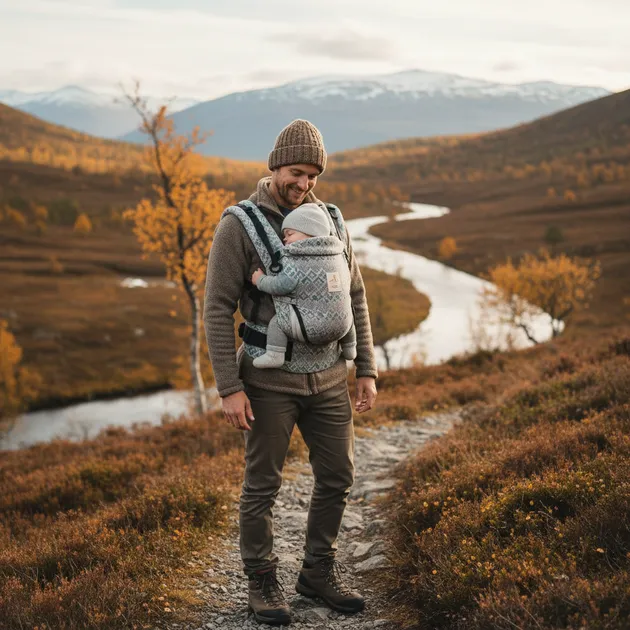
You've found a baby carrier you love, your baby is cozy against your chest, and then fall arrives. Suddenly it's too cold for a regular jacket because the baby doesn't fit inside. That's when you need a babywearing jacket.
A babywearing jacket is designed to fit both you and the baby, so you stay warm together. It's one of the most practical investments for parents who like to carry.
What Is a Babywearing Jacket?
A babywearing jacket is an outer jacket with extra room for a baby in a carrier or wrap. Most models have an insert panel or a zipper extension that makes the jacket large enough to cover both you and your child.
Many babywearing jackets also work as a regular jacket without the panel, meaning you can use it long after the carrying phase is over.
Some models also have room for back carrying, suitable for older babies and toddlers.
Types of Babywearing Jackets
There are three main types, each with its own advantages.
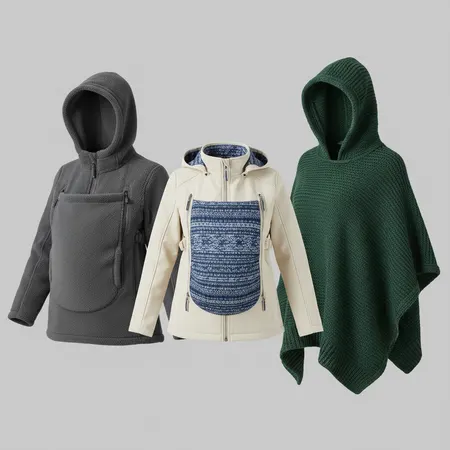
All-in-One Babywearing Jacket
A complete jacket with a built-in carrier panel. The panel can usually be removed so the jacket works as a regular jacket afterward. This is the most popular solution.
Pros: Seamless fit, looks like a regular jacket, warmest option. Cons: More expensive, only works with the jacket it comes with.
Zipper Insert (Carrier Panel)
A separate panel that attaches between two zippers on your existing jacket. You buy the panel and adapters that mount onto the jacket you already own.
Pros: More affordable, works with different jackets, compact. Cons: Not all jackets are compatible, may have gaps between jacket and panel.
Babywearing Poncho or Cape
A wide poncho that goes over both you and the baby in the carrier. The simplest option, but provides the least protection from wind and rain.
Pros: Cheapest, fits everyone, easy to put on and take off. Cons: Less windproof, looks bulky, no sleeves.
If you already have a good winter jacket, a zipper insert is the most cost-effective solution. Brands like Kokoala make universal panels that fit most jackets with two-way zippers.
Babywearing Jacket vs. Regular Jacket with Carrier
Many parents wonder if they really need a babywearing jacket, or if they can manage with what they have.
With a regular jacket, the baby has to be outside your jacket. This means the baby needs their own warm clothes and an extra suit or carrier cover. You lose much of the natural body heat sharing that is one of the big benefits of babywearing.
With a babywearing jacket, the baby is inside the jacket against your body. The child gets warmth from you, needs less clothing, and you both stay warmer. It's also easier to check on the baby without fully opening the jacket.
For short trips in mild weather, you'll manage fine without a babywearing jacket. For daily carrying through fall and winter, a babywearing jacket is a major comfort upgrade.
How to Choose the Right Babywearing Jacket
Here's what matters most.
Season and Climate
Winter jacket (insulated): For cold winters, you need a well-insulated babywearing jacket. Look for models with down or synthetic fill. Remember that your baby generates heat back to you, you don't need as much insulation as usual.
Softshell (spring/fall): A windproof and water-resistant softshell is perfect for transitional seasons. Lighter and more flexible than a winter jacket.
Rain jacket: For wet weather, a waterproof option is invaluable. Some brands make 3-in-1 jackets with removable liners, covering all seasons.
Size and Fit
Order your regular size. The carrier panel provides the extra space needed for the baby. Make sure the jacket is roomy enough in the shoulders to fit over the carrier.
Try the jacket with the carrier and baby if possible. Online stores with good return policies are worth choosing.
Compatibility with Your Carrier
Most babywearing jackets work with all types of carriers and wraps. Still, check that the jacket has enough room for your specific carrier, some structured carriers are thicker than others.
Babywearing Jacket Through the Seasons
Winter
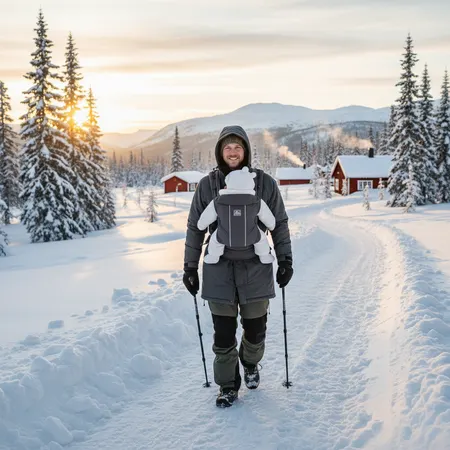
Cold winters require good insulation. An insulated babywearing jacket with wind-stopper and a high collar protects both you and the baby. The baby only needs regular indoor clothes plus a wool layer under the jacket, your body provides the rest of the warmth.
Remember that the baby's head sticks up above the jacket. A good hat and possibly a balaclava are important. Some babywearing jackets have an integrated hood that covers the baby's head.
Spring and Fall
A softshell or light all-weather jacket is ideal. Temperatures fluctuate a lot, so layering is important. Keep an extra sweater in your bag in case it gets colder than expected.
Summer
You usually don't need a babywearing jacket in summer. In rain or cool summer weather, a light rain jacket with a carrier panel can be practical.
Check the baby's temperature by feeling the back of the neck. The neck should feel warm but not sweaty. Cold hands and feet don't necessarily mean the baby is cold, that's normal for small babies.
Safety When Using a Babywearing Jacket
Safe carrying always comes first.
Airway Access
Make sure the baby always has a clear airway. The face should be visible at all times, and the chin should not be pressed down against the chest. Most babywearing jackets have an opening at the top so the baby's head sticks out, this is intentional.
Temperature Control
Babies can quickly overheat inside a babywearing jacket, especially indoors. Open the jacket or take it off when you enter stores or other warm spaces. Overheating is a bigger risk than the baby getting cold.
Correct Carrying Position
The baby should sit in an ergonomic M-position in the carrier regardless of the jacket. The babywearing jacket should not change the baby's position. Check that the carrier sits correctly before closing the jacket.
Read more about safe babywearing in a carrier for complete guidelines.
How to Dress the Baby Under the Jacket
Remember that your body is a heat source. The baby needs less clothing in the babywearing jacket than in a stroller.
Indoor temperature: Regular indoor clothes are enough.
Mild outdoors (40-60°F / 5-15°C): Indoor clothes plus a light wool layer or sweater.
Cold outdoors (25-40°F / -5 to 5°C): Wool base layer, wool sweater, wool pants. Possibly a thin fleece suit.
Very cold (below 25°F / -5°C): Wool base layer, wool sweater, wool pants, wool socks. Check temperature regularly.
Always pack extra wool socks and a hat in your bag. These items get lost easily and are important for warmth.
Frequently Asked Questions
Do I really need a babywearing jacket?
If you carry the baby regularly outdoors from fall to spring, a babywearing jacket is a big advantage. It means you don't have to bundle the baby in lots of clothes, and you both stay warmer. For those who only carry occasionally in summer, it's not necessary.
Can I use a babywearing jacket with all carriers?
Most babywearing jackets work with all common carriers and wraps. Some very large or rigid carriers may require a roomier jacket model. Check with the manufacturer if you're unsure.
From what age can the baby be in a babywearing jacket?
From when the baby is big enough to use a carrier, usually from birth with an ergonomic carrier with newborn insert. Remember that newborns are extra sensitive to temperature, so check regularly that the baby is not too warm or too cold.
Can the babywearing jacket be used for back carrying?
Yes, many babywearing jackets have a panel that can be moved from front to back. Back carrying is usually appropriate from when the child is 6-8 months old and has good head control. Check that your jacket supports this.
How do I wash a babywearing jacket?
Follow the manufacturer's washing instructions. Most softshell jackets can be washed at 86°F (30°C). Insulated winter jackets should be washed less frequently and re-waterproofed after washing to maintain water-resistant properties.
Read More
Sources:
- AAP. Infant Development (healthychildren.org)
- International Hip Dysplasia Institute. Baby Carriers (hipdysplasia.org)
Sources
- ACOG. Clinical guidance on pregnancy and women's health
- WHO. Global recommendations for maternal health
- Mayo Clinic. Evidence-based pregnancy health information
🔧 Helpful Tools
- All Baby Tools. Browse all free tools for pregnancy and baby care
📖 Related Articles
- Baby Carrier: Guide to Types, Ergonomic Carrying, and Choosing Right. Everything about baby carriers, structured carrier vs wrap, ergonomic carrying, age guide, hip dysplasia, and tips for choosing the right carrier for your baby.
- Baby Wrap and Carrier: Safe Babywearing Guide. Complete guide to baby wraps and carriers. Correct carrying position, M-position, and tips for safe babywearing from newborn.