Trying to get pregnant? Knowing your body's own signals at ovulation is invaluable. About 20% of women can feel ovulation clearly, but with a little knowledge, most people can learn to pick up the signs. Here are the most important symptoms to watch for.
What Happens in the Body During Ovulation?
Ovulation is the moment when a mature egg is released from the ovary and begins its journey through the fallopian tube toward the uterus. This typically happens 12–16 days before your next period, not 14 days after your last period, as many believe.
In the lead-up to ovulation, the hormone estrogen rises, causing cervical mucus to change and the body to prepare for fertilization. Just before ovulation itself, a sharp increase in LH (luteinizing hormone) triggers the egg's release.
The egg lives only 12–24 hours after ovulation, but sperm can survive up to 5 days inside the body. This means your fertile window is approximately 5–6 days: the days before ovulation and ovulation day itself.
Did you know: Your greatest chance of getting pregnant is if you have intercourse 1–2 days before ovulation, not on ovulation day itself. That way, sperm are already in place when the egg is released.
1. Changed Discharge. Ovulation Mucus
The most reliable sign that ovulation is approaching is changes in vaginal discharge. The hormone estrogen affects the mucus produced in the cervix, and this changes noticeably through the cycle.
How the mucus changes:
- Right after period: Little or no discharge (dry days)
- Days before ovulation: More moist, fluid, and clear discharge
- At ovulation: Transparent, stretchy, and elastic, resembles raw egg white
- After ovulation: Thicker, white, and clumpy discharge
The classic ovulation mucus is so stretchy that you can pull it between your fingers in a long thread without it breaking. This mucus has a specific function: it makes the pH in the vagina more alkaline and helps sperm swim through the cervix.
Tip: Check your discharge by taking a small amount of mucus between your thumb and index finger. If it is transparent and can be stretched into a long thread, you are probably near ovulation. After ovulation, the mucus will again become thicker and whiter.
2. Ovulation Pain (Mittelschmerz)
Approximately 1 in 5 women feels pain at ovulation. Medically this is called mittelschmerz. German for "pain in the middle" (of the cycle).
The pain is caused by the follicle (egg sac) in the ovary rupturing and releasing the egg. The small amount of fluid released can irritate the peritoneum and create a noticeable sensation.
What it feels like:
- Mild cramps or sharp pains in the lower abdomen
- Can be felt on one side (the side from which the egg is released)
- Usually lasts from a few minutes to a couple of hours, rarely more than 24–48 hours
- Milder than menstrual cramps for most people
The pain can switch sides from month to month, depending on which ovary releases the egg that cycle.
3. Higher Body Temperature
After ovulation, the corpus luteum (yellow body) produces the hormone progesterone, which causes a small but measurable temperature rise.
Basal body temperature and ovulation:
- Temperature rises by 0.2–0.5°C (0.4–0.9°F) after ovulation
- The rise is too small to feel, but can be measured with a precise thermometer
- Temperature stays elevated for the rest of the cycle until the next period
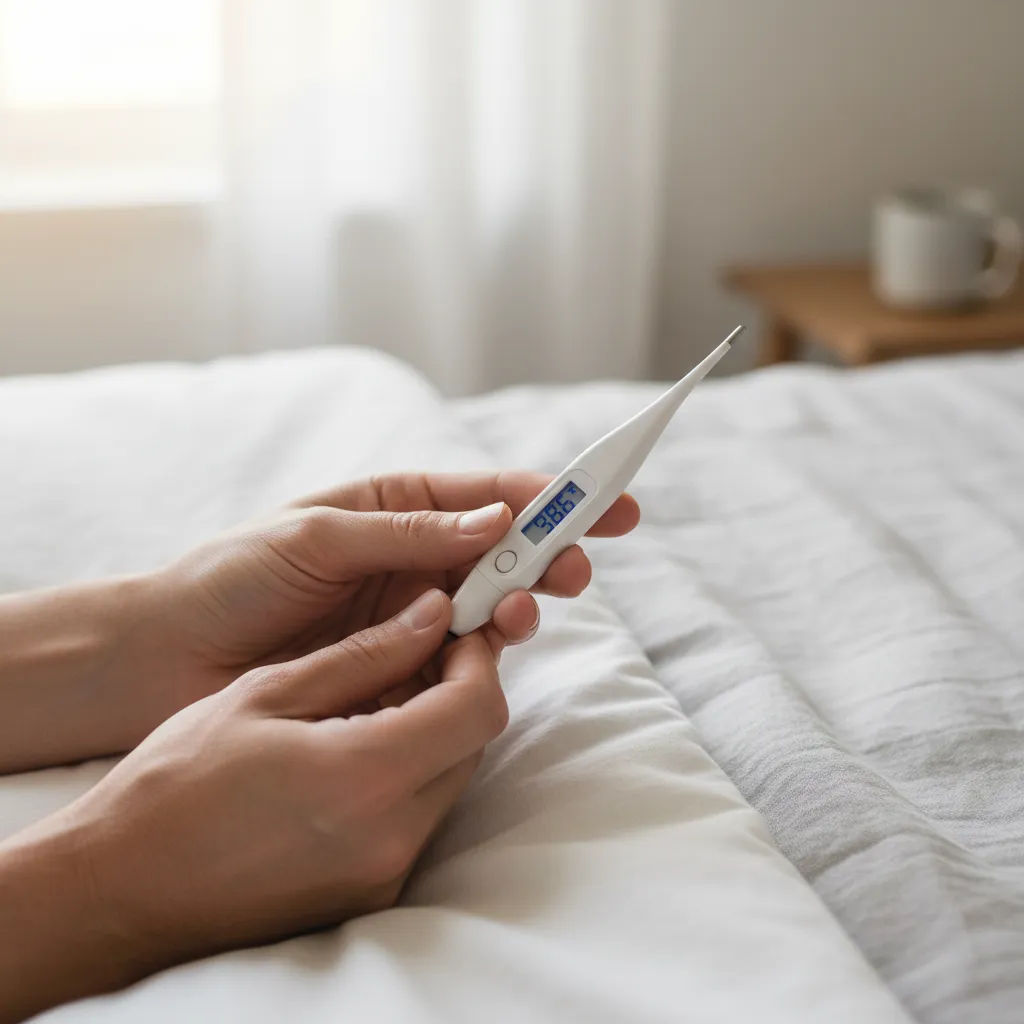
To use the basal temperature method, take your temperature every morning before you get up, with a digital thermometer that reads to two decimal places. Over time you will see a pattern: low temperature before ovulation, then a jump that lasts until the end of the cycle.
Important: Basal body temperature tells you that ovulation has already happened. It is therefore most useful for confirming that you are ovulating and for learning your cycle over time , not for predicting ovulation in real time. Use it alongside other signs.
4. Breast Tenderness
Many women find their breasts become a little tender and heavy around ovulation. This is caused by hormonal fluctuations, particularly rising estrogen and progesterone levels.
The tenderness is usually mild and transient, and can start a couple of days before ovulation and last a few days afterward. It is a normal sign, but not everyone notices it.
5. Ovulation Spotting
Some women experience light bleeding or pinkish-brown discharge around the time of ovulation. This spotting is caused by the small rupture in the ovary when the egg is released, and by a temporary drop in estrogen levels.
Ovulation spotting is typically:
- Very light, just a few drops or pinkish-brown discharge
- Brief, lasts from a few hours to a day
- Not like a normal period
Did you know: Ovulation spotting is completely normal and harmless. But if you experience heavier or new types of bleeding between periods, discuss it with your doctor.
6. Increased Sex Drive
Nature is clever. Many women notice increased sexual desire in the days around ovulation, exactly the period when the chance of getting pregnant is greatest. This is linked to rising estrogen levels.
Some research also suggests that women may feel more attractive and energetic in this phase of the cycle. Desire is of course individual, but if you notice a noticeable increase mid-cycle, it can be a sign that ovulation is approaching.
7. Bloating and Nausea
Hormonal fluctuations around ovulation, particularly the increase in progesterone, can cause a feeling of abdominal bloating. Some women also experience mild nausea or fatigue.
These symptoms are similar to what many feel right before their period (PMS), and they are not as reliable as, for example, changed discharge or ovulation pain. But they can still help confirm the suspicion that ovulation is near.
Tools for Tracking Ovulation
Beyond listening to your body's signals, there are several tools that can help:
Ovulation Tests
An ovulation test works somewhat like a pregnancy test, you hold a test stick in the urine stream. But instead of hCG, it measures LH, which rises sharply 24–36 hours before ovulation. A positive ovulation test means you should have intercourse in the next 24–48 hours for the best chance of pregnancy.
Ovulation Calculator
Use our ovulation calculator to estimate your approximate ovulation date based on your cycle length. The calculator gives you a good starting point, even though the exact day can vary from cycle to cycle.
The Calendar Method
The simplest method is to count back 14 days from your expected next period. With a 28-day cycle, ovulation is approximately day 14. With a 30-day cycle, it is approximately day 16.
Tip: For best results, combine several methods: mucus observation, basal temperature, and ovulation tests. Together they give a much clearer picture than any single method alone.
When Should You Seek Help?
Most couples (around 80–90%) conceive within the first year with regular intercourse. But there are situations where you should contact your doctor:
- You have irregular periods or widely varying cycle lengths
- You never notice any signs of ovulation
- You have been trying to conceive for over one year (or over 6 months if you are over 35)
- You have severe pain at ovulation that affects your daily life
Read more about when to seek help with fertility and tips for getting pregnant.
Frequently Asked Questions
What Is the Most Reliable Sign of Ovulation?
A change in discharge is the most reliable sign. When the mucus becomes transparent, stretchy, and elastic, like raw egg white, you are probably near ovulation. Combined with an ovulation test, you get the clearest picture.
Can All Women Notice Ovulation?
About 20% of women notice ovulation clearly through pain (mittelschmerz). But with a little practice, most people can learn to recognize signs like changed discharge, breast tenderness, and increased desire.
When in the Cycle Do I Ovulate?
Ovulation typically occurs 12–16 days before your next period. With a 28-day cycle, this is approximately day 14. The fertile window is approximately 5–6 days, and your greatest chance of pregnancy is 1–2 days before ovulation.
Next Steps: From Symptoms to Action
Now that you know the signs of ovulation, you are well prepared to find your most fertile days. Here are some useful next steps:
- Ovulation calculator, calculate your next ovulation
- Folic acid guide, start this supplement now
- Due date calculator, calculate your due date when you conceive
- Early signs of pregnancy
Sources
- WHO. Reproductive health
- American College of Obstetricians and Gynecologists. Ovulation
- Mayo Clinic. Ovulation signs
- Cleveland Clinic. Mittelschmerz
🔧 Helpful Tools
- Ovulation Tracker. Track your cycle and predict ovulation
- All Baby Tools. Browse all free tools for pregnancy and baby care
📖 Related Articles
- Ovulation Test: Complete Guide to Using It Correctly. Wondering how ovulation tests work? Learn when to test, how to read the result, and the most common mistakes to avoid.
- Ovulation After Your Period: When Does It Happen and How Do You Calculate It?. When do you ovulate after your period? Learn to calculate your ovulation day, understand the fertility window, and recognize the signs. Complete guide with a table for different cycle lengths.
- Understanding Your Cycle: Everything About Ovulation. Learn everything about ovulation, the fertile window, and how to calculate your most fertile days. Complete guide covering OPK tests, BBT charting, mucus tracking, ovulation after birth control, and PCOS.