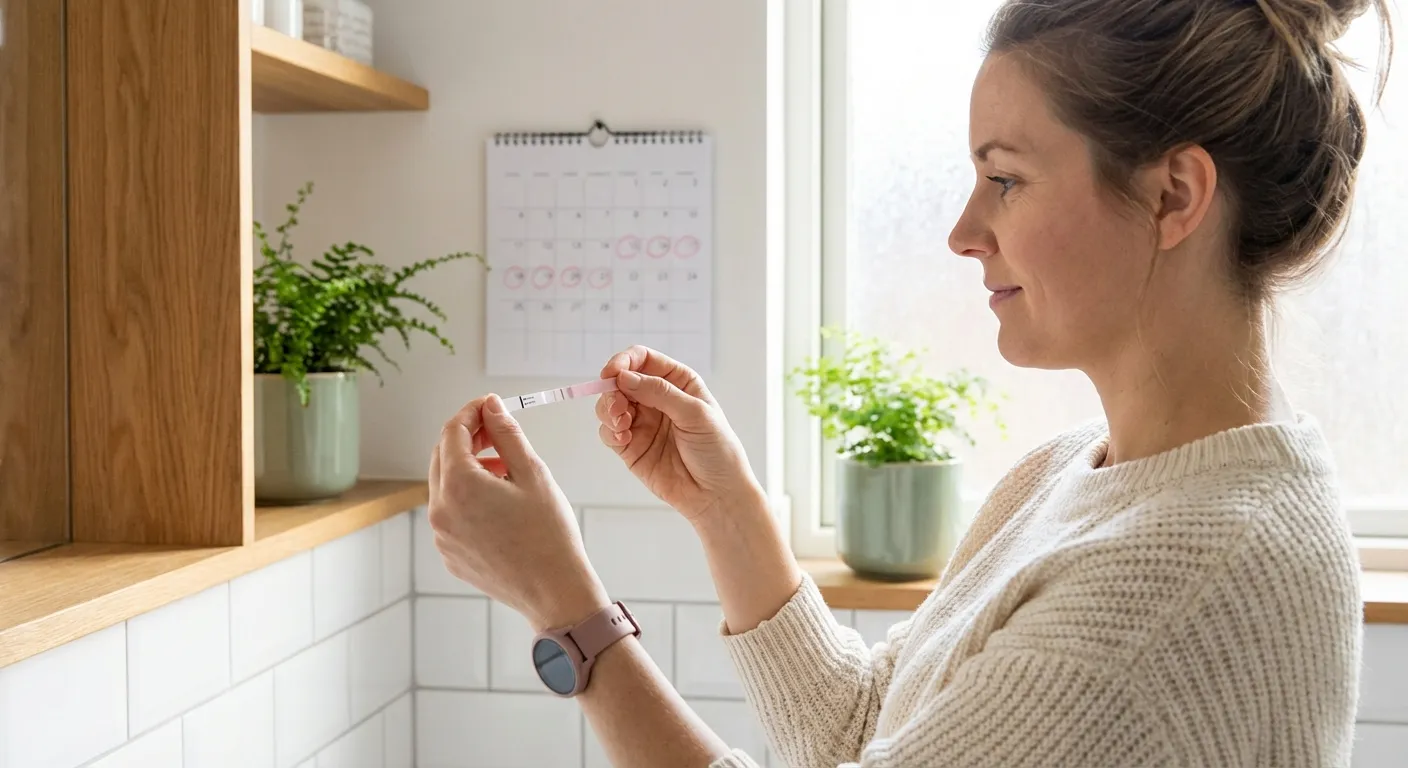
Understanding your own cycle is the key to knowing when you have the greatest chance of getting pregnant. Ovulation, the moment the egg is released from the ovary, happens only once per cycle, and there is only a brief window in which fertilization can occur. Here's the biology.
What Is Ovulation?
Ovulation is the process by which a mature egg is released from one of your ovaries. The egg then travels down the fallopian tube, where it can meet a sperm and be fertilized.
Key Facts About Ovulation:
- Happens once per menstrual cycle
- The egg lives only 12–24 hours after release
- Sperm can survive up to 5–7 days in the uterus
- The fertile window is therefore approximately 5–6 days
Important: You can only get pregnant if a sperm meets and fertilizes the egg. This must happen within 24 hours of ovulation.
When Does Ovulation Happen? Day by Day in the Cycle
Here is the myth many believe: "Everyone ovulates on day 14."
The reality: Ovulation typically occurs 12–16 days BEFORE your next period, not after your last one. The timing of ovulation varies from person to person and can also vary from cycle to cycle in the same person.
Ovulation Day by Cycle Length
| Cycle length | Approximate ovulation day | Fertile window (approx.) |
|---|---|---|
| 21 days | Day 5–9 | Days 3–10 |
| 25 days | Day 9–13 | Days 7–14 |
| 28 days | Day 12–16 | Days 10–17 |
| 30 days | Day 14–18 | Days 12–19 |
| 35 days | Day 19–23 | Days 17–24 |
What Happens Day by Day in the Cycle?
Days 1–5: Menstruation (bleeding) The uterine lining is shed. FSH (follicle-stimulating hormone) begins to rise, and new follicles (egg sacs) start maturing in the ovaries.
Days 6–9: Follicular phase A dominant follicle is selected and grows. Estrogen rises gradually. The uterine lining rebuilds. Cervical mucus begins to change.
Days 10–13: Fertile phase begins Estrogen is high. Cervical mucus becomes clearer and more elastic (egg white consistency). Sperm can now survive in the uterus. LH begins to rise.
Day 14 (in a 28-day cycle): Ovulation The LH surge triggers ovulation 24–36 hours after peaking. The egg is released from the dominant follicle and picked up by the fallopian tube. Some women experience ovulation pain (mittelschmerz).
Days 15–28: Luteal phase The empty follicle becomes the corpus luteum, which produces progesterone. Body temperature rises 0.2–0.5°C (0.4–0.9°F). The uterine lining prepares for a potentially fertilized egg. If fertilization does not occur, progesterone drops after approximately 12–14 days and a new period begins.
Use our ovulation calculator to calculate your fertile days based on your cycle length, and our due date calculator once you are pregnant.
How to Calculate Your Fertile Days
Method 1: The Calendar Method
The simplest way to estimate ovulation:
Formula: First day of last period + (cycle length − 14) = ovulation day
Example: Last period started January 1st, cycle is 30 days.
- 30 − 14 = 16
- January 1st + 16 days = January 17th (estimated ovulation)
The fertile window is then approximately January 14–18.
Limitation: The calendar method is an estimate based on averages. It works best for women with a regular cycle. For more precise results, combine with other methods.
Method 2: Ovulation Test (OPK)
More precise than the calendar method. Ovulation predictor kits (OPKs) measure LH (luteinizing hormone) in urine.
- LH increases sharply 24–36 hours before ovulation
- A positive test means: Have intercourse in the next 1–2 days!
How to use an ovulation test, step by step:
- Start testing 3–4 days before expected ovulation (with a 28-day cycle: days 10–11)
- Test at the same time each day, afternoon is often best (do not use first morning urine)
- Do not drink a lot of fluid 2 hours before the test (dilutes urine)
- Read the result within the time window indicated in the instructions
- Positive test = test line is as dark or darker than the control line
Types of ovulation tests:
| Type | Price (approx.) | Advantages | Disadvantages |
|---|---|---|---|
| Strip tests (Wondfo, Easy@Home) | Low-cost, bulk packs | Inexpensive, many tests | Requires interpreting line darkness |
| Clearblue Digital | Mid-range | Clear yes/no result | More expensive per test |
| Clearblue Advanced | Higher-end | Measures estrogen + LH | Most expensive option |
All are available at pharmacies and online retailers.
Method 3: Basal Body Temperature (BBT)
BBT is your lowest body temperature at rest. After ovulation it rises by 0.2–0.5°C (0.4–0.9°F) and stays elevated for the rest of the cycle.
How to measure BBT:
- Measure every morning before getting up, at the same time (use an alarm!)
- Use a precise thermometer with two decimal places
- Measure vaginally or rectally for most accurate results (under the tongue is next best)
- Record the value daily in an app or on a chart
- Look for a temperature shift, a rise of at least 0.2°C (0.4°F) lasting at least 3 days
Interpreting the BBT chart:
- Before ovulation: Temperature is lower (typically 36.2–36.5°C / 97.2–97.7°F)
- After ovulation: Temperature rises by 0.2–0.5°C (36.5–37.0°C / 97.7–98.6°F)
- The temperature shift confirms that ovulation has occurred, but shows it AFTER the fact, not before
Limitation: BBT shows that ovulation HAS happened, but does not predict it in advance. It is most useful over several cycles to identify a pattern. Combine with cervical mucus tracking to catch the fertile window.
Method 4: Cervical Mucus Tracking
The clearest body-based sign that ovulation is approaching. Cervical mucus changes throughout the cycle under the influence of estrogen and progesterone.
Mucus categories through the cycle:
| Phase | Appearance | Consistency | Fertility |
|---|---|---|---|
| Right after period | Little or dry | None | Not fertile |
| Early in cycle | White, sticky | Thick, pasty | Low fertility |
| Approaching ovulation | Creamy | Smooth, lotion-like | Moderately fertile |
| Just before ovulation | Clear, elastic | "Egg white," stretchy | Highly fertile |
| After ovulation | White, thick | Sticky, pasty | Not fertile |
How to check your mucus:
- Wash your hands thoroughly
- Take a sample from the vagina (by wiping with tissue or with a finger)
- Stretch the mucus between thumb and index finger
- Fertile mucus can be stretched several centimeters without breaking
The most fertile mucus looks like raw egg white, clear, elastic, and smooth. When you see this mucus, it is time for intercourse!
The Fertile Window. Explained
Even though the egg lives only 12–24 hours, the fertile window is longer because sperm can wait inside your body.
Day -5: Sperm can survive
Day -4: Sperm can survive
Day -3: Good chance of fertilization
Day -2: Very good chance
Day -1: Best chance (day before ovulation)
Day 0:  OVULATION - good chance
Day +1: Low chance (egg is dying)
Probability of fertilization per day:
| Day relative to ovulation | Chance per cycle |
|---|---|
| Day −5 | ~5% |
| Day −4 | ~10% |
| Day −3 | ~15% |
| Day −2 | ~25% |
| Day −1 | ~25–30% |
| Day 0 (ovulation day) | ~20% |
| Day +1 | ~5% |
The two days with the highest chance of pregnancy are the day BEFORE ovulation and ovulation day itself. Intercourse every other day during the fertile window provides optimal coverage.
Signs of Ovulation: How to Recognize It
Your body sends several signals when ovulation is approaching. Here are the most common signs to look for:
Change in Cervical Mucus
The clearest sign for many is a change in cervical mucus. In the days before ovulation, it gradually becomes clearer, more elastic, and smoother. Many describe it as "egg white consistency", you can stretch it between your fingers without it breaking.
After ovulation, the mucus changes again and becomes thicker, whiter, and more pasty. This change is driven by progesterone.
Body Temperature Rises
After ovulation, your body temperature increases by approximately 0.2–0.5°C (0.4–0.9°F). This is called a biphasic temperature curve. By measuring your temperature every morning before getting up (basal body temperature), you can confirm that ovulation has occurred.
The drawback is that the temperature rise happens after ovulation, so it is most useful for confirming the pattern over several cycles.
Ovulation Tests (LH Surge)
Ovulation tests are the most precise home method. They measure LH hormone levels in urine. LH surges sharply (the LH surge) 24–36 hours before ovulation.
Other Ovulation Signs
- Increased sex drive, hormones make you more interested in sex around ovulation
- Breast tenderness, some experience tenderness after ovulation
- Bloating, mild abdominal bloating
- Increased energy, many feel more energetic around ovulation
- Heightened sense of smell, research shows smell can become more acute
Ovulation Pain (Mittelschmerz)
About 20% of women experience pain associated with ovulation. This is called mittelschmerz (German for "middle pain") because it happens mid-cycle.
What Does Ovulation Pain Feel Like?
- A sharp or dull ache on one side of the lower abdomen
- Lasts from a few minutes to a few hours
- Can switch sides from cycle to cycle (depending on which ovary releases the egg)
- Some experience light bleeding or spotting at the same time
What Causes Ovulation Pain?
The pain is likely caused by the follicle (egg sac) growing and rupturing when the egg is released. The fluid released can irritate the abdominal lining and cause discomfort.
When Should You See a Doctor?
Ovulation pain is normal, but contact a doctor if:
- The pain is very intense and persistent
- You have fever along with the pain
- The pain is accompanied by vomiting
- The pain lasts more than 2–3 days
Severe pain on one side of the abdomen can also be caused by an ovarian cyst, appendicitis, or ectopic pregnancy. Seek help if the pain is unusually severe.
Ovulation After Birth Control: What to Expect
Many wonder what happens to ovulation after stopping hormonal birth control. It can take some time for the cycle to normalize.
Combined Pill (Estrogen + Progestin)
- Ovulation can return as early as the first cycle after stopping
- For most people, the cycle normalizes within 1–3 months
- Some experience irregular cycles for up to 6 months
- The pill "masks" your natural cycle, the underlying cycle length may be different than you expect
Progestin-Only Pill (Mini-Pill)
- Ovulation can return within days to weeks
- Faster normalization than combined pills for many people
- Some ovulate even while taking the mini-pill (it works mainly on mucus)
Hormonal IUD (Mirena, Kyleena)
- Ovulation has often been present throughout (the hormonal IUD works locally)
- The cycle typically normalizes within 1–3 months after removal
- Fertility is not reduced after use
Injectable Contraceptive (Depo-Provera)
- Can take 3–12 months before ovulation and cycle normalize
- Some experience delayed return of fertility for up to 18 months
- This is the contraceptive method with the longest wait time
Tips for Monitoring Ovulation After Birth Control
- Start using ovulation tests from 2–3 weeks after stopping
- Track cervical mucus, it gives early signs of resumed ovulation
- Measure basal body temperature to confirm ovulation is happening
- Use our ovulation calculator to keep track
- Be patient, it can take several cycles before the pattern becomes predictable
PCOS and Ovulation
PCOS (polycystic ovary syndrome) is the most common cause of irregular ovulation and affects 8–13% of women of reproductive age. PCOS is one of the most frequent causes of fertility challenges.
What Is PCOS?
PCOS is a hormonal disorder in which the ovaries produce too much androgen (male sex hormone). This can disrupt the normal maturation of follicles and ovulation.
Symptoms of PCOS
- Irregular or absent menstruation
- Long cycles (over 35 days)
- Acne
- Excess hair growth (hirsutism)
- Weight gain, especially around the waist
- Many small cysts on the ovaries (visible on ultrasound)
PCOS and Fertility
Even with PCOS, it is entirely possible to get pregnant. Many women with PCOS have sporadic ovulation. Measures that can help:
- Weight loss, even 5–10% weight reduction can restore ovulation in overweight women with PCOS
- Dietary changes, stable blood sugar and a low-glycemic diet can help regulate hormones
- Regular exercise, moderate activity improves insulin sensitivity
- Medication, letrozole or clomiphene can stimulate ovulation (requires a prescription from a gynecologist)
When to Seek Help for PCOS?
Contact your doctor or gynecologist if you have:
- Cycles over 35 days or fewer than 8 periods per year
- Irregular periods combined with acne or excess hair growth
- Been trying to conceive for over 12 months (6 months if you are over 35)
Irregular Ovulation: Other Causes and Solutions
Common Causes of Irregular Ovulation
Thyroid problems: Both hypothyroidism (underactive thyroid) and hyperthyroidism (overactive thyroid) can affect ovulation. A simple blood test (TSH) can identify this. Women with fertility challenges should have their thyroid checked.
Stress and lifestyle factors: Chronic stress increases cortisol, which can suppress GnRH hormones and thereby delay or prevent ovulation. Extreme exercise, being underweight, or being overweight can also disrupt the cycle.
High prolactin: Prolactin is the hormone that stimulates milk production. Elevated prolactin (hyperprolactinemia) can inhibit ovulation even if you are not breastfeeding.
Premature ovarian insufficiency: In some women, the ovaries begin to function poorly before age 40. This affects approximately 1% of women.
What Can You Do?
- Track your cycle, use our ovulation calculator to keep track
- Maintain a healthy lifestyle, balanced diet, moderate exercise, enough sleep
- Reduce stress, yoga, meditation, or other relaxation techniques
- Contact your doctor, if your cycle is shorter than 21 days or longer than 35 days
- Blood tests, your doctor can check hormone levels (FSH, LH, progesterone, TSH, prolactin)
Anovulation: When Ovulation Does Not Happen
Sometimes you have a period without ovulation actually occurring. This is called anovulation.
Signs that may indicate anovulation:
- Very irregular or absent periods
- Very short or long cycles
- No signs of ovulation (no mucus change, no temperature shift)
If you have fewer than 4 periods per year and are not using hormonal contraception, contact your doctor.
Hormones and Ovulation: How Your Cycle Is Controlled
To truly understand ovulation, it helps to know the hormones that drive the process:
Follicle-Stimulating Hormone (FSH)
FSH is produced in the pituitary gland and initiates the maturation of follicles (egg sacs) in the ovaries. Each month several follicles begin maturing, but typically only one becomes dominant and releases an egg.
Estrogen
As the follicle grows, it produces increasing amounts of estrogen. Estrogen makes cervical mucus more egg white-like and builds up the uterine lining (endometrium) in preparation for a fertilized egg.
Luteinizing Hormone (LH)
When estrogen levels are high enough, they signal the pituitary to release a large amount of LH, the so-called LH surge. This hormone peak triggers ovulation itself, typically 24–36 hours after the LH surge. This is what ovulation tests measure.
Progesterone
After ovulation, the empty follicle transforms into the corpus luteum, which produces progesterone. Progesterone stabilizes the uterine lining and prepares the body for a potential pregnancy. If fertilization does not occur, progesterone drops after approximately 12–14 days and menstruation begins.
Hormone Levels in Numbers
| Hormone | Before ovulation | During LH surge | After ovulation |
|---|---|---|---|
| FSH | Moderate | Drops | Low |
| Estrogen | Rising | Peak | Moderate |
| LH | Low | Sharp peak | Drops quickly |
| Progesterone | Low | Low | Rises markedly |
How to Increase Your Chances of Conceiving
Did you know that timing matters more than frequency? Here are evidence-based tips:
Optimize Timing
- Have intercourse every other day during the fertile window (5 days before ovulation + ovulation day)
- The day before ovulation statistically gives the highest chance (~25–30% per cycle)
- You do not need to have intercourse every day, sperm quality is best with 2–3 days between
Lifestyle Tips That Can Help
- Folic acid: Start with 400 micrograms daily at least 3 months before trying to conceive. This helps prevent neural tube defects in the fetus.
- Limit caffeine: Health authorities generally recommend no more than 200 mg caffeine daily for women trying to conceive
- Stop smoking: Smoking reduces fertility and egg quality
- Maintain a healthy weight: Both over- and underweight can affect ovulation
- Limit alcohol: Alcohol can negatively affect fertility
Cycle Apps: Help or Hindrance?
Many people use apps like Clue, Flo, or Natural Cycles to track their cycle.
Advantages:
- Gives you an overview of your pattern
- Reminds you of fertile days
- Collects data over time
Limitations:
- They estimate based on average numbers
- Cannot predict hormonal fluctuations
- Not 100% reliable for contraception or conception
Best practice: Combine apps with ovulation tests and mucus tracking for best results.
Ovulation and Age
Your age affects both ovulation and fertility. Here is what you should know:
Under 30
Fertility is at its highest. Most people have regular ovulation, and the chance of fertilization per cycle is approximately 20–25%. It is normal for it to take up to 6–12 months to conceive.
30–35
Fertility begins to decline gradually. Ovulation is still regular for most, but egg quality starts to decrease. The chance of fertilization per cycle is approximately 15–20%.
35–40
Fertility declines more noticeably. The number of eggs decreases more quickly, and the proportion of chromosomal errors increases. Cycles may become shorter or more irregular. After 6 months of trying, you should contact your doctor.
Over 40
Fertility is significantly lower. Ovulation may be irregular, and egg quality is reduced. Many need assisted reproductive technology. Speak with your doctor early if you want to conceive.
Frequently Asked Questions
When Do You Ovulate?
Ovulation typically occurs 12–16 days BEFORE your next period. For someone with a 28-day cycle, this means around day 12–16. For shorter or longer cycles, ovulation happens correspondingly earlier or later. The most precise way to determine ovulation is by using ovulation tests (OPKs) that measure LH hormone levels in urine.
When Is Ovulation in a 28-Day Cycle?
In a 28-day cycle, ovulation typically occurs between day 12 and day 16, with day 14 as the most common estimate. But this varies, some people with a 28-day cycle ovulate as early as day 11, while others ovulate on day 17. Use ovulation tests to find your precise timing.
How Long Does Ovulation Last?
The ovulation itself, the release of the egg from the follicle, takes only a few minutes. But the fertile window lasts approximately 5–6 days: the 5 days BEFORE ovulation (because sperm can survive that long) plus ovulation day itself. The egg lives only 12–24 hours after release, so timing is important.
Can I Get Pregnant Outside the Fertile Window?
The probability is very low. The egg must be fertilized within 12–24 hours of ovulation, and sperm survive a maximum of 5–7 days. Thus the fertile window is limited to approximately 6 days per cycle.
When Does Ovulation Return After Birth Control?
For most people, ovulation returns within 1–3 months after stopping combined pills. Some ovulate in the first cycle. After the injectable, it can take longer, up to 3–12 months. After a hormonal IUD, the cycle typically normalizes within 1–3 months.
Do All Women Notice Ovulation?
No, many notice nothing. About 20% experience ovulation pain (mittelschmerz), while others only notice changes in cervical mucus. Using ovulation tests is the most reliable way to know when you are ovulating.
Can Stress Affect Ovulation?
Yes, stress can delay or prevent ovulation by affecting hormone levels. Chronic stress increases cortisol, which can suppress reproductive hormones. Relaxation techniques, enough sleep, and moderate exercise can help.
What If I Never Have a Regular Period?
Contact your doctor or gynecologist. Irregular periods can be caused by PCOS, thyroid problems, or other conditions that can be treated. Evaluation with blood tests and possibly an ultrasound provides answers.
Can You Have Ovulation Without Menstruation?
Yes, it is possible to ovulate without subsequently bleeding (this is common in breastfeeding women). It is also possible to bleed without having ovulated (anovulatory bleeding). Therefore, menstruation alone is not a reliable sign that ovulation has occurred.
How Many Eggs Does a Woman Have?
A woman is born with approximately 1–2 million eggs. By puberty, the number has been reduced to approximately 300,000–400,000. Over the course of a lifetime, approximately 400–500 eggs mature and are released through ovulation. The number and quality of eggs declines with age, especially after 35.
Can I Ovulate Twice in the Same Cycle?
Yes, but it is rare. Double ovulation (when two eggs are released) always happens within 24 hours. This is the mechanism behind fraternal twins. You cannot ovulate on day 10 and then again on day 20 in the same cycle.
Does PCOS Affect the Chance of Getting Pregnant?
PCOS is the most common cause of irregular ovulation, but this does not mean you cannot get pregnant. Many women with PCOS have sporadic ovulation. Lifestyle changes (weight loss, diet, exercise) can help, and medications like letrozole or clomiphene can stimulate ovulation. Talk to your doctor or gynecologist for an individualized plan.
Conclusion
Understanding ovulation and your cycle is a gift you give yourself, whether you are trying to conceive or simply want to know your body better.
Key takeaways:
- Ovulation occurs 12–16 days before your next period
- The fertile window is approximately 5–6 days
- Ovulation tests give more precise results than the calendar method
- Body signals (mucus, pain, temperature) can help you recognize ovulation
- Ovulation typically returns within 1–3 months after stopping birth control pills
- With PCOS or irregular cycles, speak with your doctor
Use our ovulation calculator to calculate your fertile days, and our due date calculator once you get pregnant.
Further Reading
- Calculate your fertile days with our ovulation calculator
- How to increase your chances of getting pregnant
- Ovulation test: How to use it correctly
- Ovulation symptoms you should know
- Age and fertility: What the research says
Sources
- WHO. Reproductive health
- American College of Obstetricians and Gynecologists (ACOG). The menstrual cycle
- Mayo Clinic. Ovulation
- Cleveland Clinic. Polycystic ovary syndrome (PCOS)
- Endocrine Society. Hormones and the menstrual cycle
🔧 Helpful Tools
- Due Date Calculator. Calculate your estimated due date
- Contraction Timer. Track your contractions during labor
- All Baby Tools. Browse all free tools for pregnancy and baby care
📖 Related Articles
- Ovulation After Your Period: When Does It Happen and How Do You Calculate It?. When do you ovulate after your period? Learn to calculate your ovulation day, understand the fertility window, and recognize the signs. Complete guide with a table for different cycle lengths.
- Can You Get Pregnant on Your Period?. Yes, it is possible to get pregnant during your period. Learn why it happens, who is most at risk, and what sperm lifespan and short cycles mean for your chances.
- How Long Does It Take to Get Pregnant? Statistics and Facts. How long does it actually take to get pregnant? Chances by age, a timeline of what is normal, and when you should seek help.