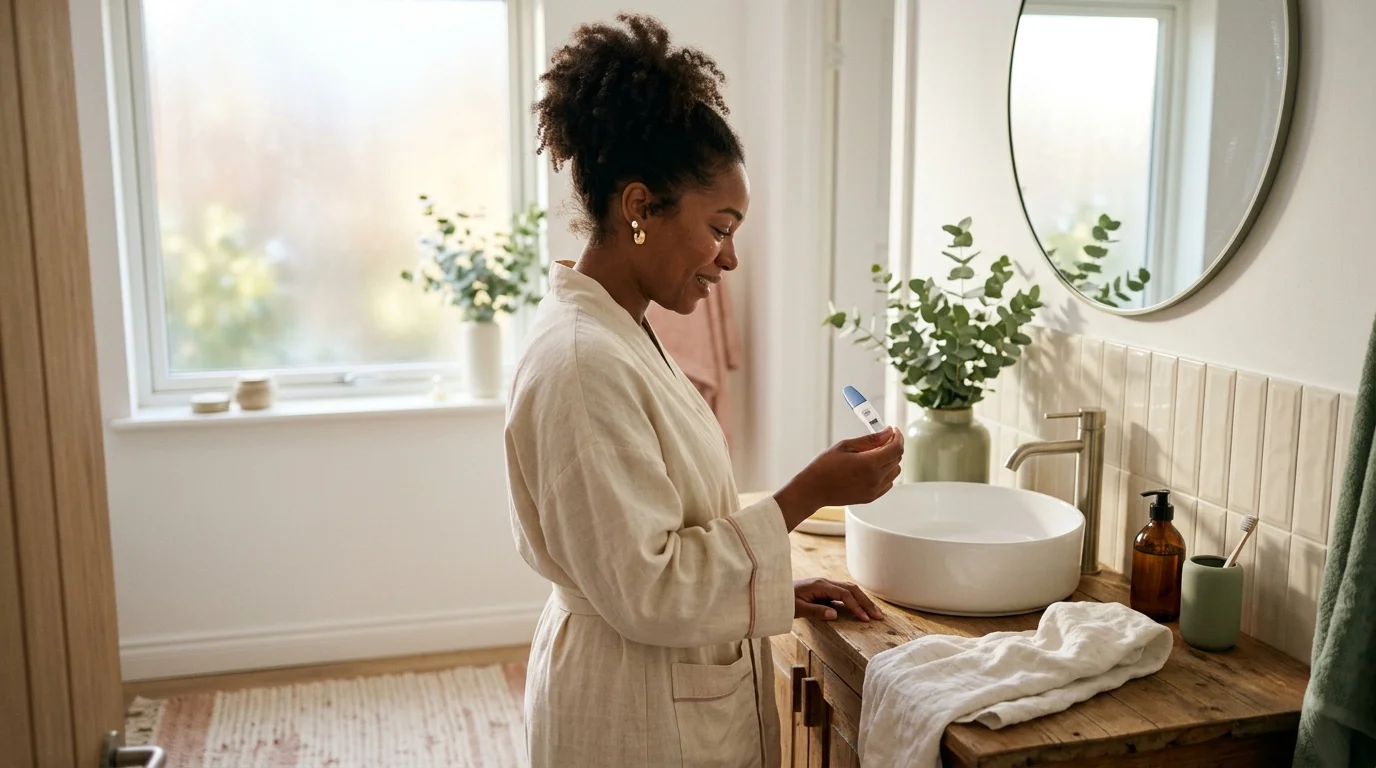
A pregnancy test at home is usually the quickest private way to find out whether you might be pregnant. Most home tests use urine to look for human chorionic gonadotropin, or hCG, the hormone that rises after implantation.
The hard part is timing. Test too early and you can get a negative result even if you are pregnant. Test at the right time, follow the instructions, and a home pregnancy test is usually very reliable.
This guide explains when to test, how to take a home test correctly, what positive and negative results mean, and when to contact a clinician.
When to Take a Pregnancy Test at Home
For most people, the best time to take a pregnancy test at home is from the first day of a missed period. NHS guidance says most pregnancy tests can be used from that point.
If you do not know when your next period is due, test at least 21 days after unprotected sex. This matters if your cycles are irregular, you recently stopped birth control, you are breastfeeding, or you are not tracking ovulation.
Some early-result tests say they can be used before a missed period. That can be useful, but it comes with a tradeoff: the earlier you test, the easier it is to miss a pregnancy because hCG may still be too low in urine.
Use the ovulation tracker if you are trying to understand cycle timing, and use the due date calculator after a positive test to estimate how far along you may be.
Quick Timing Guide
| Situation | What to do |
|---|---|
| Period is due today | Test today if pregnancy is possible |
| Period is late | Test now |
| Period timing is unknown | Test 21 days after unprotected sex |
| Test is negative but period does not come | Repeat in a few days |
| You have severe pain, heavy bleeding, dizziness, or fainting | Seek medical advice urgently |
How Home Pregnancy Tests Work
Home pregnancy tests are qualitative urine tests. That means they answer a yes-or-no question: is there enough hCG in this urine sample for the test to detect?
hCG appears after a fertilized egg implants in the uterus. In early pregnancy, hCG rises quickly. The FDA notes that if you have a 28-day menstrual cycle, hCG may be detectable in urine about 12 to 15 days after ovulation.
Different tests have different sensitivity levels, and people do not all ovulate on day 14. That is why a negative test very early is not final.
Blood tests ordered by a clinician can measure hCG more precisely, but most people do not need a blood test just to confirm a clearly positive home urine test. Blood testing is more useful when your clinician needs to follow hCG over time, assess bleeding or pain, or clarify an uncertain result.
How to Take a Pregnancy Test Correctly
Read the instructions for the specific test you bought. Brands differ in how long to hold the test in urine, how long to wait, and how to interpret faint lines or digital results.
For the most reliable home test:
- Check the expiration date before using it.
- Use first morning urine if you are testing early.
- Avoid drinking a large amount of fluid right before testing.
- Either hold the test in your urine stream or dip it in collected urine, depending on the instructions.
- Place it flat while waiting if the instructions say to.
- Read the result only within the stated time window.
Reading a test too late can be misleading because evaporation lines or display changes may appear after the official reading window. If you miss the window, take a new test.
Positive Pregnancy Test at Home
A positive home pregnancy test usually means you are pregnant, especially if the result appears within the test's reading window and you followed the instructions.
A faint line can still count as positive. Early in pregnancy, hCG may be present but low, so the test line can be pale. If you are unsure, repeat the test in 2 to 3 days. hCG usually rises quickly in early pregnancy, so the line may become clearer.
After a positive test, practical next steps are:
- Start or continue a prenatal vitamin with folic acid.
- Avoid alcohol, smoking, and recreational drugs.
- Review medications and supplements with a clinician or pharmacist.
- Schedule pregnancy care.
- Estimate your due date with the due date calculator.
- Read what can happen next in early signs of pregnancy.
WHO advises contacting a health worker as soon as possible after pregnancy is confirmed. In the United States, that usually means calling an OB-GYN, midwife, family physician, clinic, or health center to ask when your first prenatal visit should be.
Negative Pregnancy Test at Home
A negative result means the test did not detect enough hCG in that urine sample. It does not always mean you are definitely not pregnant.
Common reasons for a false negative include:
- Testing before hCG has risen enough.
- Ovulating later than expected.
- Using urine that is diluted from drinking a lot of fluid.
- Not following the test directions.
- Reading the test too early or too late.
- Using an expired or damaged test.
If your period still does not come, repeat the test in a few days. If you keep getting negative tests and still have no period, contact a clinician. Missed or irregular periods can also come from stress, weight change, intense exercise, thyroid conditions, polycystic ovary syndrome, breastfeeding, perimenopause, or medication changes.
When to Call a Clinician
Call a clinician after a positive home test to start pregnancy care, especially if you have a medical condition, take prescription medication, have a history of ectopic pregnancy or miscarriage, or are unsure what you want to do next.
Seek urgent care now if you have a positive test with:
- Heavy vaginal bleeding.
- Severe abdominal or pelvic pain.
- One-sided pain.
- Shoulder pain.
- Dizziness or fainting.
- Trouble breathing.
- A symptom that feels seriously concerning.
These symptoms do not always mean something dangerous is happening, but they can be warning signs. CDC maternal warning-sign guidance is clear that severe pain, heavy bleeding, fainting, and breathing problems deserve prompt care during pregnancy.
Home Test, Blood Test, or Ultrasound?
A home urine test is usually the first step. It is private, fast, and inexpensive.
A blood test may be used if your clinician needs more information, such as the exact hCG level or whether hCG is rising appropriately. This can matter with bleeding, pain, fertility treatment, prior ectopic pregnancy, or unclear urine test results.
An ultrasound does not usually confirm a very early pregnancy immediately. It becomes more useful after enough time has passed for a pregnancy to be visible. AAP and other prenatal care resources emphasize that pregnancy care includes timed screening tests and ultrasound exams later in pregnancy, not just the first positive test.
Frequently Asked Questions
When should I take a pregnancy test at home?
Test from the first day of a missed period if your cycles are regular. If you do not know when your period is due, test at least 21 days after unprotected sex.
Is morning urine better for a pregnancy test?
Morning urine is usually most concentrated, so it can help when testing early. If your period is already late, many tests can work at any time of day when used correctly.
Can a negative pregnancy test be wrong?
Yes. A negative test can be wrong if you tested too early, ovulated later than expected, used diluted urine, or did not follow the instructions. Repeat the test in a few days if pregnancy is still possible.
Does a faint line mean I am pregnant?
Usually, yes, if the line appears during the official reading window. A faint line often means hCG is present but still low. Repeat the test in 2 to 3 days if you want a clearer result.
What should I do after a positive test?
Start pregnancy care, take folic acid if you are not already, avoid alcohol and smoking, review medications with a clinician, and estimate your due date. If you have severe pain, heavy bleeding, dizziness, or fainting, seek urgent medical care.
Next Steps
If the test is positive, the next useful step is planning, not panic. Use the due date calculator, then read the first trimester guide so you know what appointments, symptoms, and early decisions may come next.
If the test is negative and your period still has not arrived, wait a few days and test again. Your body may simply need more time to produce enough hCG for the test to detect.
Sources
- U.S. Food and Drug Administration. Pregnancy. https://www.fda.gov/medical-devices/home-use-tests/pregnancy
- NHS. Doing a pregnancy test. https://www.nhs.uk/pregnancy/trying-for-a-baby/doing-a-pregnancy-test/
- Office on Women's Health. Pregnancy tests. https://womenshealth.gov/a-z-topics/pregnancy-tests
- MedlinePlus. Pregnancy Test. https://medlineplus.gov/lab-tests/pregnancy-test/
- Centers for Disease Control and Prevention. Urgent maternal warning signs. https://www.cdc.gov/hearher/maternal-warning-signs/index.html
- World Health Organization. Getting the health services you need during pregnancy. https://www.who.int/tools/your-life-your-health/life-phase/pregnancy--birth-and-after-childbirth/getting-the-health-services-you-need-during-pregnancy
- American Academy of Pediatrics. Tests & Screenings During Pregnancy. https://www.healthychildren.org/English/ages-stages/prenatal/Pages/Tests-During-Pregnancy.aspx