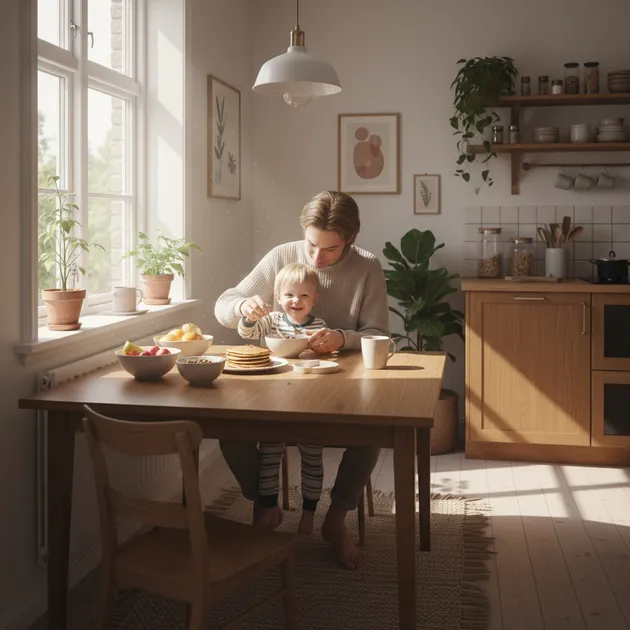
Mornings with young children. You had imagined calm breakfasts with fresh-baked rolls and coffee enjoyed in peace. In reality, it feels more like a military operation, you're trying to dress a wriggling child, feed someone who would rather play, and locate the one missing mitten, all while you haven't even brushed your own teeth yet.
There is no magic solution that makes mornings perfect. But with a few simple adjustments you can significantly reduce the stress, and maybe even enjoy that first cup of coffee while it's still warm.
Why are mornings so difficult?
Before we look at solutions, it helps to understand why mornings feel so chaotic:
- Time pressure, there is a hard deadline (daycare, work) that cannot be moved
- Little control, children do not follow your schedule
- Everyone is tired, morning is often the point of the day when everyone has the least reserves
- Many tasks, food, clothes, hygiene routines, packing, all compressed into a short window
- Unpredictability, the baby has a blowout just as you finish dressing them, or your toddler refuses to put on their shoes
It is completely normal for mornings to be challenging. You are not alone, and you are doing better than you think.
The golden rule: Do as much as possible the night before
The single most important morning routine hack has nothing to do with the morning itself. What you do the evening before determines whether the morning is chaotic or manageable.
Evening preparations that make mornings easier
Clothes:
- Lay out clothes for your child (and yourself) the night before
- Check the weather forecast and choose outerwear
- Have a spare outfit available for unexpected accidents
Food:
- Set the breakfast table the night before
- Prepare what you can, slice bread, make oatmeal for reheating, mix smoothie ingredients
- Fill water bottles and pack the lunchbox for daycare
Bag:
- Pack the daycare bag the night before
- Check that spare clothes, diapers, and bibs are included
- Put keys, wallet, and phone in a fixed spot
Practical:
- Set shoes and outerwear by the door
- Set the alarm 15 minutes earlier than you think you need
- Get yourself ready (showered, dressed) before your child wakes up, if possible
Create a fixed "evening checklist" on a piece of paper by the front door. Tick off the items each evening: clothes, food, bag, shoes, keys. After a few weeks it becomes automatic.
Age-adapted morning routines
A morning routine for a six-month-old baby is completely different from one for a three-year-old. Here are tailored tips for different ages:
Baby 0–6 months: Follow your baby's rhythm
At this stage, the morning is driven by your baby's needs, feeding, diaper changes, and sleep. Focus on:
- Flexibility, your baby sets the pace
- Preparation, have diapers, clothes, and food within easy reach
- Early feeding, feed your baby as early as possible to avoid hunger cries later
- Combining diaper change and clothing for efficiency
- A baby carrier can be a lifesaver, your baby is content and your hands are free
Baby 6–12 months: Introduce routine gradually
Now you can begin building a simple, consistent sequence:
- Wake up, diaper change, morning clothes
- Breakfast (breastfeeding/bottle + solid food)
- Play or floor time while you get yourself ready
- Pack the bag and put on outerwear
- Out the door
Tips for this age:
- Let your baby eat in the high chair with finger foods while you prepare the rest
- Keep a few "special" toys that are only used in the mornings to keep your baby occupied
- If there are two of you, take turns on who gets the baby ready and who does the rest
Toddler 1–2 years: Offer simple choices
Toddlers are starting to have opinions. Use this to your advantage:
- Give a choice between two options: "Do you want the blue or the red sweater?"
- Let your child "help": Hold the diaper, put the shoe on the shelf, lay the spoon on the table
- Use consistent phrases: "It's breakfast time now!" gives predictability
- Use pictures: A visual morning routine chart with images of each step can be very helpful
Toddlers are slowly effective. They can manage surprisingly many things on their own, but it takes time. Expect everything to take twice as long as you think, and plan accordingly.
Toddler 2–3 years: Independence and positive reinforcement
Two- and three-year-olds can do a great deal themselves with a little preparation:
- Clothes within reach: Put clothes in a drawer your child can open themselves
- Shoes on the right feet: Place shoes with the insoles facing each other, so your child finds the correct foot
- Own tasks: "You put your shoes on while I get your jacket"
- Reward system: A simple sticker chart can motivate, "when all the morning jobs are done, you pick the music in the car"
- Consistent order: Always the same sequence builds security and predictability
Breakfast: How to make it easier
Breakfast is often the bottleneck. Here are ways to simplify it:
Quick and nutritious breakfast ideas for babies and toddlers
- Oatmeal, make a large batch, reheat in portions throughout the week
- Bread with toppings, butter, nut butter, soft cheese, simple and familiar
- Fruit in pieces, banana, blueberries, pear slices, no preparation needed
- Yoghurt with fruit, from around 10 months
- Boiled eggs, make several on Sunday, store in the fridge (good for 5–7 days)
- Pancakes, make large batches at the weekend and freeze; warm in the toaster in the morning
Breakfast hacks
- Sit down and eat together, your child eats better when you eat too
- Limit the options, two or three choices is plenty
- Set a time limit, "in five minutes we clear up" gives a warning
- Accept the mess, letting your child feed themselves is more important than a clean table
- Bib and mat, save cleanup time with good protection underneath
Sleep and the morning routine
The morning routine really starts with the bedtime routine the night before. Well-rested children (and parents) have easier mornings.
Tips for better mornings through better sleep
- Consistent bedtime, helps your child wake at roughly the same time each day
- Early enough bedtime, overtired children sleep worse and wake more often
- Consistent morning start, open the curtains, say good morning, change the diaper
- Avoid screens in the morning, they can make the transition to breakfast and getting dressed harder
Use Babysential's sleep tracker to find out whether your child is getting enough sleep. Well-rested children are more cooperative in the morning.
When there are two of you: dividing morning tasks
If there are two parents in the household, a clear division of labour is the key:
System 1: Fixed roles
- Person A: Gets the child ready (clothes, food, hygiene)
- Person B: Packs the bag, prepares food, tidies, gets themselves ready
System 2: Alternating
Swap roles every other day or every other week. Both learn all the tasks, and neither feels stuck.
System 3: Early/late
- Early person: Gets up first, gets ready in peace, starts breakfast preparations
- Late person: Takes over with the child, gets the child ready, does the daycare drop-off
The important thing is that the arrangement is explicitly agreed on, not assumed. Talk about what works and adjust as you go.
When everything goes wrong
Some days are just terrible. The baby hasn't slept, the toddler is in full meltdown mode, you can't find your keys, and you're already running late. That's okay. Here are survival tips:
- Let go of perfect, breakfast in the car is better than no breakfast
- Clothes don't need to match, your child will survive in stripes and polka dots
- Call the daycare, "we're going to be a little late today" takes 30 seconds and removes time pressure
- Breathe, stop for 10 seconds, take a deep breath, and start again
- Humour helps, laugh at the chaos instead of stressing over it
It's okay to have bad mornings. Everyone has them. A chaotic morning doesn't make you a bad parent , it makes you a normal parent.
Morning routine checklist
Here is a simple checklist you can put on the fridge:
The night before:
- Clothes laid out (child + adult)
- Daycare bag packed
- Breakfast prepared
- Shoes and outerwear by the door
- Keys and wallet in a fixed spot
In the morning:
- Diaper change / toilet visit
- Morning clothes on
- Breakfast
- Teeth / face
- Outerwear and shoes
- Out the door
Frequently asked questions
How early should I get up? Ideally 15–30 minutes before your child wakes. It gives you time to get yourself ready, which makes the rest of the morning much easier. Try it for a week and see whether it helps.
My child refuses to get dressed. What do I do? Give a choice between two options, let your child try themselves (even if it takes a while), and use distractions like a song or a book during dressing. Avoid power struggles, flexibility wins.
Is it okay to use screens in the morning? Some parents use 10–15 minutes of children's TV to get time to get themselves ready. It's a personal choice. Be aware that screens can make the transition to the next activity harder for some children.
How do I manage two children of different ages? Get the older one ready first (they can start eating independently) and then handle the baby. Or let the older one "help" with the baby, it gives them an important role.
Should my child eat breakfast at home or at daycare? Many daycares offer breakfast. If mornings are very stressful, having your child eat at daycare can be a good solution. Check with your daycare about what's available.
Useful tools on Babysential
- Sleep tracker. Make sure your child (and you) get enough sleep for good mornings
- Checklists. Create and customise checklists for your morning routine
- Milestone tracker. Track your child's growing independence
Read also: Dividing household tasks | Parental burnout | Starting daycare, how to prepare | Sleep routines for babies
Sources
- WHO / AAP: Recommendations on nutrition and physical activity (children 0–5 years)
- CDC: Children's sleep needs (cdc.gov/sleep)
- AAP: Everyday advice for families with young children
🔧 Helpful Tools
- All Baby Tools. Browse all free tools for pregnancy and baby care