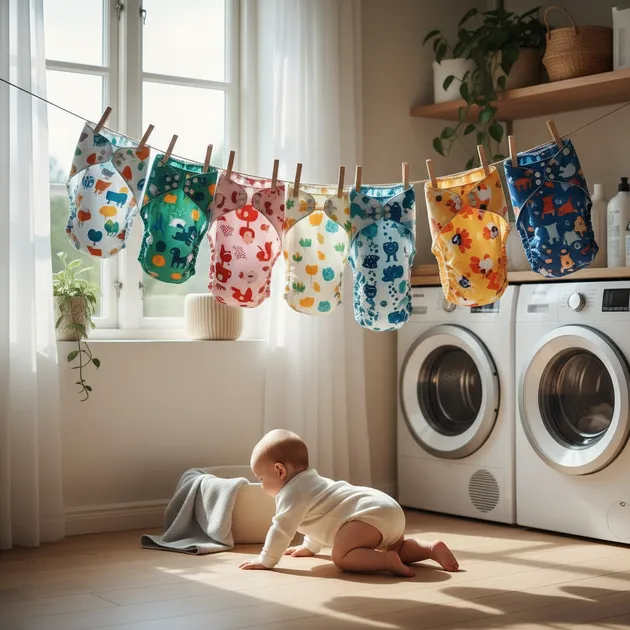
A child uses between 5,000 and 6,000 disposable diapers before being potty trained. That is a lot of waste, and a significant expense. Cloth diapers are an alternative that saves the environment, your wallet, and often results in fewer cases of diaper rash.
This guide gives you everything you need to get started with cloth diapers, from the types available to washing routines and everyday tips.
Why choose cloth diapers?
Environment
A disposable diaper takes 500 years to break down. According to environmental agencies, hundreds of thousands of tons of diapers are thrown away each year worldwide. Cloth diapers can be reused hundreds of times and used for multiple children. Even accounting for electricity and water for washing, cloth diapers have a lower carbon footprint than disposables, according to lifecycle analyses.
Cost
Disposable diapers typically cost $1,500–$3,000 over the entire diaper period. A complete set of cloth diapers costs $300–$800 and lasts until the child is potty trained, and can be used for the next child.
Skin
Cloth diapers contain no chemicals, superabsorbents, or fragrances. Many parents report less diaper rash after switching to cloth diapers. Natural materials like cotton and bamboo breathe better than synthetic materials.
Potty training earlier
Children in cloth diapers feel better when they are wet. This can make the transition to potty training easier and earlier.
Types of cloth diapers
There are several systems. Here are the most important ones.
All-in-one (AIO)
The entire diaper is in one piece, the absorbent layer is sewn onto the waterproof outer shell. You use it like a disposable diaper: on, off, into the wash.
Pros: Easiest to use. Perfect for daycare, grandparents, and skeptical partners.
Cons: Longest drying time. Often more expensive per diaper.
Pocket diaper
A waterproof shell with an opening (pocket) where you insert an absorbent insert. You can adjust absorption capacity by inserting more or less.
Pros: Quick drying because parts separate. Flexible absorption. Most popular type.
Cons: You need to stuff the pocket before use. A little more work than AIO.
Prefolds and flats
Traditional folded cloth diapers fastened with a diaper pin or Snappi clip. Used with a separate waterproof cover.
Pros: Cheapest per diaper. Simple washing and quick drying. Very versatile, can be folded in many ways.
Cons: Requires some practice with folding. Needs a separate cover.
Fitted diaper
A shaped diaper that fits like a disposable but without a waterproof layer. Used with a cover.
Pros: Good fit and high absorption. Especially popular as a nighttime diaper.
Cons: Needs a cover. Longer drying time than prefolds.
Not sure which type to choose? Start with pocket diapers. They are the most popular among cloth diaper parents, easy to use, and available at all price points.
Materials
The material in the absorbent layer matters a lot for performance and comfort.
Bamboo viscose. Soft, absorbent, and naturally antibacterial. The most popular material for inserts. Dries somewhat more slowly than cotton.
Cotton. Durable, affordable, and tolerates high wash temperatures. Good absorption that increases after several washes. Dries faster than bamboo.
Microfiber. Synthetic material that absorbs quickly. Should not lie directly against the skin as it can dry it out. Often used as an inner layer in pocket diapers.
Hemp. Extremely absorbent but absorbs slowly. Often used as a booster (extra insert) in combination with cotton or bamboo.
Wool. Naturally water-repellent. Wool covers need less frequent washing, airing and lanolizing keeps them fresh.
How many cloth diapers do you need?
To wash every other day you need:
| Baby's age | Diapers per day | Recommended number |
|---|---|---|
| Newborn (0–3 months) | 10–12 | 24–30 |
| Baby (3–12 months) | 8–10 | 20–25 |
| Toddler (12+ months) | 6–8 | 18–20 |
Starter kit for most: 20–25 one-size diapers cover the need from about 9 lbs until the child is potty trained. Some choose separate newborn diapers for the first months.
Washing routine
Washing cloth diapers is simpler than many think. Here is a basic routine.
Step 1: Remove solids
Rinse off feces in the toilet. For breastfed babies with loose stools, you can use a flushable liner, or just rinse the diaper under running water. Breast milk stools are water-soluble and need no special treatment.
Step 2: Storage
Place used diapers in a bucket with a lid (dry storage). Do not soak, it breaks down the materials and can promote bacterial growth. Air circulates better with an open mesh bag insert in the bucket.
Step 3: Pre-wash
Run a short pre-wash (30–40 minutes) at 40°C (104°F) with a small amount of detergent. This removes the worst of the urine and feces.
Step 4: Main wash
Run a full wash cycle at 40–60°C (104–140°F) with a full dose of detergent. Fill the machine two-thirds full for good mechanical washing. Use a regular detergent without fabric softener, fabric softener reduces absorbency.
Step 5: Drying
Line drying is gentlest and saves energy. A tumble dryer on low heat is fine for inserts, but not for PUL fabric (the waterproof layer in covers and shells).
Common question about smell: Do the diapers smell after washing? Increase the detergent dose or temperature. A "strip wash" (wash with extra detergent and rinsing) can remove built-up residue if the problem persists.
Cloth diapers vs disposable diapers
| Cloth diapers | Disposable diapers | |
|---|---|---|
| Total cost | $300–$800 | $1,500–$3,000 |
| Environmental impact | Lower CO₂, water, and energy use | 500 years to decompose per diaper |
| Chemicals | None | Superabsorbents, fragrances |
| Practical | Requires washing 2–3 times per week | Use and discard |
| Diaper rash | Often less | Varies |
| Daycare | Accepted at most places | Standard |
Cloth diapers at daycare
Most daycare centers accept cloth diapers. The key is to make it easy for the staff.
Send AIO or pocket diapers that work like disposables, no folding or extra steps required. Label the diapers with the child's name. Send a wet bag for used diapers that staff simply drop the diaper into.
Talk to the daycare early. Explain the system and show them how simple it is. Most are positive once they see it requires no extra work.
Myths about cloth diapers
"It's unhygienic." Diapers washed at 60°C (140°F) are just as clean as other clothes. Detergent kills bacteria. You also wash the baby's clothes that get soiled.
"They leak more than disposables." Properly fitted cloth diapers rarely leak. Leakage is almost always due to the wrong size, worn-out elastic, or too little absorption, not the diaper type itself.
"It's too much work." With a good routine it takes 15–20 extra minutes per week. You start a wash and hang it up, very little hands-on time.
"You have to go all or nothing." Many use cloth diapers at home and disposables while traveling or at night. A combination is completely fine.
Tips for beginners
Start after the newborn period. The first few weeks are chaotic enough. Many start with cloth diapers from 1–2 months of age when everyday life has settled down a bit.
Buy a trial pack. Many stores sell trial packs with various brands and types. Test what works for you and your baby before investing in a full set.
Find a community. Online groups for cloth diaper parents have thousands of members who share tips, experiences, and second-hand diapers.
Be patient. It takes 2–3 weeks to find a routine. After that it runs on autopilot.
Frequently asked questions
How much do I save with cloth diapers?
With disposables at $1,500–$3,000 and cloth diapers at $300–$800, you save at least $1,000–$2,000 per child. If you use the diapers for multiple children, the savings increase significantly. Electricity and detergent cost around $100–$150 per year.
Can I use cloth diapers from birth?
Yes, but you need separate newborn diapers for babies under 9–10 lbs. One-size diapers are too large for newborns. Alternatively, you can use disposables for the first weeks and start with cloth diapers when the baby has grown a little.
Do cloth diapers smell?
Properly washed cloth diapers have no smell after washing. During storage between washes (1–2 days), there may be some smell of urine, a bucket with a lid keeps the smell contained. Persistent smell after washing means the washing routine needs adjusting.
Do I need special detergent?
No. Regular, fragrance-free detergent works fine. Avoid fabric softener, it coats the fabric and reduces absorbency. Also avoid detergent with optical brighteners as these can irritate sensitive skin.
Do cloth diapers work at night?
Yes, with the right setup. Use a fitted diaper or pocket diaper with extra hemp or bamboo inserts. A wool cover provides extra protection. Many parents use cloth diapers at night without leaks.
Read more
Sources
- Environment Agency (2008). "An updated lifecycle assessment for disposable and reusable nappies." Science Report SC010018/SR2.
- EPA. Municipal Solid Waste
- AAP. Diaper Care Guidelines
🔧 Helpful Tools
- All Baby Tools. Browse all free tools for pregnancy and baby care
📖 Related Articles
- Sustainable Baby Gear: Eco-Friendly Choices for Your Baby. Want to make eco-friendly choices for your baby? Here's your guide to sustainable baby gear, from secondhand shopping and quality brands to cloth diapers.