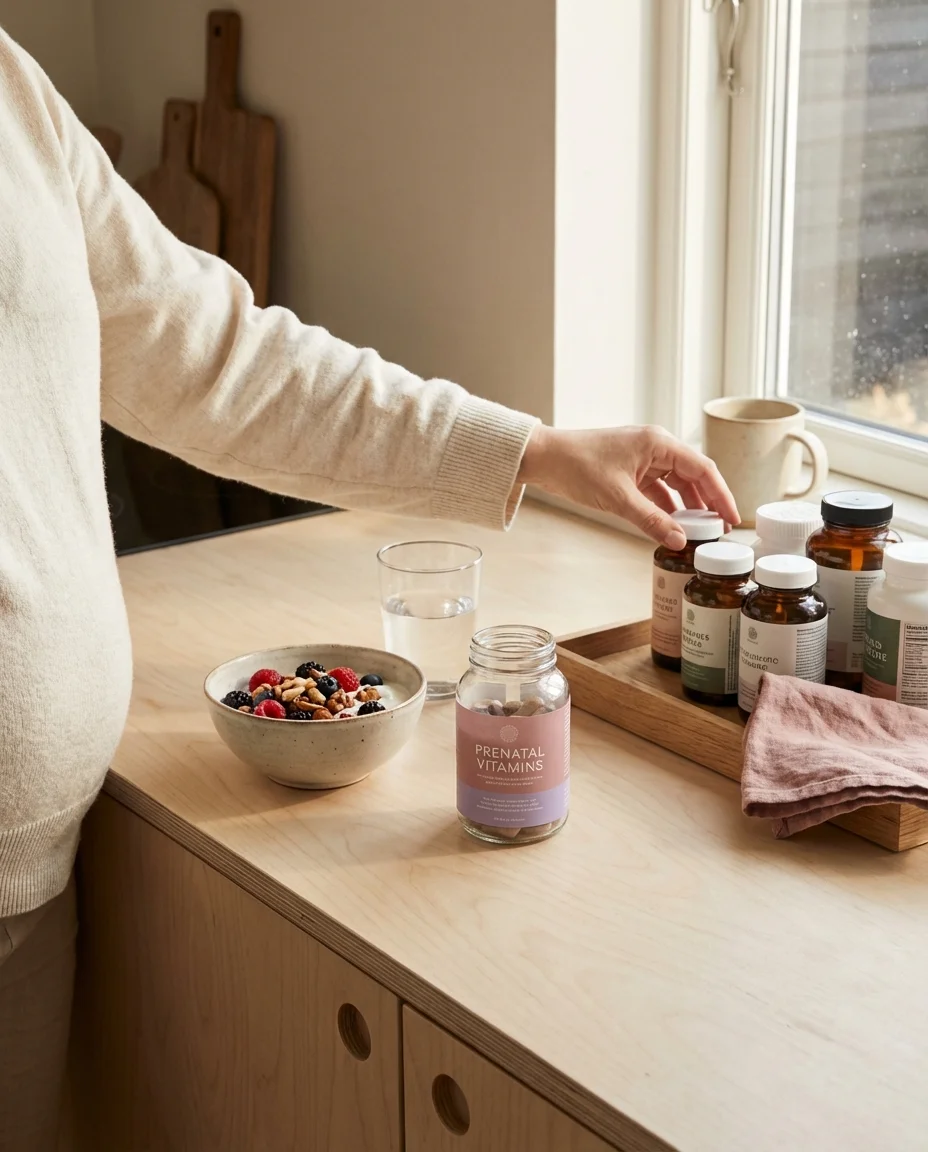
The best prenatal vitamin is not always the most expensive bottle or the one with the longest ingredient list. It is the one you can take consistently, that covers the nutrients pregnancy actually increases, and that fits your lab results, diet, nausea level, and budget.
Most people shopping for prenatal vitamins are trying to answer the same practical question: "Which one should I buy?" This guide gives you a checklist instead of a brand ranking. Product formulas change, prices change, and your own needs may change by trimester. The label standards below are the part that stays useful.
If you are already pregnant, start with any prenatal vitamin that contains folic acid today, then refine the choice with your OB-GYN or midwife. Do not wait for the perfect product.
What the Best Prenatal Vitamins Have in Common
The strongest prenatal vitamins cover the nutrients that are difficult to get reliably from food alone during pregnancy. According to ACOG, pregnancy nutrition needs include folic acid, iron, calcium, vitamin D, choline, omega-3 fatty acids, B vitamins, vitamin C, and iodine.
When you compare labels, prioritize these:
| Nutrient | Good target on the label | Why it matters |
|---|---|---|
| Folic acid or folate | At least 400 mcg folic acid, often 600-800 mcg DFE | Helps prevent neural tube defects |
| Iron | About 27 mg, unless your provider says otherwise | Supports extra blood volume and helps prevent anemia |
| Iodine | 150-220 mcg | Supports thyroid function and baby's brain development |
| Vitamin D | 600 IU / 15 mcg or more if prescribed | Supports bones and immune function |
| DHA | 200-300 mg, often in a separate softgel | Supports brain and eye development |
| Choline | Ideally meaningful amount, often 100-450 mg | Supports brain and spinal cord development |
| Vitamin B12 | At least 2.6 mcg | Especially important for vegetarians and vegans |
No single prenatal is perfect. Many excellent multivitamins leave out DHA, calcium, magnesium, or most of the recommended choline simply because those nutrients take up physical space. That is normal. The goal is to know what your prenatal covers and what may need to come from food or a second supplement.
Best Overall Approach: Choose by Nutrient Coverage First
For most pregnant people in the US, a good default prenatal vitamin contains folic acid, iron, iodine, vitamin D, B12, and a moderate amount of choline. DHA may be included, but it is often sold separately.
This type of prenatal is best if:
- You are trying to conceive or newly pregnant
- You want one daily routine that covers the basics
- You are not sure yet whether your iron or vitamin D is low
- You eat a mixed diet but want insurance against gaps
Look for third-party testing when possible, such as USP, NSF, or another independent quality program. Supplements are regulated differently than medications, so third-party testing is useful for label accuracy and contamination screening.
If you are comparing two similar products, choose the one you can actually tolerate. A technically perfect prenatal that makes you vomit every morning is not the best prenatal for you.
Best Prenatal Vitamins for Nausea or Sensitive Stomachs
The first trimester can make even a normal vitamin feel impossible. If your prenatal makes nausea worse, the usual triggers are iron, pill size, smell, or taking it on an empty stomach.
Try these adjustments:
- Take it at night instead of in the morning
- Take it with a small snack
- Split the dose if the label allows it
- Try a smaller capsule or a delayed-release formula
- Ask whether you can use a lower-iron prenatal temporarily
Prenatal gummies can be easier to tolerate, but read the label carefully. Many gummy prenatal vitamins do not contain iron, and many contain little or no DHA, iodine, or choline. Gummies can be a good short-term bridge during nausea, but they are not automatically complete.
If you cannot keep vitamins, food, or fluids down, contact your healthcare provider. Severe pregnancy nausea can require treatment, and hydration matters more than forcing a large prenatal.
For more nausea strategies, read pregnancy nausea guide, and use the due date calculator to map symptoms against your trimester.
Best Prenatal Vitamins With DHA
DHA is an omega-3 fatty acid involved in fetal brain and eye development. Many OB-GYNs recommend about 200-300 mg DHA daily during pregnancy, especially if you do not eat low-mercury fish regularly.
There are two common ways to get DHA:
- A prenatal multivitamin that includes DHA
- A separate prenatal DHA softgel or algae-based DHA supplement
A separate DHA supplement is not a problem. In fact, it can make sense because DHA is an oil, while most prenatal nutrients are dry vitamins and minerals. Separate capsules also let you switch DHA brands without changing your whole prenatal.
Choose algae-based DHA if you are vegan, vegetarian, or cannot tolerate fish oil. Choose fish oil only from brands that test for heavy metals and contaminants.
Best Prenatal Vitamins With Iron
Iron needs rise during pregnancy because your body makes more blood. ACOG lists 27 mg of iron per day as the recommended pregnancy intake. Many prenatal vitamins contain this amount.
Iron is helpful, but it is also one of the most common reasons prenatal vitamins cause constipation, nausea, or stomach pain. Some people need extra iron because ferritin or hemoglobin is low. Others may not need a high-iron product early on.
Talk to your provider about iron if:
- You have a history of anemia
- You are vegetarian or vegan
- You are carrying multiples
- Your prenatal causes constipation
- Your blood work shows low ferritin or hemoglobin
Iron bisglycinate is often gentler than ferrous sulfate for some people, though individual tolerance varies. Taking iron with vitamin C can improve absorption. Taking it with calcium, tea, or coffee can reduce absorption.
Best Prenatal Vitamins for Vegetarians and Vegans
Vegetarian and vegan pregnancies can be healthy, but the supplement checklist needs extra attention. The NIH Office of Dietary Supplements notes that pregnant people following vegetarian or vegan diets should talk with a healthcare provider about iron, B12, iodine, choline, zinc, and EPA/DHA.
If you eat no animal products, look closely for:
- Vitamin B12: Essential, because reliable food sources are animal-based or fortified
- Iron: Plant-based iron is less easily absorbed
- Iodine: Can be low without dairy, seafood, or iodized salt
- DHA: Choose algae-based DHA
- Choline: Often low if you do not eat eggs
Vegan prenatal vitamins may skip gelatin and fish-derived ingredients, but that does not guarantee complete coverage. Always compare the Supplement Facts panel, not just the front label.
When to Start Prenatal Vitamins
Start a prenatal vitamin at least one month before pregnancy if possible. The CDC recommends 400 mcg of folic acid every day for anyone who could become pregnant because neural tube development happens very early, often before a missed period.
If you are trying to conceive, start now. If pregnancy was unplanned, start as soon as you know. You still benefit from folic acid, iron, iodine, vitamin D, and other nutrients throughout pregnancy.
Related guides:
What to Avoid in a Prenatal Vitamin
Avoid using multiple overlapping supplements unless your provider has reviewed the labels. The risk is not usually folic acid at standard doses; it is accidentally stacking high doses of fat-soluble vitamins or minerals.
Be careful with:
- High-dose preformed vitamin A (retinol): Too much can be harmful in pregnancy
- Mega-dose formulas: More is not automatically better
- Proprietary blends: These can hide exact amounts
- Gummies as your only prenatal: Fine for some people, incomplete for others
- Unverified online brands: Especially if they make dramatic fertility or pregnancy claims
Also check serving size. Some prenatal vitamins require two, three, or even eight pills per day. A good formula only works if you can follow the dose.
FAQ: Prenatal Vitamins
Are prenatal vitamins necessary if I eat a healthy diet?
Usually, yes. A healthy diet matters, but folic acid is specifically recommended as a supplement before and during early pregnancy. Many people also need help meeting iron, iodine, vitamin D, DHA, or choline needs.
What is the most important ingredient in a prenatal vitamin?
Folic acid is the most time-sensitive because it helps prevent neural tube defects early in pregnancy. After that, iron, iodine, vitamin D, DHA, choline, and B12 are common label priorities.
Is folate better than folic acid?
Both appear on prenatal labels. CDC guidance specifically recommends 400 mcg of folic acid daily because folic acid is the form proven to help prevent neural tube defects. Some products list methylfolate or DFE; ask your provider if you are unsure how to compare labels.
Do prenatal vitamins help you get pregnant?
Prenatal vitamins prepare your nutrient stores for pregnancy, but they are not fertility medication. If you are trying, use the ovulation tracker and discuss irregular cycles, recurrent loss, or prolonged trying with your clinician.
Can I keep taking prenatal vitamins while breastfeeding?
Often yes. Many people continue a prenatal during breastfeeding, especially if diet is limited or iron, vitamin D, iodine, B12, or DHA intake is a concern. Ask your provider what fits your postpartum labs and feeding plan.
Bottom Line
The best prenatal vitamin is the one that covers the basics, fits your body, and does not create a routine you dread. Start with folic acid, make sure iron, iodine, vitamin D, B12, DHA, and choline are considered, and use your blood work and diet to personalize the rest.
If you are overwhelmed, choose a reputable prenatal with folic acid today, then bring the bottle or Supplement Facts photo to your next prenatal appointment.