Your baby's first tooth is an exciting milestone, and the beginning of a lifetime of dental care. Even though baby teeth are temporary, they are critically important for your child's development, speech, chewing, and the healthy positioning of adult teeth. In this guide, you'll find everything you need to know: when teeth come in, in what order, how to brush, fluoride recommendations, and when to schedule the first dental checkup.
When Do the First Teeth Appear?
Most babies get their first tooth between 6 and 8 months of age, but there is wide variation. Some babies have a tooth as early as 4 months; others don't see one until 12–14 months. Both extremes are completely normal.
If your baby has no teeth by 18 months, it is worth mentioning to your pediatrician or pediatric dentist. In most cases, it is simply a genetic variation, late teething often runs in families.
Rarely, babies are born with one or two teeth already through the gum ("natal teeth"). These are usually wobbly and may need to be removed to prevent a choking hazard. Your pediatrician will advise you.
Order of Tooth Eruption
Baby teeth come in a fairly predictable sequence, though timing varies. Most children have a full set of 20 baby teeth by age 2.5–3 years.
| Tooth | Name | Typical Age of Eruption |
|---|---|---|
| Lower central incisors | Bottom front teeth | 6–10 months |
| Upper central incisors | Top front teeth | 8–12 months |
| Upper lateral incisors | Top side front teeth | 9–13 months |
| Lower lateral incisors | Bottom side front teeth | 10–16 months |
| First upper molars | Upper back teeth | 13–19 months |
| First lower molars | Lower back teeth | 14–18 months |
| Upper canines (cuspids) | Upper pointed teeth | 16–22 months |
| Lower canines (cuspids) | Lower pointed teeth | 17–23 months |
| Second lower molars | Lower back teeth (2nd) | 23–31 months |
| Second upper molars | Upper back teeth (2nd) | 25–33 months |
The lower front teeth typically appear before the upper ones. Molars and canines come in later and can cause more noticeable teething discomfort due to their larger surface area.
Teething Signs: What to Expect
Teething is a normal developmental process, but it can be uncomfortable. Common signs that a tooth is about to emerge include:
- Drooling, often increases significantly in the weeks before a tooth appears
- Chewing and biting, babies seek pressure on the gums to relieve discomfort
- Gum swelling and redness, the area over the incoming tooth may look puffy and inflamed
- Irritability and fussiness, particularly in the day or two before and after the tooth breaks through
- Disrupted sleep, teething discomfort can cause night wakings
- Rubbing the cheek or ear on the same side as the incoming tooth
- Mild temperature, a very slight elevation in temperature can occur, but teething does NOT cause high fever
Teething does not cause high fever, diarrhea, or serious illness. If your baby has a fever above 100.4°F (38°C), a rash, or other concerning symptoms alongside teething, contact your pediatrician , there is likely another cause.
How to Soothe Teething Discomfort
- Chilled (not frozen) teething rings, the cold provides mild relief; never freeze teethers as they can become too hard and damage gum tissue
- Gentle gum massage, use a clean finger to apply gentle pressure to the gums
- Chilled washcloth, give your baby a cold, damp cloth to chew on
- Pain relief if needed, infant acetaminophen or ibuprofen (for babies 6 months and older) can help with significant discomfort; always follow dosing instructions and consult your pediatrician
Avoid: Teething gels containing benzocaine (can cause a rare but serious blood condition called methemoglobinemia), amber teething necklaces (choking and strangulation hazard), and homeopathic teething tablets with belladonna.
When to Start Brushing
The American Academy of Pediatric Dentistry (AAPD) and the American Dental Association (ADA) recommend beginning oral hygiene before the first tooth even arrives. Here is a stage-by-stage guide:
Before the First Tooth (Birth to ~6 Months)
Wipe your baby's gums once or twice a day with a clean, soft, damp cloth or gauze after feedings. This removes bacteria from the gums and helps your baby get used to having something in their mouth, making the transition to a toothbrush easier.
Ages 0–2 Years: First Tooth Onward
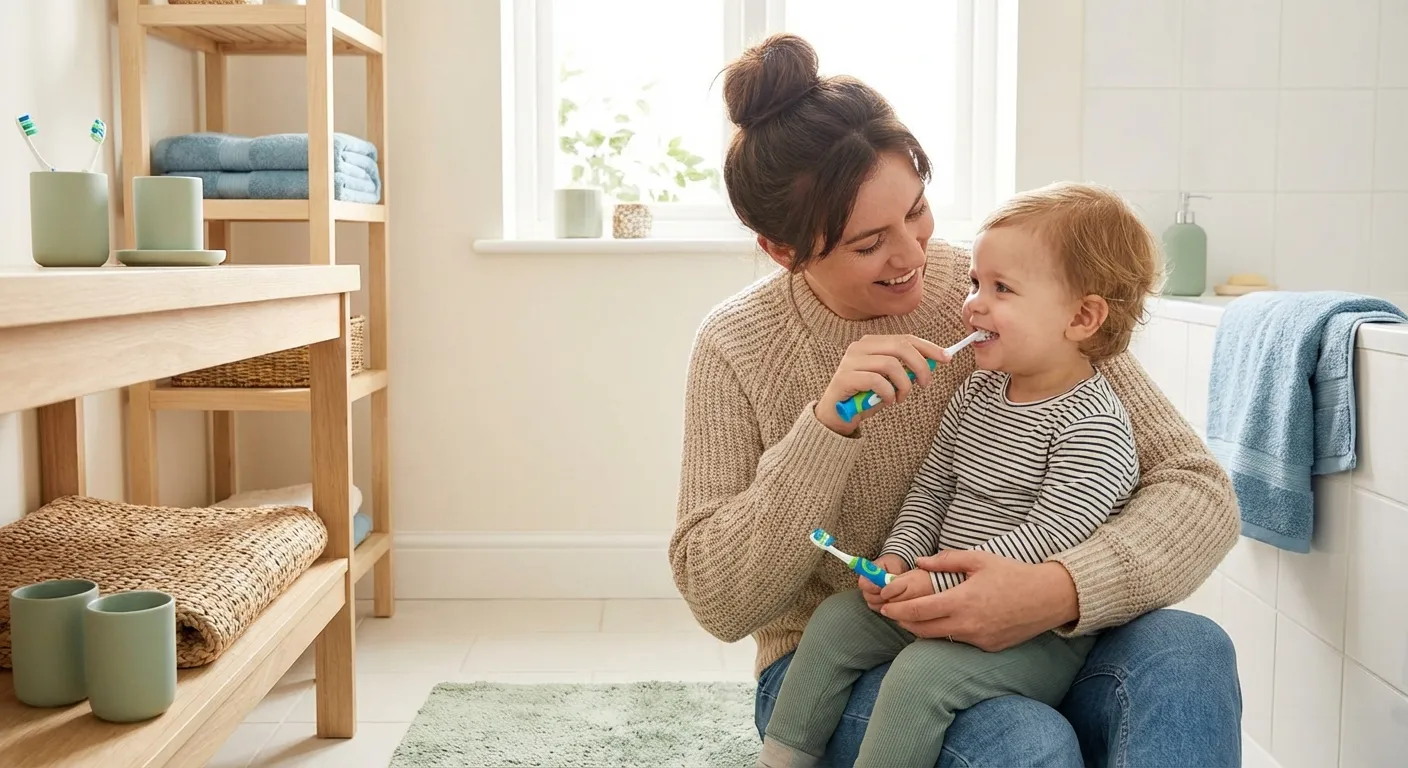
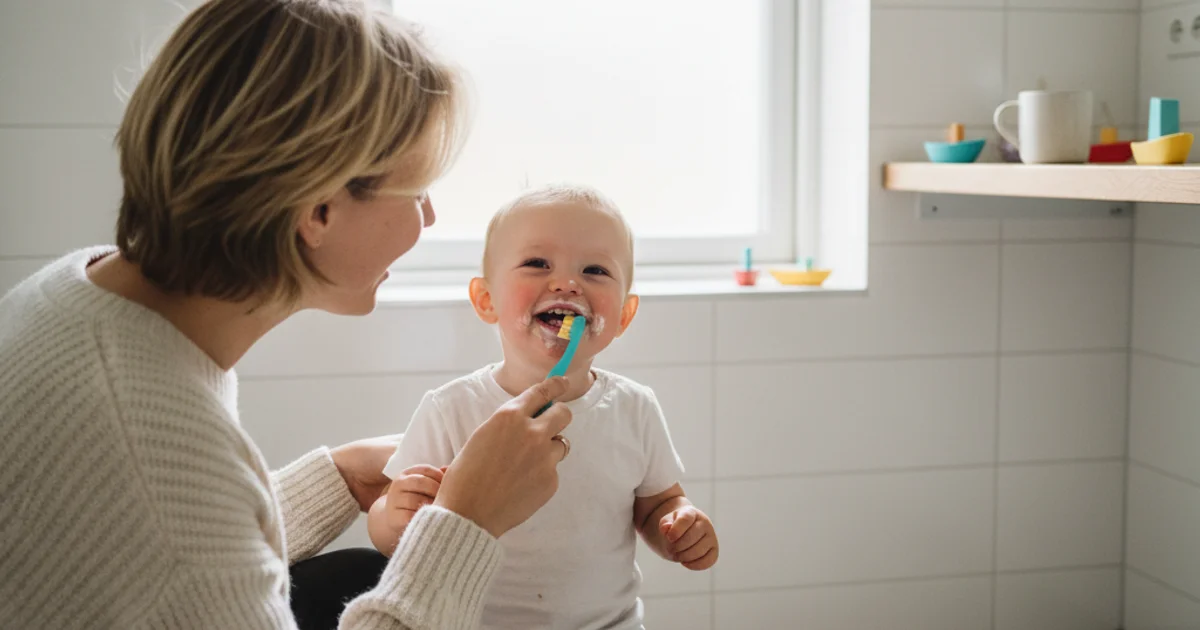
As soon as the first tooth appears, begin brushing:
- Toothbrush: Use an infant-sized, soft-bristled toothbrush
- Toothpaste: Use a fluoride toothpaste, a rice grain–sized amount (about 0.1 mg fluoride per use)
- Frequency: Brush twice daily, after breakfast and before bed
- Technique: Hold the brush at a 45-degree angle to the gum line; use gentle, circular motions; brush each tooth surface and along the gum line
- Duration: About 2 minutes total, though this is hard to achieve with infants, simply be thorough
- Adult supervision and help: At this age, parents do the brushing; children lack the fine motor skills to brush effectively on their own
Ages 2–6 Years
- Toothpaste: Increase to a pea-sized amount of fluoride toothpaste
- Frequency: Continue twice daily
- Spitting: Teach your child to spit out toothpaste rather than swallowing it; rinsing is not necessary and washing away the fluoride reduces its protective effect
- Supervision: Parents should assist and supervise brushing until at least age 6–7, when most children have the dexterity to brush adequately on their own
- Flossing: Begin flossing as soon as two teeth are touching, usually around age 2–3
Make brushing fun: use a two-minute timer, play a brushing song, let your child choose their own toothbrush, and take turns brushing each other's teeth (pretend). Routine and positive association are more important than perfection.
Fluoride Recommendations (AAP / ADA Guidelines)
Fluoride is a naturally occurring mineral that strengthens tooth enamel and prevents cavities. Both the American Academy of Pediatrics (AAP) and the American Dental Association (ADA) recommend fluoride toothpaste from the moment the first tooth appears.
Fluoride Toothpaste Dosing by Age
| Age | Amount of Fluoride Toothpaste |
|---|---|
| Birth to 3 years | Smear/rice grain–sized amount (approx. 0.1 mg F) |
| 3–6 years | Pea-sized amount (approx. 0.25 mg F) |
| 6 years and older | Standard pea-sized or slightly more |
Fluoride in Water
In communities where tap water contains fluoride (at the recommended level of 0.7 ppm in the US), children who drink tap water receive additional systemic fluoride benefit. If your household uses well water or a water filter that removes fluoride, ask your pediatric dentist about fluoride supplements.
Fluoride Varnish
Pediatric dentists may apply fluoride varnish (a concentrated fluoride treatment painted directly onto teeth) at routine checkups starting around 6 months of age, before teeth erupt, or as soon as teeth appear. The AAP recommends this as a standard preventive care measure.
Is Fluoride Safe?
Yes, when used in the recommended amounts, fluoride is safe and highly effective. The main risk from excess fluoride in early childhood is dental fluorosis, white spots or streaks on the permanent teeth, which occurs only with excessive ingestion of fluoride during tooth development. This is why using the correct small amount of toothpaste is important.
Diet and Dental Health
What your child eats and drinks has a significant impact on dental health:
- Limit sugary foods and drinks, sugar feeds bacteria that produce acid and cause cavities
- No juice before age 1, the AAP recommends no fruit juice for babies under 12 months; limit to 4 oz per day for ages 1–3
- No juice or milk in a bottle at bedtime, putting a baby to bed with a bottle of milk, formula, or juice is a leading cause of "baby bottle tooth decay" (early childhood caries)
- Water is the best drink, between meals and at bedtime, offer water rather than juice or sweetened drinks
- Limit sticky, sweet snacks, dried fruit, gummy snacks, and crackers stick to teeth and promote decay
- Frequency matters, frequent small snacks of sugary foods expose teeth to acid repeatedly; consolidate eating into set meal and snack times
Breastfeeding does not cause tooth decay when practiced normally. However, prolonged, frequent night nursing once teeth have erupted, particularly if the baby falls asleep at the breast, may increase cavity risk. Good dental hygiene is still important for breastfed babies.
Dental Checkups: When to Start
The American Academy of Pediatric Dentistry (AAPD) recommends that every child see a dentist:
- By their first birthday, or within 6 months of the first tooth appearing, whichever comes first
- Then every 6 months for routine preventive care
Early dental visits are not just about checking for problems, they are an opportunity for your child to become comfortable with the dental environment, and for parents to receive guidance on brushing technique, diet, fluoride, and habit management (pacifiers, thumb sucking).
What Happens at the First Dental Visit?
- A gentle examination of the teeth, gums, jaw, and bite
- Teeth cleaning (if needed)
- Fluoride varnish application
- Review of brushing and dietary habits
- Guidance on teething, thumb sucking, and pacifier use
- Questions and answers for parents
There is no need to wait until your child is older or has a full set of teeth. Starting early builds positive associations with dental care.
When Do Baby Teeth Fall Out?
Baby teeth are placeholders for the permanent (adult) teeth. They typically begin to fall out around age 5–7, and the process continues until about age 12–13.
The sequence of loss generally mirrors the order of eruption, the lower front teeth are usually first to go. The last baby teeth to fall out are typically the second molars.
Typical Order of Baby Tooth Loss
| Tooth | Typical Age of Loss |
|---|---|
| Lower central incisors | 6–7 years |
| Upper central incisors | 6–7 years |
| Lower lateral incisors | 7–8 years |
| Upper lateral incisors | 7–8 years |
| First molars | 9–11 years |
| Canines (cuspids) | 9–12 years |
| Second molars | 10–12 years |
If a baby tooth is knocked out prematurely, contact a pediatric dentist. Unlike with adult teeth, knocked-out baby teeth should NOT be replanted, but a space maintainer may be needed to prevent neighboring teeth from drifting into the gap.
Key Takeaways
- Most babies get their first tooth between 6 and 8 months, with a full set of 20 baby teeth by age 2.5–3.
- Start brushing as soon as the first tooth appears using a rice grain–sized amount of fluoride toothpaste; increase to a pea-sized amount at age 3.
- The AAP and AAPD recommend a first dental visit by the first birthday or within 6 months of the first tooth.
- Avoid putting babies to bed with a bottle of milk or juice, this is a major cause of early childhood tooth decay.
- Baby teeth begin falling out around age 5–7 and are replaced by permanent teeth by around age 12–13.
Sources
- American Academy of Pediatric Dentistry (AAPD). "Periodicity of Examination, Preventive Dental Services, Anticipatory Guidance/Counseling, and Oral Treatment for Infants, Children, and Adolescents." aapd.org
- American Academy of Pediatrics (AAP). "Oral Health." aap.org
- American Dental Association (ADA). "Fluoride and Fluoridation." ada.org
- WHO. "Oral health." who.int
🔧 Helpful Tools
- Baby Milestones Tracker. Track your baby's developmental milestones
- All Baby Tools. Browse all free tools for pregnancy and baby care
📖 Related Articles
- Baby Teeth: Teething, Brushing, and Fluoride. Everything about baby teeth. When they come in, the order, brushing from the first tooth, fluoride recommendations, and when they fall out. Evidence-based guidance.
- Dental Health for Children Ages 0–3: Brushing, Fluoride, and First Dentist Visit. Everything about dental health for young children. When to start brushing, the right amount of fluoride, and what to expect at your child's first dentist visit.