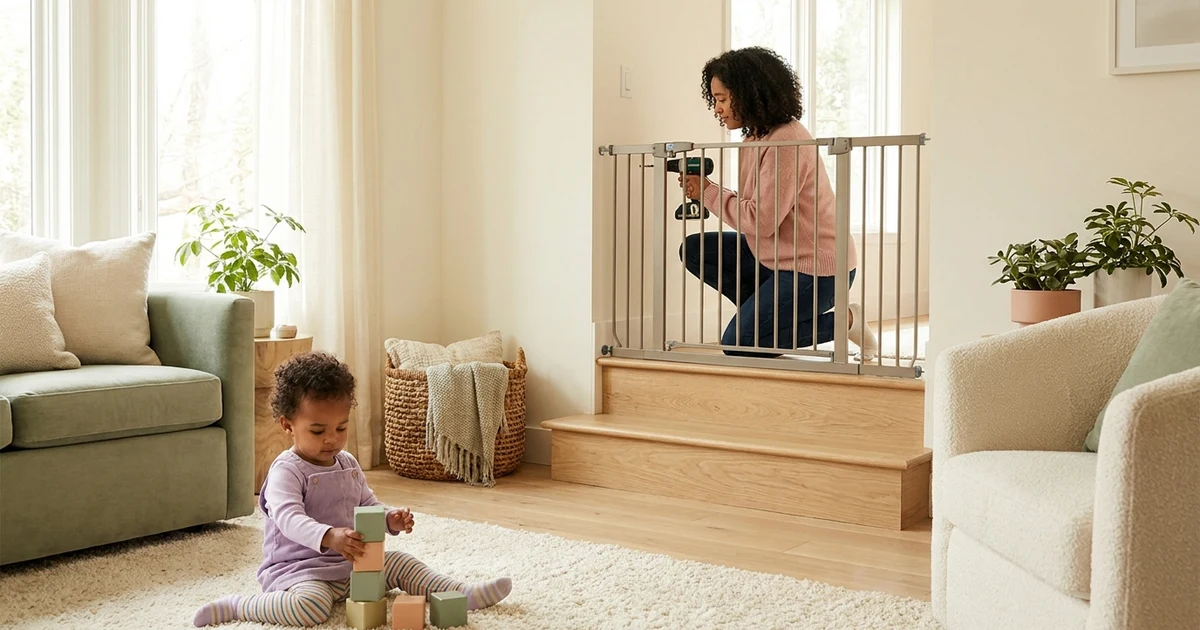
Your baby just started pulling up on the coffee table, and the stairs suddenly look less like architecture and more like a hazard waiting to happen.
Choosing the right baby gate for stairs is one of the few safety decisions where the wrong product can create new dangers instead of preventing them. The CPSC, AAP, and NHS all have specific guidance on which gate type belongs where and how to install it. This guide covers those rules clearly, with a decision table so you can pick the right gate in under a minute.
The one rule to remember: At the top of any staircase, use only a hardware-mounted gate that screws into the wall. Pressure-mounted gates can dislodge under a toddler's weight and must never be placed above a drop.
Key Takeaways
- Hardware-mount only at stair tops: pressure-mounted gates can pop loose and cause falls
- Install gates at both top and bottom: babies climb up stairs as well as down
- Fit gates before mobility begins: around 6 months, per AAP and CDC guidance
- No bottom trip bar at stair tops: choose a gate with a flush threshold
- Remove gates when your child climbs over or opens the latch: typically between 24 and 36 months
What Type of Baby Gate Is Best for Stairs?
Not all baby gates belong on staircases. The CPSC's mandatory safety standard for gates and enclosures (16 CFR part 1239, which incorporates ASTM F1004) covers products intended for children aged 6 to 24 months. Within that standard, two mounting types matter for stair use.
Hardware-mounted gates attach directly to the wall or banister with screws. They stay rigid under pressure. A toddler pushing, rattling, or hanging on the gate will not knock them out of position. The CPSC explicitly recommends screw-mounted gates at the top of stairs in its childproofing guidance.
Pressure-mounted gates rely on rubber bumpers wedged against the wall or doorframe. They are quick to install and work well between rooms on flat surfaces. But they can dislodge when a child leans on them, which makes them unsafe above any staircase.
Retractable mesh gates roll out from a wall-mounted cassette. A 2025 CPSC recall of roughly 2,200 Dearlomum retractable gates shows the risk: a child's torso could fit between the mesh and the floor, violating the federal standard. If you choose retractable, verify the product carries ASTM F1004 certification and check for active recalls at CPSC.gov.
| Gate type | Top of stairs | Bottom of stairs | Between rooms |
|---|---|---|---|
| Hardware-mounted | Required | Safe | Safe |
| Pressure-mounted | Unsafe | Acceptable if firm | Safe |
| Retractable mesh | Check ASTM cert + recalls | Check certification | Safe |
| Accordion / V-shaped (old) | Never | Never | Replace immediately |
Can You Use a Pressure-Mounted Gate at the Top of Stairs?
No. The CPSC states this directly: use safety gates that screw into the wall at stair tops. Pressure-mounted gates lack the anchor strength to hold when a toddler pushes hard, and the fall consequences at the top of a staircase are severe.
This is one of the few black-and-white rules in baby proofing. A pressure gate might feel solid in a flat doorway, but the force changes when a full flight of stairs sits on the other side.
If you rent and cannot drill into walls, look for clamp-on banister adapters. These still use screws, but the screws go into a bracket that clamps around the banister post rather than into drywall. Our baby-proofing checklist includes a section on rental-friendly stair safety setups.
Do You Need Baby Gates at the Top and Bottom of Stairs?
Yes. The AAP, through HealthyChildren.org, recommends placing gates at both the top and bottom of every staircase in your home.
The top gate prevents the obvious danger: falls down the stairs. The bottom gate matters just as much. Babies and toddlers who can crawl or climb a few steps can fall backward trying to descend, or reach the top unsupervised. NHS Wales advises continuing both gates until a child is at least two years old.
For broader home safety context, see our room-by-room baby-proofing guide and our complete childproofing walkthrough.
When Should You Install Baby Gates for Stairs?
Install stair gates before your baby becomes mobile. The CDC notes that toddlers aged 1 to 2 are increasingly mobile and need stair access blocked. Mayo Clinic's infant development guidance recommends stairway gates as part of an exploration-safe environment for babies reaching 10 to 12 months.
A practical timeline:
- Around 6 months: Measure your stair openings and order gates. Your baby may start crawling within weeks.
- 7 to 9 months: Gates should be up, tested, and familiar to everyone in the household before independent movement starts.
- 10 to 12 months: Recheck all hardware. Your baby is pulling up, cruising, and testing every surface.
Do not wait until your baby is already climbing. Measuring openings, ordering the right gate, drilling, and testing all take time. Babies develop fast enough to surprise you.
Are Retractable Baby Gates Safe for Stairs?
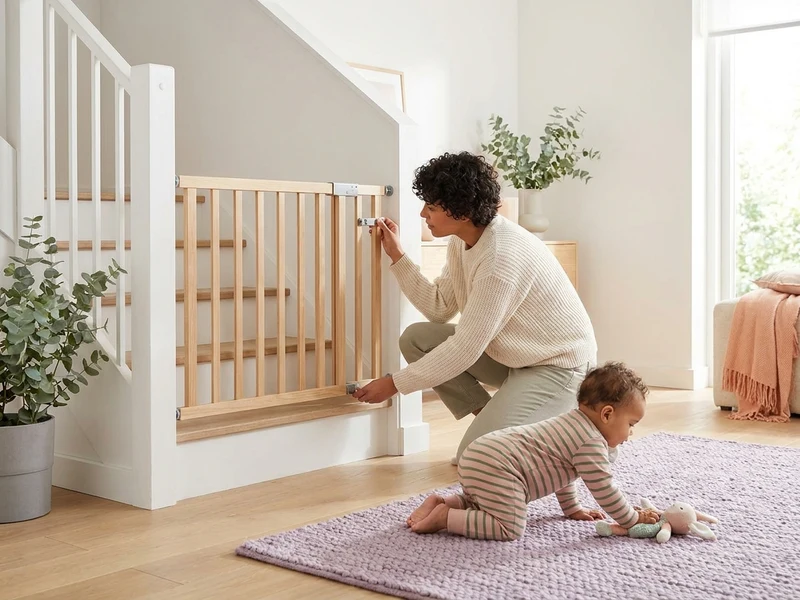
It depends on the product and where you place it. Some retractable gates carry ASTM F1004 certification and are rated for stair-top use. Others fail the federal standard because the gap between the retracted mesh and the floor can admit a child's torso, as the 2025 CPSC recall of Dearlomum gates demonstrated.
If you are considering a retractable gate for stairs:
- Look for ASTM F1004 or JPMA certification on the packaging or product listing
- Search for active recalls at CPSC.gov before buying
- Measure the gap between the closed gate and the floor yourself, after installation
- Test the latch mechanism to confirm it requires adult-level dexterity to open
For top-of-stairs use, a traditional hardware-mounted gate remains the safer choice. Retractable gates can work at the bottom of stairs or between rooms if they carry current safety certifications and have no outstanding recalls.
How Do You Install a Baby Gate on Stairs with a Banister?
Banister installations add complexity because you cannot always screw directly into a round or decorative rail. Three standard approaches:
Clamp-on banister adapter kits are sold by most gate brands. The adapter wraps around the banister post and provides a flat mounting surface for the gate's wall brackets. No drilling into the banister itself, and the hardware can be removed later without visible damage.
Wood mounting blocks attach to the banister with heavy-duty zip ties or U-bolts. You then screw the gate bracket into the wooden block. This distributes pressure across a wider surface and protects the banister finish.
Professional installation is worth considering for iron balusters, stone walls, or unusually wide openings. A baby-proofer can fabricate custom mounts rated for the specific load. It costs more but removes the guesswork around load-bearing surfaces.
Regardless of which method you choose, verify four things after installation:
- The gate swings away from the stairs, not over the drop
- The latch sits on the side you reach from the top landing
- There is no horizontal bottom bar at the top of the stairs that could trip someone
- The gate holds firm against pushing and pulling without shifting
When Should You Stop Using a Baby Gate?
Most children outgrow stair gates between 24 and 36 months, but the timing depends on your child's development, not just the calendar.
Remove or open the gate when your child can:
- Climb over it. A gate a child scales is worse than no gate, because the closed gate gives a false sense of security while the child attempts a dangerous climb.
- Open the latch. Once a toddler works the mechanism, the gate no longer functions as a barrier.
- Navigate stairs safely. Walking up and down with alternating feet, holding the rail, without rushing.
NHS-linked guidance recommends removing gates once children demonstrate safe stair skills, or leaving the gate open during supervised hours and closing it at night. Never stack one gate on top of another to create a taller barrier. That creates instability and entrapment hazards of its own.
If your child is past the gate stage but you have younger children visiting, our nursery and home safety checklist covers temporary safety setups by developmental stage.
What to Look for When Buying a Stair Gate
A buying checklist based on CPSC and AAP guidance:
- Certification: ASTM F1004 compliance or JPMA certification on the packaging
- Mounting type: Hardware-mounted for stair tops. Pressure or hardware for stair bottoms
- No trip bar: Top-of-stairs gates should have a flush or very low threshold
- One-way swing: The gate opens toward the landing, not out over the stairs
- Latch type: Dual-action or auto-close that an adult operates one-handed but a child cannot
- Width range: Measure your opening first. Standard gates cover 28 to 42 inches, but staircases vary widely
- Height: Standard gates are roughly 28 to 30 inches tall. Extra-tall models suit early climbers
- Material: Metal frames with mesh or vertical slats. Avoid horizontal bars a child could use as ladder rungs
Check CPSC.gov for recalls before you buy, especially for less expensive or imported brands. The CPSC recalled over 1.3 million gate and enclosure units between 2008 and 2018 due to injury and entrapment risks.
Frequently Asked Questions
What type of baby gate is best for stairs?
A hardware-mounted (screw-fix) gate is the only safe choice for the top of stairs. The CPSC specifically recommends screw-mounted gates at stair tops because pressure-mounted gates can dislodge under a child's weight. At the bottom of stairs, either hardware-mounted or firmly installed pressure-mounted gates are acceptable.
Can you use a pressure-mounted baby gate at the top of stairs?
No. The CPSC advises against it. Pressure-mounted gates rely on friction against the wall or frame and can pop loose when a toddler pushes or leans on them. At the top of a staircase, that dislodging can cause a serious fall. Use only hardware-mounted gates that screw into the wall or a banister adapter.
Do you need baby gates at the top and bottom of stairs?
Yes. The AAP recommends gates at both locations. The top gate prevents falls down the stairs, while the bottom gate stops babies and toddlers from climbing up unsupervised. NHS Wales advises continuing both gates until at least age two.
When should you install baby gates for stairs?
Install gates before your baby becomes mobile, typically around 6 months. The CDC notes that toddlers aged 1 to 2 need stair access blocked. Ordering and installing takes time, so measure openings and buy gates early.
When should you stop using a baby gate?
Most children outgrow stair gates between 24 and 36 months. Remove the gate when your child can climb over it, open the latch, or navigate stairs independently with the rail. NHS guidance also recommends removing gates once a child can climb over them, since a scaled gate is more dangerous than no gate.
Summary
A baby gate for stairs is not optional. The CPSC, AAP, and NHS all recommend hardware-mounted gates at both the top and bottom of every staircase in homes with children under two. Pressure-mounted gates belong in flat doorways, not above a drop. Install before mobility, check hardware monthly, and remove when your child can navigate stairs on their own.
Grab our interactive nursery and home safety checklist to cover stair gates, furniture anchoring, outlet covers, and more, sorted by your child's age.
This article is for informational purposes only and does not replace professional medical advice. Always consult your pediatrician for guidance specific to your child.
This guide draws on current CPSC, AAP, CDC, NHS, and Mayo Clinic guidance. Babysential Team used an automated drafting workflow to organize the checklist, FAQ, and source citations. The goal is simple: help tired parents pick a stair gate that fits the actual risk, not just the product listing.
Sources:
- Childproofing Your Home: 12 Safety Devices to Protect Your Children. CPSC, 2023
- Childproofing Tips for Grandparents. AAP/HealthyChildren, 2021
- Safety Gates. NHS/Just One Norfolk, 2026
- Positive Parenting Tips: Toddlers 1–2 Years. CDC, 2026
- Dearlomum Retractable Safety Gates Recall. CPSC, 2025