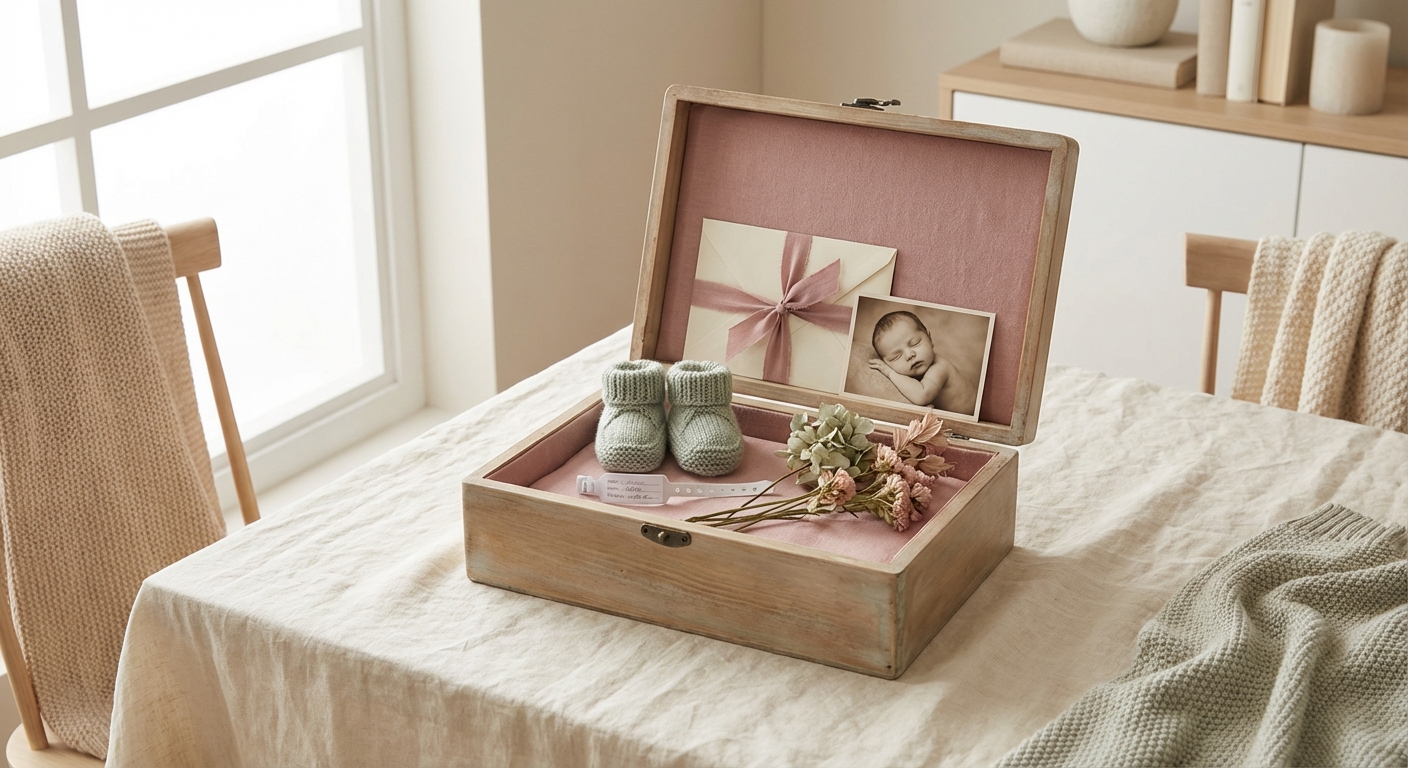
Your newborn will never be this small again. The tiny hospital bracelet, the first little onesie, the card from the birth announcement, these things seem ordinary in the moment, but they become priceless within months.
A memory box is the simplest and most meaningful way to preserve the physical artifacts of your baby's earliest days. This guide covers exactly what to save, how to create a beautiful DIY memory box, digital alternatives, and gift ideas for expecting parents.
Start your memory box before baby arrives. Having it ready means you won't miss the very first keepsakes, which disappear faster than you'd expect.
What Is a Newborn Memory Box?
A memory box is a physical container, a box, chest, or tin, where you collect and preserve keepsakes from your baby's earliest weeks and months. Unlike a photo album or memory book, a memory box holds actual objects: tiny things that tell the story of a life just beginning.
Over the first year, it naturally expands to include milestones beyond the newborn period. Many families keep adding to the same box through the toddler years and beyond.
The box doesn't need to be elaborate. A simple wooden box from a craft store, a vintage tin, or even a sturdy gift box can serve perfectly well, what matters is the contents.
What to Put in a Newborn Memory Box
Here is a curated list of what to save, organized by when you'll collect it:
From the Hospital or Birth Center
- Hospital identification bracelet, the tiny band with your baby's name and birth details
- The first hat, hospitals typically place a small knit hat on newborns immediately after birth
- Footprint and handprint card, most hospitals make these in the first day or two; ask if they don't offer one automatically
- Birth announcement card, the one given to visitors or placed on the crib
- First photo, print a copy and include it in the box
- Your hospital wristband, a small but meaningful detail
- Any flowers or cards from well-wishers at the birth
From the First Weeks at Home
- First outfit worn at home, the tiny onesie or sleep suit from their first night home
- First swaddle blanket, if you have a small one from the hospital
- First lock of hair, from the first haircut (or even from birth if baby had hair)
- Dried umbilical cord stump, not everyone keeps this, but many parents do
- Newborn nail clippings, tiny, improbable, perfect
- Birth announcement card, the one you sent to family and friends
- Congratulations cards, a selection of the most meaningful ones
- A note or letter you write to your baby, in the newborn haze, from your heart
From the First Months
- Monthly photos, print one from each month and store in the box
- First pair of shoes (when they start wearing them)
- Artwork, their first attempts at drawing or painting
- Milestone cards, the physical cards from milestone card photos
- First tooth (when it falls out, years later)
- A pressed flower from a meaningful occasion
- A note about their personality at each stage, what made them laugh, what they loved
- Growth measurements from each well-baby checkup
Sentimental and Unexpected Items
- A postage stamp from their birth month, small and perfect for a memory box
- A newspaper front page from their birth date, a time capsule of the world they were born into
- A coin from their birth year
- A handwritten recipe from something you made for them often
- A note from a grandparent written to the baby in the first weeks
Step-by-Step: Creating Your DIY Memory Box
Step 1: Choose Your Box
The container matters. You want something that will last decades and that feels special enough to deserve the contents.
Great options:
- Wooden keepsake box, available from craft stores and online marketplaces. Can be painted, stenciled, or decoupaged.
- Vintage tin, beautiful, durable, and unique. Estate sales and thrift stores are good sources.
- Fabric-covered box, hatbox style, soft and beautiful on a shelf
- Acrylic or clear storage box, if you want to see the contents without opening
- A sturdy gift box, a high-quality one can work beautifully, especially if it's meaningful (from a gift you received)
What to avoid:
- Cardboard boxes that will deteriorate over time
- Boxes with strong smells (cedar can be overwhelming for delicate keepsakes)
- Plastic boxes that can trap moisture and cause mildew
Step 2: Personalize the Outside
This step is optional but adds something special:
- Paint the box in a color that matches the nursery
- Stencil your baby's name, birth date, or a small design on the lid
- Decoupage with patterned paper, pressed flowers, or a copy of the birth announcement
- Add a nameplate, small brass nameplates are available online and screw onto the lid beautifully
- Stamp or wood-burn your baby's initials
Step 3: Prepare the Interior
Line the inside of the box to protect delicate items:
- Acid-free tissue paper, the standard for archival keepsakes
- Velvet liner, more luxurious, available cut-to-size from fabric stores
- Felt, practical and soft
Add small dividers or compartments if you have items of very different sizes.
Step 4: Preserve Items Properly
Some keepsakes need a little care to stay beautiful long-term:
- Fabric items (first outfit, hospital hat): fold gently in acid-free tissue paper. Do not use plastic bags, which can trap moisture.
- Paper items (cards, birth announcement): store in a clear acid-free sleeve or envelope.
- Photos: use archival-quality prints (not standard home prints, which fade). Store in acid-free photo sleeves.
- Hair: place in a small glass or clear plastic vial with a lid, or fold in acid-free paper.
- Dried flowers: press between absorbent paper first, then store flat in acid-free paper once fully dried.
Step 5: Add a Welcome Note
Write a letter to your baby and place it in the box. It doesn't need to be long. A few sentences about how you feel right now, what the world is like, what you hope for them, written in your own handwriting, will be one of the most treasured things in the box when they're older.
Step 6: Store It Well
Keep the box in a dry, stable environment, not the attic (too hot in summer, cold in winter) or the basement (moisture risk). A wardrobe shelf, closet, or storage chest in a living area is ideal.
Digital Memory Box Alternatives
If a physical box doesn't suit your lifestyle, or you want to complement it with a digital archive, here are the best approaches:
Dedicated Digital Folder System
Create a structured folder on your computer or cloud storage:
Baby Name - Memory Archive/
├── Birth/
│   ├── Hospital photos
│   ├── Birth announcement scan
│   └── Birth story document
├── Month 1/
│   ├── Photos
│   └── Notes.txt
├── Month 2/
│   └── ...
├── Milestones/
│   ├── First smile
│   ├── First tooth
│   └── First steps
└── Documents/
    ├── Pediatric visit records
    └── Growth charts
Back this up in at least two places, an external hard drive and a cloud service (Google Drive, iCloud, or similar).
Scanning Physical Keepsakes
For items you want to preserve digitally as well as physically, scan them in high resolution:
- Birth announcement and cards
- Footprint and handprint art
- Handwritten letters and notes
- Growth charts
A flatbed scanner produces better results than photographing paper items.
Digital Memory Apps
Several apps are designed specifically for this purpose:
- Keepy. Create digital memory boxes with photos, voice recordings, and documents. Family members can contribute.
- Shoebox. Designed for archiving old photos, but works well for baby memories too.
- Tinybeans. Primarily a baby journal and photo sharing app, but doubles as a digital memory archive.
- Artifact Uprising. Turn your digital archive into printed books and art prints. A beautiful hybrid approach.
Voice and Video Recordings
One of the most powerful (and underused) memory-keeping tools is audio and video. Consider:
- Recording yourself reading your welcome letter aloud
- Capturing video of your baby's first sounds and attempts at language
- Recording grandparents talking to the baby in those early weeks
- Making a short video on each monthly birthday
These recordings become enormously meaningful as children grow.
Memory Box as a Gift: Ideas for Expecting Parents
A memory box makes an exceptionally thoughtful gift for new or expecting parents. Here's how to make it special:
Gift Idea 1: The Empty Beautiful Box
Give a beautiful, high-quality keepsake box with a note explaining its purpose and a few supplies to get started: acid-free tissue paper, small vials for hair, a pack of fine-liner pens for writing notes.
Gift Idea 2: The Partially Filled Box
Fill the box with some first keepsakes you've gathered yourself:
- A beautiful card to the baby
- A small book for bedtime reading
- A coin from the birth year
- A newspaper from the birth date
- A handwritten note or letter from you to the baby
Gift Idea 3: The Personalized Box
Order a custom-made wooden box engraved or painted with the baby's name and birth date. This is a premium gift that parents will keep for decades.
Gift Idea 4: The Memory Kit
Assemble a kit that makes the memory box easy to start:
- An inkless handprint/footprint kit
- A milestone card set
- A small journal for notes
- Acid-free archival supplies
- A beautiful pen
Memory boxes make especially meaningful gifts for baby showers and new birth celebrations. Unlike most baby gifts, a memory box is something the parents, and eventually the child, will treasure for the rest of their lives.
Frequently Asked Questions
When should I start a memory box?
Ideally before baby arrives, or in the first week home. The earliest keepsakes (hospital bracelet, first hat, birth announcement) disappear quickly if you don't intentionally save them.
Do I need to buy a special box?
No. A beautiful tin, a sturdy cardboard gift box, or any container you love can work. What matters is starting, not the vessel.
What if I already missed some early keepsakes?
Start with what you have. A memory box begun at three months is still a treasure. There are plenty of wonderful things to add from any point in the first year.
How long should I keep adding to the box?
There's no rule. Many families keep one box for the first year, then start a new one for later childhood. Others add to the same box through childhood and adolescence. Do what feels natural.
What do I do with the box when my child is grown?
Give it to them. This is one of the most meaningful things you can pass on, a curated record of who they were when they were new to the world, preserved with love.
Can I make memory boxes for each child?
Yes, and it's worth doing. Each child's memory box is a distinct and irreplaceable archive of their early life. If you have multiple children, keeping their keepsakes separate means each child eventually receives their own.
Looking for more ways to preserve your baby's first year? Read our guides on milestone cards for baby and baby memory book: digital vs. paper.
Sources
- AAP. Infant and toddler nutrition guidelines
- WHO. Global infant feeding recommendations
- CDC. Infant and toddler nutrition resources
🔧 Helpful Tools
- All Baby Tools. Browse all free tools for pregnancy and baby care