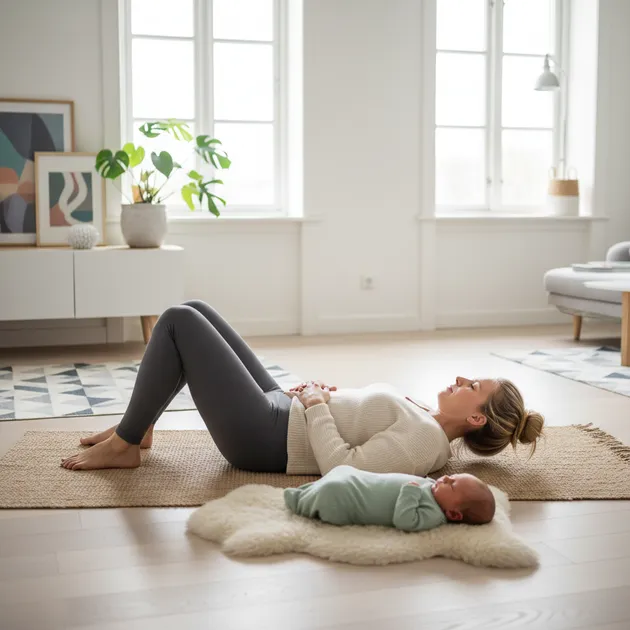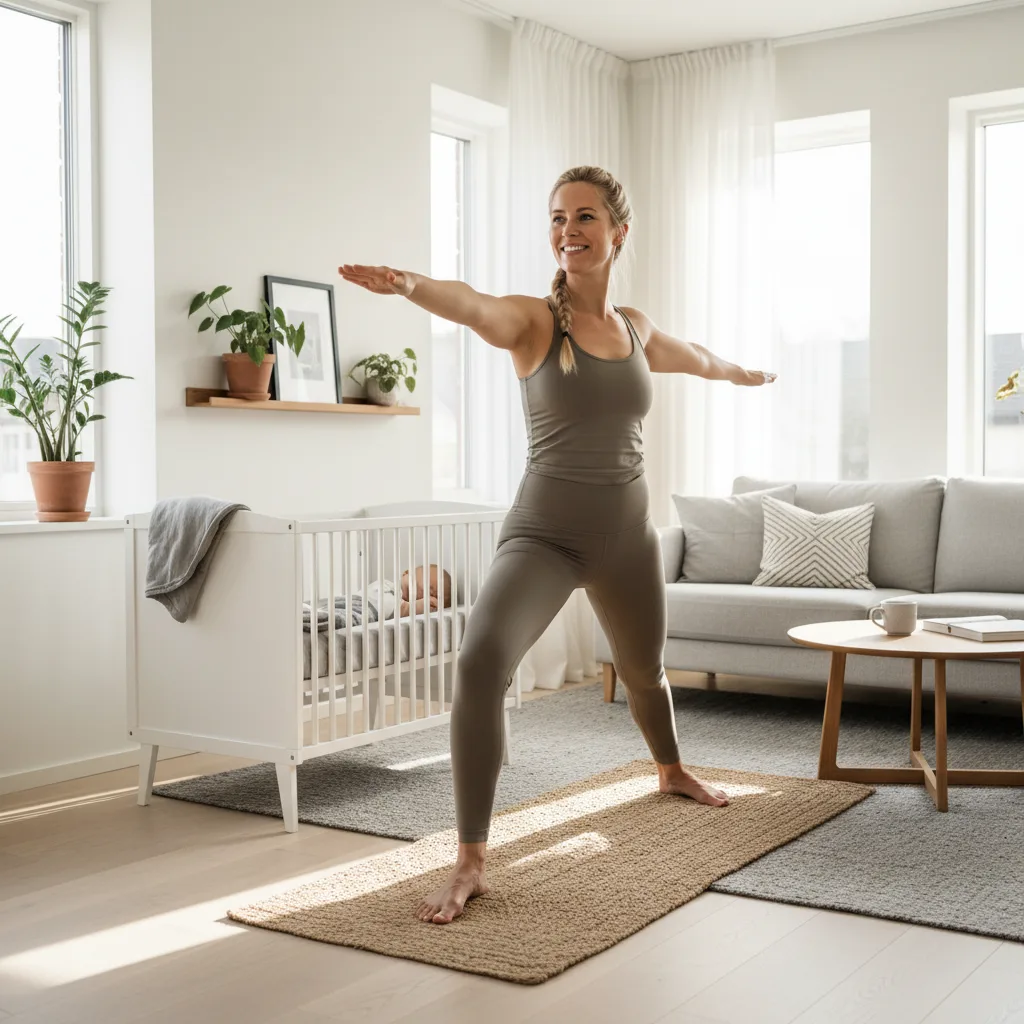
Baby is sleeping. You have maybe 20 minutes. Maybe 40, if you're lucky. You know exercise would do you good, but who has time to get to the gym?
The solution is simple: work out at home, with what you have, in the time you have. No equipment. No travel time. No babysitter. Just you, the living room, and a window of sleeping baby.
Why short home workouts work
Many people believe that exercise only counts if it lasts at least an hour. That is not true.
Research shows that short, intense workout sessions of 15–20 minutes have a significant effect on:
- Muscle strength and endurance
- Cardiovascular fitness
- Mood and energy levels
- Sleep quality
The WHO and AAP recommend 150 minutes of moderate activity per week. That is five sessions of 30 minutes, or ten sessions of 15 minutes. Short, frequent sessions are just as effective as long, infrequent ones.
For new parents, short home workouts are often the only realistic form of exercise. And exercise you actually do always beats exercise you plan to do "someday."
Before you start: checklist
Do not jump straight into exercise without thinking it through. Here is what to check:
- Postpartum clearance: Has your doctor or midwife given you the go-ahead? Usually at the 6-week checkup.
- Pelvic floor: Can you engage your pelvic floor without leakage? Start with pelvic floor exercises if you're unsure.
- Diastasis recti: Check for diastasis by placing fingers along the midline of your abdomen and lifting your head. A gap of more than 2 finger widths? Avoid sit-ups and planks.
- Pain: Do you have pain in the pelvis, back, or a C-section scar? Speak with a physical therapist.
Stop your workout if you experience leakage, downward pressure in the pelvis, pain, or if your abdomen domes along the midline. Return to lighter exercises and contact a physical therapist.
Equipment you need (almost nothing)
- Mat or blanket, for floor exercises
- Good shoes, or just socks for floor exercises
- Water bottle, especially important if you are breastfeeding
- Clock or phone, to track time
Optional extras:
- Resistance band (adds extra challenge)
- Light dumbbells or water bottles as weights
- Yoga block for modifications
Program 1: The 15-minute session
Perfect for days when time is short. Do the exercises in sequence with minimal rest.
Warm-up (2 min):
- March in place for 30 seconds
- Arm circles forward and backward, 15 seconds each way
- Hip rotations, 15 seconds each way
- Bodyweight squats, 30 seconds at a slow pace
Main set (11 min), 3 rounds:
| Exercise | Time | Rest |
|---|---|---|
| Squat | 40 sec | 20 sec |
| Modified push-up (on knees) | 40 sec | 20 sec |
| Glute bridge with hold | 40 sec | 20 sec |
| Side-lying clamshell (left) | 30 sec | 10 sec |
| Side-lying clamshell (right) | 30 sec | 30 sec before next round |
Cool-down (2 min):
- Stand and breathe deeply for 30 seconds
- Stretch quadriceps, 20 seconds per side
- Chest stretch in a doorframe, 20 seconds
- Stand with eyes closed and check in with your body, 30 seconds
Program 2: The 20-minute session
A little more time, a little more variety. This session combines strength and cardio.
Warm-up (3 min):
- Light jog or brisk march in place, 1 minute
- Arm circles and shoulder shrugs, 30 seconds
- 10 squats at a slow pace
- Cat-cow stretch on all fours, 1 minute
Main set (15 min), 3 rounds:
Rounds 1–3 (repeat 3 times):
- Squat: 12 reps
- Push-up (on knees or toes): 8–12 reps
- Reverse lunge: 10 per side
- Glute bridge: 12 reps with 3-second hold at top
- Bird-dog: 8 per side
- 30-second rest between rounds
Cool-down (2 min):
- Child's pose, 30 seconds
- Light hip and quad stretch, 30 seconds per side
- Deep breathing lying on back, 30 seconds
Program 3: The 30-minute session
For days when baby sleeps long and you have a little extra time. This session gives a more complete workout.
Warm-up (4 min):
- Light jog in place, 1 minute
- High knees, 30 seconds
- Butt kicks, 30 seconds
- 10 arm circles forward + 10 backward
- 10 squats with arms reaching overhead
- Cat-cow, 30 seconds
Part 1: Strength, upper body (8 min):
- Push-up: 3 sets x 10 (modify to knees as needed)
- Tricep dips on a chair: 3 sets x 10
- Shoulder taps in plank position (on knees): 3 sets x 8 per side
- 30-second rest between sets
Part 2: Strength, lower body (8 min):
- Squat: 3 sets x 15
- Forward lunge: 3 sets x 10 per side
- Sumo squat: 3 sets x 12
- Single-leg glute bridge: 3 sets x 8 per side
- 30-second rest between sets
Part 3: Core (6 min):
- Marching bridge: 2 sets x 10 per side
- Side-lying clamshell: 2 sets x 15 per side
- Bird-dog: 2 sets x 10 per side
- Modified dead bug: 2 sets x 8 per side
- 20-second rest between sets
Cool-down (4 min):
- Child's pose, 45 seconds
- Lying spinal twist, 30 seconds per side
- Stretch quads and hips, 30 seconds per side
- Chest stretch in doorframe, 30 seconds
- Deep breathing, 30 seconds
Exercise library: proper technique
Squat
- Stand with feet hip-width apart
- Sit back and down as if sitting in a chair
- Keep weight in your heels, knees track over toes
- Lower until thighs are parallel to the floor (or as far as you can)
- Press up through your heels
Modified push-up
- Start on your knees with hands slightly wider than shoulder-width
- Lower your chest toward the floor with control
- Press up to straight arms
- Keep your body straight from knees to head, don't let hips sag
Lunge
- Take a long step forward or backward
- Lower the back knee toward the floor
- Both knees bent at about 90 degrees
- Press up to the start through your front foot
Glute bridge
- Lie on your back with knees bent, feet hip-width apart
- Press your hips up toward the ceiling
- Squeeze your glutes at the top
- Lower slowly, vertebra by vertebra
Modified dead bug
- Lie on your back with arms straight up and knees bent over hips
- Slowly extend your right arm overhead and your left leg out
- Keep your lower back pressed to the floor the whole time
- Return to start, switch sides
Tips for working out while baby naps
Have your clothes ready
Don't waste precious minutes searching for a sports bra and leggings. Keep workout clothes easily accessible, ideally in a set place.
Start immediately
When baby falls asleep, it's tempting to do the dishes, check your phone, or just rest. But your body doesn't know the difference between exercising at 10am and 2pm. Work out when the window is there.
Accept interruptions
Baby wakes up mid-session? That's completely fine. You've already exercised for 10 minutes, that counts. Finish the rest later, or leave it. Half is much better than nothing.
Make a playlist
Music increases motivation and makes the time go faster. Make a playlist that lasts exactly as long as your workout session.
Weekly plan: combine home workouts with other activity
Here is a realistic weekly plan that combines home workouts with walks and pelvic floor exercises:
| Day | Activity | Time |
|---|---|---|
| Monday | 20-min home workout | 20 min |
| Tuesday | Walk with stroller | 30–45 min |
| Wednesday | 15-min home workout | 15 min |
| Thursday | Walk or stroller workout | 30–45 min |
| Friday | 20-min home workout | 20 min |
| Saturday | Longer walk or family activity | 45–60 min |
| Sunday | Rest or light stretching | 10–15 min |
Pelvic floor exercises should be done daily in addition, they take just 5 minutes.
Progression: make it harder over time
After 2–3 weeks with the same program, increase the challenge:
Weeks 1–3: Learn the exercises, focus on technique Weeks 4–6: Increase reps by 20–30 percent Weeks 7–9: Add a resistance band or light weights Weeks 10–12: Increase pace, reduce rest, try the 30-minute session
From 12 weeks: Consider a more structured postpartum fitness program that builds on the foundation you've created.
Frequently asked questions
Is 15 minutes of exercise enough?
Yes, especially at the start. Research shows that even 10–15 minutes of moderate to high intensity exercise has a measurable effect on strength, fitness, and mood. Over time, work up to 20–30 minutes. The most important thing is to exercise regularly, not for a long time.
What if baby always wakes up when I exercise?
Try scheduling your workout during the time when baby typically sleeps longest. Many babies sleep best in the morning. Alternatively, you can do exercises while baby is awake, many babies find it entertaining to watch.
Can I exercise with diastasis recti?
Yes, but avoid sit-ups, crunches, and full planks. All exercises in the programs above are safe for mild diastasis. For larger diastasis (more than 3 finger widths), start with Pilates or physical therapy first.
When can I start heavier training?
Most people can gradually increase intensity from 8–12 weeks after birth. Listen to your body: no leakage, no downward pressure, no pain. If all is well, you can add resistance, try harder exercises, or begin a structured postpartum program.
Should I exercise before or after breastfeeding?
It's most comfortable to exercise after breastfeeding, when breasts are empty. Exercise does not negatively affect breastfeeding, milk production is the same. Just remember to drink enough water.
Read more
Sources
- WHO. "Physical Activity Guidelines." World Health Organization, 2024.
- American College of Obstetricians and Gynecologists. "Exercise After Pregnancy." ACOG, 2024.
- American Academy of Pediatrics. "Breastfeeding and Physical Activity." AAP, 2024.
🔧 Helpful Tools
- Pelvic Floor Trainer. Guided pelvic floor exercises for pregnancy and postpartum
- All Baby Tools. Browse all free tools for pregnancy and baby care