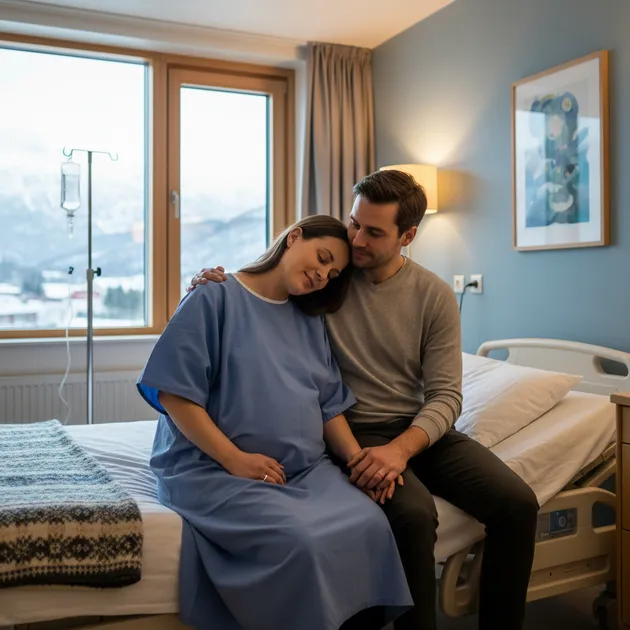
The vast majority of births go smoothly. But sometimes situations arise where an emergency c-section is needed to keep mother and baby safe. It can be frightening, but it helps to know that this is a common procedure that birth teams are well trained to handle.
This article gives you clear, factual information about what happens during an emergency c-section, so you feel better prepared, even if you hope to never need it.
What Is an Emergency C-Section?
An emergency c-section is one that is not planned ahead of time, but is decided during labor or late in pregnancy because a situation arises that requires rapid delivery. It differs from a planned c-section in that the decision is made during active labor or in an acute situation.
Emergency c-sections are generally classified into two categories:
Category 1. Immediate Threat to Life
The most urgent type. The baby must be delivered within 15–20 minutes of the decision. This is rare, but can be life-saving.
Category 2–3. Urgent but Stable
Less immediately critical, but still necessary. The baby should be delivered within 30–60 minutes. There is time to administer regional anesthesia and prepare more thoroughly.
Approximately 8–10% of all births result in an emergency c-section. Labor and delivery teams regularly train for acute situations and have clear protocols for managing them.
Causes of an Emergency C-Section
Several situations can make an emergency c-section necessary:
Fetal Distress
The most common reason. The baby's heart rate shows signs that the baby is not doing well. Continuous fetal monitoring (CTG) may show:
- Persistent slow heart rate
- Lack of variability in the heart rate
- Late decelerations (drops in heart rate after contractions)
Failure to Progress
Labor stalls despite strong contractions. The cervix stops dilating, or the baby doesn't move down the birth canal. This can happen after many hours of active labor.
Umbilical Cord Prolapse
The umbilical cord slips down in front of the baby. This is rare but serious, as the blood supply to the baby can be compressed. It requires immediate delivery.
Placental Abruption
The placenta partially or completely separates from the uterine wall before the baby is born. Symptoms include sudden severe abdominal pain, bleeding, and a hard abdomen. It requires rapid action.
Maternal Hemorrhage
Heavy bleeding during labor that cannot be controlled may make an emergency c-section necessary.
Malpresentation Discovered During Labor
In rare cases, the baby's position may shift during labor, or a breech position is discovered late.
This list is not meant for self-diagnosis. Your birth team assesses the situation and makes the decision. Your role is to trust them and ask questions if you need more information.
What Happens. Step by Step
When the decision for an emergency c-section is made, things move quickly. Here's what you can expect:
Category 1. Immediate
0–5 minutes: Decision and alerting
- The doctor briefly informs you that a c-section is necessary
- The operating room team is alerted
- The whole team (surgeon, anesthesiologist, midwife, neonatal nurse) assembles quickly
- You are moved to the operating room
5–10 minutes: Anesthesia
- If you already have an epidural, it can be topped up quickly
- If not, general anesthesia is often given because it is the fastest option
- Spinal anesthesia may be used if there is time
10–20 minutes: Operation
- Your abdomen is cleaned and draped
- The surgeon makes a rapid incision
- The baby is lifted out
- A neonatal specialist is ready to receive the baby
Category 2–3. Urgent
There is more time, and the process looks more like a planned c-section:
- You receive spinal anesthesia (you are awake during the operation)
- Your partner can usually be present
- Skin-to-skin with the baby is possible
- There is more time for information and questions
Anesthesia for an Emergency C-Section
The type of anesthesia depends on how urgent the situation is:
Spinal or Epidural (Category 2–3)
- You are awake
- No pain, but you may feel pressure
- Your partner can be present
- You can hold your baby immediately after birth
General Anesthesia (Category 1)
- Used when there is the most urgency
- You fall asleep quickly and wake up after the operation
- Your partner typically cannot be in the room
- You will meet your baby when you wake up (your partner can do skin-to-skin in the meantime)
General anesthesia for a c-section is very safe. The anesthesiologist is specially trained for this. You fall asleep in seconds and usually wake up 10–15 minutes after the baby is delivered. The baby is minimally affected because the anesthetic is given right before delivery.
Your Partner's Role
During an emergency c-section, your partner may feel helpless. Here's what partners should know:
If Your Partner Can Be Present (Category 2–3)
- You sit at the head of the table near your partner
- You can hold their hand and speak calmly to them
- You can often cut the umbilical cord
- You can receive the baby for skin-to-skin if the mother is being attended to
If Your Partner Cannot Be Present (Category 1)
- You wait outside the operating room
- A nurse or midwife will keep you updated
- You will be allowed in as soon as the situation is stable
- You can do skin-to-skin with the baby while the mother recovers from anesthesia
It is completely normal to feel shock, fear, or helplessness. Talk to someone about the experience afterward, this applies to partners just as much as to the birthing parent.
After an Emergency C-Section
Recovery after an emergency c-section is medically similar to recovery after a planned one:
- 2–4 days in the hospital
- Pain medication for the first few days
- Early mobilization (getting up and walking the same day or the next)
- Full recovery in 6–8 weeks
Emotional Processing
What sets an emergency c-section apart from a planned one is the emotional experience. Many people (and their partners) need time to process what happened.
Common feelings after an emergency c-section:
- Relief that the baby is healthy
- Disappointment that labor didn't go as planned
- A sense of loss, feeling like you "missed" the birth experience
- Flashbacks or anxiety related to traumatic moments
- Guilt (completely unwarranted, but common)
You don't have to "just be grateful" because your baby is healthy. It is completely normal to grieve a birth experience that didn't go the way you had imagined. Talk to your midwife, pediatrician, or a therapist if you're struggling to process the experience. Many hospitals offer a post-birth debrief where you can go through the timeline with a midwife.
Can You Prepare for Something You Don't Know Is Coming?
Yes, to some extent. Even if you're planning a vaginal birth, it's worth knowing what an emergency c-section involves. Here are a few things you can do:
Talk to Your Midwife or OB
Ask for information about emergency c-sections as part of your birth preparation. Many providers cover this, but it doesn't hurt to ask.
Include It in Your Birth Plan
If you have a birth plan, you can note your wishes for various scenarios, including a c-section. For example:
- Would you like your partner to do skin-to-skin if you can't?
- Would you like music in the operating room?
- Would you like to see the baby immediately?
- Who should be contacted?
Pack Your Hospital Bag for All Scenarios
Make sure to include loose, comfortable clothing that won't be uncomfortable over a surgical incision.
Talk with Your Partner
Discuss what you each want in different scenarios. Your partner should know there is a chance they may not be allowed in the room, and that it's okay to feel their own feelings afterward.
Emergency C-Section and Future Pregnancies
After one emergency c-section, you may be able to attempt a vaginal birth in your next pregnancy (VBAC, vaginal birth after cesarean). Success rates are 60–80%, depending on the reason for the previous c-section.
Talk with your provider early in your next pregnancy about your options.
Frequently Asked Questions
How common is an emergency c-section?
Approximately 8–10% of all births result in an emergency c-section. It is a common procedure that labor and delivery teams handle regularly.
Does it hurt?
With spinal anesthesia you feel no pain, only pressure. With general anesthesia you are asleep. After the operation you will have pain that is managed with medication.
Does the baby feel anything?
The baby does not feel the operation itself. With general anesthesia, the baby may be slightly drowsy in the first few minutes, but the neonatal team is prepared for this.
Can I breastfeed after an emergency c-section?
Yes, absolutely. Breastfeeding may take a little longer to get started, but with skin-to-skin and patience it works well. Ask for help from the nurses and lactation consultant.
Will I need a c-section next time?
Not necessarily. Most people can attempt a vaginal birth (VBAC) after one c-section. The success rate is 60–80%.
What if my partner couldn't be with me?
It is completely normal to feel disappointment or grief. Talk about the experience together. Many hospitals offer a post-birth debrief where both of you can go through what happened with a midwife.
Sources
- WHO. Caesarean section
- ACOG. Cesarean Delivery
- AAP. Cesarean Birth
- NIH. Cesarean Delivery on Maternal Request
🔧 Helpful Tools
- Due Date Calculator. Calculate your estimated due date
- Contraction Timer. Track your contractions during labor
- All Baby Tools. Browse all free tools for pregnancy and baby care
📖 Related Articles
- Planned C-Section: Preparation and What to Expect. Everything about a planned cesarean section: preparation, what happens at the hospital, anesthesia, skin-to-skin contact, and recovery. How to prepare yourself.