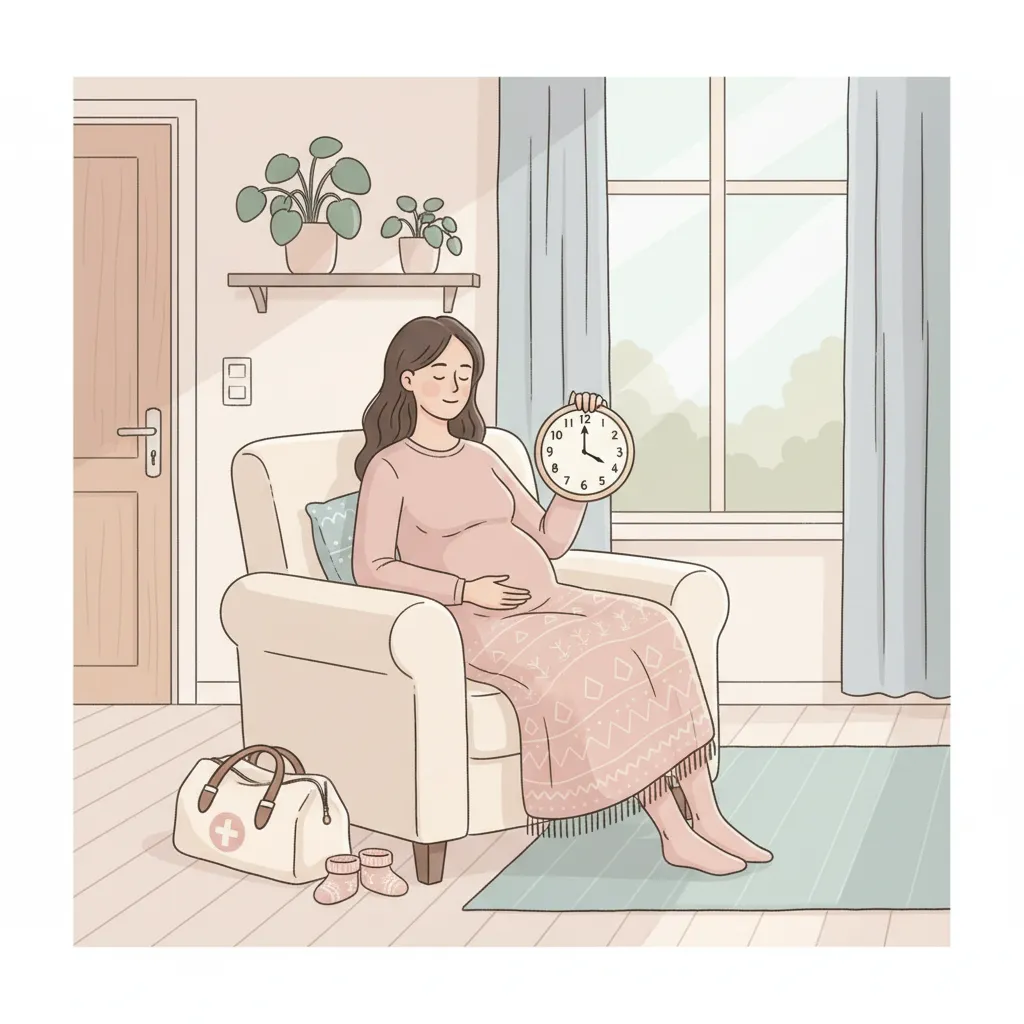
You feel the first contractions. Your belly tightens, releases, tightens again. Is it now? Should you go?
Most first-time mothers head to the hospital too early. With the 5-1-1 rule, you don't have to guess. Here you'll learn exactly when it's time to go.
What is the 5-1-1 rule?
The 5-1-1 rule is a simple mnemonic that midwives recommend. It tells you to go to the hospital when your contractions follow this pattern:
- 5 minutes between each contraction, measured from the start of one contraction to the start of the next
- 1 minute duration, each contraction lasts about one minute
- 1 hour of this pattern, the pattern has remained stable for at least one hour
When all three criteria are met, you're likely in active labor. That's when you should call the labor and delivery ward and get ready.
Some hospitals use the 4-1-1 rule instead (4 minutes between contractions). Check with your delivery ward what they recommend.
How to count contractions correctly
To use the 5-1-1 rule, you need accurate measurements. Here's what you should track:
Intervals: Start the clock when one contraction begins. Stop when the next one begins. That's the interval.
Duration: Start the clock when the contraction begins. Stop when it releases completely. That's the duration.
Pattern: Write down the times. After 4-5 contractions, you'll see if there's a pattern.
You can use pen and paper, but it's easier with a tool that does the job for you. Babysential's free contraction timer measures intervals, duration, and pattern automatically. It alerts you when your contractions follow the 5-1-1 pattern.
When should you call the hospital?
Call the labor and delivery ward when:
- Your contractions match the 5-1-1 pattern
- Your water breaks (regardless of contractions)
- You experience heavy bleeding
- Baby's movements have significantly decreased
- You have severe headache, visual disturbances, or sudden swelling (possible pre-eclampsia)
- You have a strong gut feeling something is wrong
When in doubt, call. The labor ward would always rather take a call than have you wait too long at home.
What Counts as a Real Contraction?
Not all tightenings are labor contractions. Here's how to tell the difference:
Braxton Hicks (practice contractions)
- Irregular, no pattern
- Usually painless or mildly uncomfortable
- Go away when you move or change position
- Don't increase in intensity over time
Real labor contractions
- Regular, follow a consistent pattern
- Progressive, get longer, stronger, and closer together over time
- Persistent, don't ease up with movement or a warm bath
- Often felt as a wave of pressure from back to front
If you're unsure, try drinking water, lying down on your side, and waiting 30 minutes. Real labor contractions keep coming. Braxton Hicks usually settle.
Early Labor at Home
In early labor, most women are encouraged to stay home until the 5-1-1 pattern is established. This is because arriving too early at the hospital can:
- Increase the likelihood of interventions
- Make labor feel longer and more clinical than necessary
- Lead to pressure to speed things along
What to do during early labor at home:
- Rest as much as possible, you'll need your energy for active labor
- Eat light, easily digestible food (toast, banana, soup)
- Stay hydrated, sip water regularly
- Keep a warm bath or shower available for comfort
- Use a heat pad on your lower back
- Have your partner time contractions using an app or paper log
The Norwegian Society of Obstetrics and Gynecology (NFOG) recommends that women in uncomplicated pregnancies stay home through early labor. Studies show that home birth in early labor is safe and reduces unnecessary interventions.
When Does the 5-1-1 Rule NOT Apply?
The 5-1-1 rule is a guideline for uncomplicated, low-risk pregnancies. You should go to the hospital earlier (or call immediately) if you have:
- Multiple pregnancy (twins or more), earlier admission is often recommended
- Previous preterm birth, contractions should be assessed sooner
- GBS positive status, you need IV antibiotics during labor, so earlier arrival matters
- Preeclampsia or gestational diabetes, follow your specific birth plan
- Water broken without contractions, call the hospital to get guidance
- Baby in breech position, you may have a specific plan for how to proceed
Always discuss your specific circumstances with your midwife or obstetrician in advance so you know your individual plan.
Second-Time Parents: The 4-1-1 Rule
If this is not your first birth, labor typically progresses faster. Many hospitals recommend using the 4-1-1 rule, contractions 4 minutes apart, lasting 1 minute, for 1 hour. Some women with very fast previous labors are told to leave earlier still.
Discuss this with your care provider based on your previous birth experience.
After You Arrive at the Hospital
When you arrive, you will typically be:
- Assessed by a midwife
- Connected to a CTG monitor to check baby's heart rate
- Examined to check cervical dilation
- Either admitted (if active labor is confirmed) or offered to return home if still in early labor
Don't be discouraged if you're sent home, it's not a sign anything is wrong. It means you'll labor more comfortably in familiar surroundings.
Summary
- The 5-1-1 rule: contractions 5 minutes apart, 1 minute long, for 1 hour
- Call the hospital when this pattern is met, don't just show up
- Always call if your water breaks, baby moves less, or something feels wrong
- Stay home during early labor and rest, it helps
- Check with your midwife whether you should use 4-1-1 instead, especially if this isn't your first birth
Sources
- ACOG. Clinical guidance on labor and delivery
- WHO. Global maternal health recommendations
- Mayo Clinic. Labor and delivery medical guidance
🔧 Helpful Tools
- Contraction Timer. Track your contractions during labor
- All Baby Tools. Browse all free tools for pregnancy and baby care
📖 Related Articles
- The 5-1-1 Rule: When Should You Head to the Hospital?. Learn the 5-1-1 rule for contractions and labor. Find out when to go to the hospital, when to call your provider, and which warning signs you need to know.
- Contraction Timer Guide: How to Time Contractions. Learn how to use Babysential's contraction timer to time contractions safely. Know when to head to the hospital with the 5-1-1 rule.
- Braxton Hicks or Real Contractions - How to Tell the Difference. Wondering if it's Braxton Hicks or real contractions? Learn the difference between practice contractions and labor contractions, and when to contact the hospital.