The average age of first-time mothers has been rising across the world. More and more people are getting pregnant after 35, and the vast majority have healthy babies. But there are some things worth knowing about prenatal care and risk.
What happens to fertility after 35?
Fertility declines gradually with age. This is because the number and quality of eggs decreases over time.
- Under 30: About 20–25% chance of pregnancy per cycle
- 30–35 years: About 15–20% per cycle
- 35–40 years: About 10–15% per cycle
- Over 40: About 5% per cycle
These are averages. Individual variation is significant. Some women conceive easily in their late 30s, while others struggle in their early 30s. Fertility is personal.
Risks, what does the research say?
Some risk factors increase with age, but it's important to put the numbers in perspective. The vast majority of pregnancies after 35 go completely fine.
Chromosomal abnormalities
The risk of chromosomal abnormalities (such as Down syndrome) increases with age:
- Age 25: 1 in 1,250
- Age 35: 1 in 350
- Age 40: 1 in 100
- Age 45: 1 in 30
Other factors that may increase
- Gestational diabetes
- Preeclampsia (pregnancy-induced high blood pressure)
- Cesarean section
- Preterm birth
- Low birth weight
The positives of pregnancy after 35
Research also shows advantages to becoming a parent a little later:
- Better financial stability and more established life situation
- Higher education correlates with better health behaviors
- More patience and life experience
- Children of older mothers perform on average better on cognitive tests
Prenatal testing and monitoring
Prenatal genetic testing is widely available and is typically offered to pregnant women over 35.
NIPT (non-invasive prenatal testing)
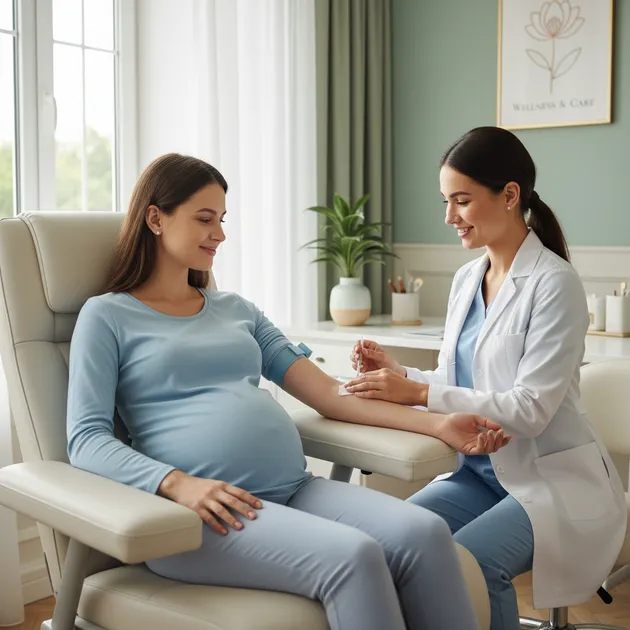
NIPT analyzes fetal DNA from a maternal blood draw, taken from week 10 onwards.
- Detects trisomy 21 (Down syndrome), 18, and 13 with over 99% accuracy
- No risk to the fetus or mother
- Results typically within 1–2 weeks
NIPT is voluntary. You decide whether you want the test. Whatever the result, the choice is yours. Your midwife or doctor will provide guidance throughout the process.
Early ultrasound
Pregnant women over 35 are typically offered an early ultrasound at weeks 11–14 (nuchal translucency scan) in addition to the standard anatomy scan at around week 20.
Extra prenatal check-ups
Your midwife or OB may schedule more frequent visits based on your individual risk profile. Many pregnant women over 35 are followed with a normal prenatal schedule if the pregnancy is uncomplicated.
How to take care of yourself
The most important thing you can do is live healthily and keep up with your prenatal appointments.
Nutrition
- Take folic acid from when you're planning pregnancy and through the first trimester
- Eat a varied, nutritious diet
- Vitamin D is recommended for all pregnant women
- Iron supplements may become relevant, follow your doctor's recommendations
Activity
- 150 minutes of moderate activity per week is recommended, also after 35
- Swimming, walking, and yoga are great choices
- Train your pelvic floor from the start with regular exercises
Rest and stress management
- Stress can negatively affect pregnancy, prioritize rest
- Sleep problems are common in pregnancy; there are safe strategies for better sleep
When should you seek help conceiving?
If you're over 35 and have been trying to conceive for 6 months without success, contact your doctor. For those under 35, the recommendation is 12 months.
Your doctor can refer you for a fertility evaluation.
Use an ovulation calculator. Timing intercourse to your fertile days significantly increases your chances. Find your most fertile days to plan ahead.
Birth after 35
Age alone is not a reason for a cesarean section or induction. Many women over 35 give birth completely normally.
Some hospitals recommend induction at week 41 (instead of 42) for pregnant women over 40. Discuss with your midwife or OB what applies to you.
Frequently asked questions
Is it dangerous to get pregnant after 35?
No, it is not dangerous. The risk of certain complications increases somewhat, but the vast majority of pregnancies after 35 are uncomplicated. Good prenatal care and a healthy lifestyle reduce the risk.
Do I need extra monitoring?
You will be offered NIPT and an early ultrasound. Beyond that, additional monitoring is assessed individually. Many pregnant women over 35 are followed with the standard prenatal program.
Can I get pregnant naturally after 40?
Yes, it is entirely possible, though the probability per cycle is lower. Many women over 40 conceive naturally. Contact your doctor after 3–6 months of trying.
Does my partner's age matter?
Yes, male fertility also declines with age, but more slowly. Sperm quality can decrease from around age 40–45.
Should I take folic acid even if the pregnancy was unplanned?
Yes. Start folic acid as soon as you know you're pregnant. Folic acid prevents neural tube defects and is important regardless of age.
Summary
Getting pregnant after 35 is common and safe for the vast majority. You have access to good genetic testing, close prenatal care, and healthcare providers experienced in supporting pregnant people of all ages.
Sources
- American College of Obstetricians and Gynecologists (ACOG). Having a baby after age 35
- Mayo Clinic. Pregnancy after 35: Healthy moms, healthy babies
- CDC. Advanced maternal age and pregnancy outcomes
🔧 Helpful Tools
- Due Date Calculator. Calculate your estimated due date
- Contraction Timer. Track your contractions during labor
- All Baby Tools. Browse all free tools for pregnancy and baby care
📖 Related Articles
- Prenatal Testing and NIPT: A Complete Guide for Expectant Parents. Everything you need to know about prenatal testing. NIPT, first trimester screening, amniocentesis, and CVS explained clearly. Updated 2026.
- PCOS: Symptoms, Diagnosis, and the Path to Pregnancy. Everything about polycystic ovary syndrome (PCOS) - symptoms, diagnosis, treatment, and how PCOS affects fertility. Based on international guidelines from WHO and AAP.