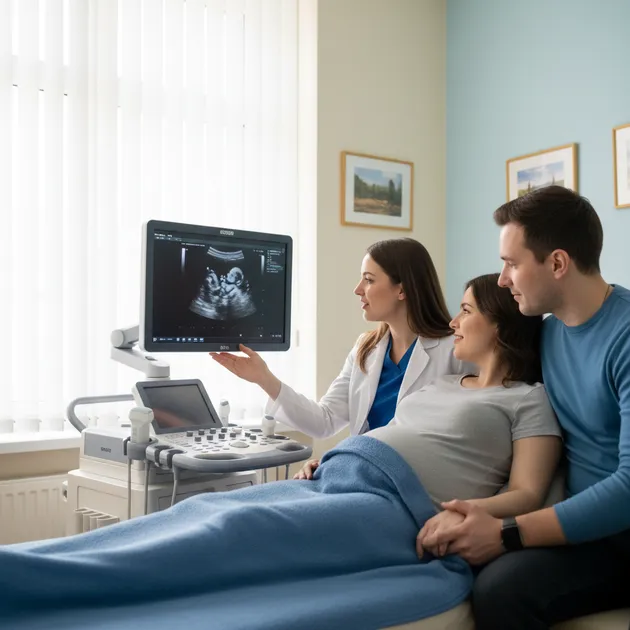
You've just had an ultrasound, and the doctor tells you that your placenta is lying low, possibly covering the cervix. What does that mean for you and your baby?
Placenta previa is a condition in which the placenta partially or completely covers the cervix. It sounds alarming, but with proper monitoring and care, the condition is managed safely by experienced obstetric teams worldwide.
What Is Placenta Previa?
Normally, the placenta attaches high up in the uterus, on the front wall, back wall, or at the top. With placenta previa, the placenta has attached lower down, near or over the cervix.
The cervix is the opening your baby will need to pass through during delivery. If the placenta is blocking that opening, it can cause complications.
Degrees of Placenta Previa
There are different classifications:
- Complete placenta previa: The placenta fully covers the cervix
- Partial placenta previa: The placenta partially covers the cervix
- Marginal placenta previa: The placenta's edge is close to the cervix (within 2 cm)
- Low-lying placenta: The placenta is low but does not cover the cervix
At the mid-pregnancy ultrasound (around 18–20 weeks), a low-lying placenta is found in up to 10% of pregnancies. In the vast majority of cases, the placenta "migrates" upward as the uterus grows. By full term, only about 0.5% of pregnancies still have placenta previa.
Risk Factors
Some women have an increased risk of placenta previa:
- Previous cesarean section: Risk increases with number of prior c-sections
- Previous uterine surgery or D&C
- Multiple pregnancy (twins, triplets)
- Advanced maternal age
- Smoking
- IVF or fertility treatment
- Previous placenta previa
Symptoms
The main symptom is painless vaginal bleeding, usually in the second or third trimester.
Typical characteristics:
- Bleeding without pain or contractions
- The blood is usually bright red
- Bleeding can appear suddenly and without warning
- It may stop on its own, but often recurs
- Some women experience bleeding after intercourse or physical activity
Not everyone bleeds
Many women with placenta previa never experience any bleeding at all. In those cases, the condition is discovered during a routine ultrasound.
Bleeding during pregnancy should always be evaluated. Contact your maternity unit or emergency services if you experience any bleeding, even a small amount. Don't wait for your next scheduled appointment.
Diagnosis and Monitoring
How is it diagnosed?
Placenta previa is typically identified by ultrasound:
- The mid-pregnancy scan (18–20 weeks) may reveal a low-lying placenta
- Transvaginal ultrasound gives the most accurate measurement of the distance between the placenta and cervix
- A follow-up scan is usually recommended around 32–36 weeks to see whether the placenta has moved
Monitoring through pregnancy
If you've been told your placenta is low:
At mid-pregnancy scan (18–20 weeks):
- Most women are asked to come back for a follow-up
- No special restrictions are usually needed at this stage
- The placenta moves upward in most cases
At follow-up scan (32–36 weeks):
- A new assessment of placental position
- If the placenta still covers the cervix: delivery planning begins
- If the placenta has moved: routine care continues
With confirmed placenta previa late in pregnancy:
- More frequent monitoring
- Advice to avoid intercourse and strenuous physical activity
- Readiness for emergency admission if bleeding occurs
- Planning for a cesarean section
Treatment
There is no treatment that can physically move the placenta. Management is focused on careful monitoring and safe planning.
If bleeding occurs
- Minor bleeding: Admission for observation, often bed rest
- Heavy bleeding: Emergency admission, possible emergency c-section
- Bleeding before 34 weeks: Steroids to mature the baby's lungs; magnesium sulfate to protect the baby's brain
Cesarean section
If the placenta covers the cervix at term, a planned cesarean is the safest way to deliver:
- Typically scheduled at 36–37 weeks (sometimes 38 weeks)
- Planned timing reduces the risk of emergency bleeding
- The surgical team plans the incision carefully around the placenta's position
Can you deliver vaginally?
- Complete/partial placenta previa: No, cesarean is required
- Marginal placenta previa: Vaginal birth may be possible if the distance is sufficient (over 2 cm) and there has been no bleeding
- Low-lying placenta: Vaginal birth can be considered depending on the distance from the cervix
Complications
In rare cases, placenta previa can lead to:
- Heavy bleeding: The most serious complication, which may require an emergency cesarean
- Preterm birth: If an emergency cesarean must be performed before term
- Placenta accreta: In rare cases, particularly after previous cesarean sections, the placenta can grow too deeply into the uterine wall
With appropriate monitoring and planning, the outlook is excellent for both mother and baby. Most women with placenta previa go on to deliver healthy babies.
What You Can Do
If you've received a diagnosis of placenta previa:
- Stay informed: Talk with your OB or midwife about your specific situation
- Know the warning signs: Be alert to any bleeding and contact your hospital immediately
- Have a plan: Pack your hospital bag early and know your route to the hospital
- Avoid heavy lifting: Follow your doctor's guidance on activity levels
- Rest: Stress isn't good for you or your baby
- Avoid intercourse: If your doctor has advised this
- Plan your birth: Discuss your preferences for a cesarean birth with your care team
Frequently Asked Questions
Can the placenta move?
Yes, the placenta "migrates" in most cases. What actually happens is that the uterus grows and its lower segment stretches, drawing the placenta upward. In about 90% of women with a low-lying placenta at the 20-week scan, the placenta has moved away from the cervix by term.
Is placenta previa dangerous?
With proper care, the prognosis is very good. The main risk is heavy bleeding, but this is carefully monitored throughout pregnancy. The vast majority of women with placenta previa deliver healthy babies.
Can I travel with placenta previa?
Discuss this with your doctor. Generally, travel far from a hospital is not recommended in the third trimester with confirmed placenta previa, particularly air travel.
Can placenta previa affect future pregnancies?
Yes, there is a somewhat increased risk of placenta previa in subsequent pregnancies, particularly if you also had a cesarean. The risk increases with each c-section.
When should I call the hospital?
Call your maternity unit immediately if you experience any bleeding, no matter how little. Also call if you have strong abdominal pain or notice reduced fetal movement.
Read More
Sources
- ACOG. Placenta Previa
- WHO. Managing Complications in Pregnancy and Childbirth
- RCOG. Placenta Praevia and Placenta Accreta
🔧 Helpful Tools
- Due Date Calculator. Calculate your estimated due date
- Contraction Timer. Track your contractions during labor
- All Baby Tools. Browse all free tools for pregnancy and baby care
📖 Related Articles
- Amniotic Fluid Levels: Too Little or Too Much. Been told you have too little or too much amniotic fluid? Learn about causes, symptoms, and treatment of oligohydramnios and polyhydramnios.
- Anterior vs Posterior Placenta: Everything You Need to Know. Anterior or posterior placenta? Learn what the position of your placenta means for your pregnancy, feeling kicks, and birth. Based on obstetric guidelines.