
Ovulation is the moment in your cycle when your body releases a mature egg from one of the ovaries. It is a brief window, just 12 to 24 hours, but this is the exact time that determines whether fertilization can happen.
Whether you are actively trying to get pregnant or simply want to understand your body better, this guide gives you everything you need to know about ovulation, how to recognize the signs, and how to use tools like our ovulation calculator to find your fertile days.
What Happens During Ovulation?
During ovulation, a mature egg is released from a follicle in the ovaries. The egg is picked up by the fallopian tube and begins its journey toward the uterus. This typically happens around 14 days before your next period, regardless of how long your cycle is.
The entire process is controlled by hormones:
- FSH (follicle-stimulating hormone) matures follicles in the ovaries
- LH (luteinizing hormone) triggers ovulation itself with a sharp surge
- Estrogen rises before ovulation and prepares the uterine lining
- Progesterone dominates after ovulation and maintains the lining
It is the rise in LH that ovulation tests measure, and that gives you advance warning that ovulation is near.
The greatest chance of fertilization is if you have intercourse 1–2 days before ovulation. Sperm can survive up to 5 days in the uterus, while the egg lives only 12–24 hours.
Signs and Symptoms of Ovulation
Your body gives you several hints that ovulation is approaching. Not all women notice every sign, but the better you know your own body, the easier it becomes to recognize the pattern.
Change in Cervical Mucus
The clearest sign for many is that the cervical mucus changes. In the days around ovulation, it becomes:
- Clear and transparent, rather than white or creamy
- Smooth and stretchy, can be pulled out between the fingers like egg white
- Abundant, you notice more moisture than usual
This consistency makes it easier for sperm to survive and swim toward the egg. After ovulation, the mucus becomes thicker and stickier again.
Ovulation Pain (Mittelschmerz)
About 20 percent of women feel a brief, sharp pain in the lower abdomen around ovulation. The pain usually sits on one side and can last from a few minutes to a few hours.
Other Common Signs
- Slight temperature rise, basal body temperature rises by 0.2–0.5°C (0.4–0.9°F) after ovulation
- Breast tenderness, due to hormones after ovulation
- Increased sex drive, the body signals fertility
- Light spotting, some experience a drop of blood around ovulation
- Bloating, due to hormonal changes
Want to learn to recognize your own ovulation signs? Use our ovulation calculator to log cycles and see the pattern over time. The more cycles you log, the more accurate the calculations become.
Ovulation Tests. How They Work
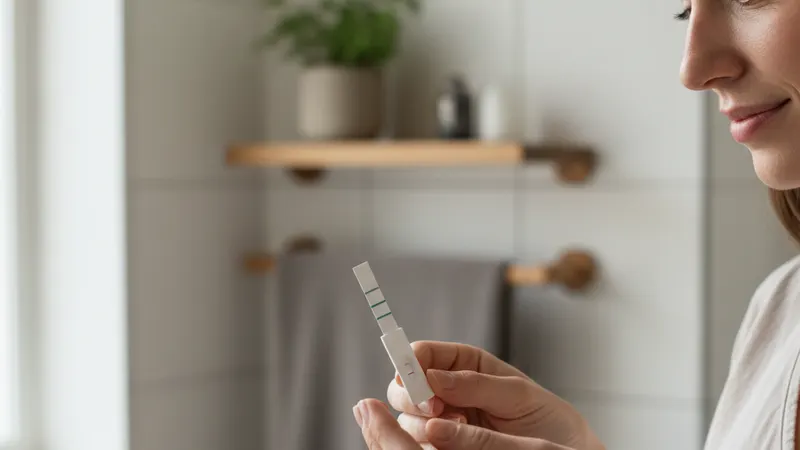
An ovulation test (also called an LH test or ovulation predictor kit) measures the level of luteinizing hormone in urine. When LH rises sharply, ovulation is typically 24–36 hours away.
How to Use an Ovulation Test
- Start testing 2–3 days before expected ovulation, with a 28-day cycle, this means around day 11
- Test at the same time each day, afternoon is often best (LH typically rises in the morning and appears in urine by afternoon)
- Avoid drinking a lot of fluid in the 2 hours before the test
- Read the result within the time window stated on the package
Interpreting Results
- Two lines equally dark = Positive. Ovulation within 24–36 hours
- Test line lighter than control = Negative. Test again the next day
- Only control line = Negative. Test again the next day
Digital vs. Traditional Tests
Digital tests (such as Clearblue Advanced) show a smiley face for a positive result and can also measure estrogen in addition to LH. Traditional strips are less expensive and work just as well, but require you to interpret line darkness yourself.
A positive ovulation test means LH has surged, but does not guarantee that ovulation actually occurs. In some women, LH can rise without an egg being released (anovulatory cycle).
The Fertile Window. When Is the Chance Greatest?
The fertile window spans approximately 6 days: the 5 days before ovulation plus ovulation day itself. The most fertile days are the 2–3 days immediately before ovulation.
Calculate Your Fertile Window
Ovulation typically occurs 12–16 days before your next period. To calculate:
| Cycle length | Estimated ovulation day | Fertile window |
|---|---|---|
| 24 days | Day 10 | Days 5–10 |
| 28 days | Day 14 | Days 9–14 |
| 30 days | Day 16 | Days 11–16 |
| 35 days | Day 21 | Days 16–21 |
Our ovulation calculator does this calculation automatically based on your cycle data. Enter the first day of your last period and your average cycle length, and immediately see your fertile days highlighted in the calendar.
Optimal Timing for Intercourse
Research shows that the chance of fertilization per cycle is:
- 1–2 days before ovulation, 25–30 percent chance
- Ovulation day itself, 10–12 percent (the egg may already be too old)
- 3–5 days before ovulation, decreasing chance, but still possible
- The day after ovulation, very low chance
Intercourse every other day during the fertile window provides good coverage without putting unnecessary pressure on the process.
Irregular Cycle. What Do You Do?
Not everyone has a regular 28-day cycle. Cycle length between 21 and 35 days is considered normal, and variation from month to month is common.
Common Causes of an Irregular Cycle
- Stress, affects hormone balance and can delay ovulation
- Weight changes, both weight loss and weight gain
- Polycystic ovary syndrome (PCOS), a common hormonal disorder
- Breastfeeding, can suppress ovulation
- Shift work and sleep deprivation, disrupts the internal clock
- Age, cycles can become more irregular toward 40
Tips for an Irregular Cycle
If your cycle varies a lot, these strategies can help:
- Log your cycle over several months with our ovulation calculator to find the pattern
- Use ovulation tests to confirm when ovulation actually occurs
- Measure basal body temperature daily to see the temperature shift
- Observe cervical mucus to recognize your fertile days
Have cycles shorter than 21 days or longer than 35 days? Contact your doctor. A very irregular cycle can have a medical cause that should be investigated, especially if you are trying to conceive.
Basal Body Temperature. Charting Your Cycle
Basal body temperature is your body temperature at rest, measured right after you wake up, before you get out of bed. After ovulation, basal body temperature rises by 0.2–0.5°C (0.4–0.9°F) due to progesterone.
How to Do It
- Measure your temperature every morning at the same time, ideally after at least 5 hours of consecutive sleep
- Use a thermometer with two decimal places for accurate readings
- Log the temperature in our ovulation calculator or an app
- Look for the temperature shift, a sustained rise over 3 days confirms that ovulation has occurred
Basal body temperature measurement confirms that ovulation has happened, but does not warn you in advance. Combined with mucus observation and ovulation tests, you get the most complete picture.
When Should You See a Doctor?
Most couples who have regular intercourse during the fertile window conceive within 12 months. You should contact your doctor if:
- You are under 35 and have been trying for over 12 months
- You are over 35 and have been trying for over 6 months
- You have a very irregular cycle or absent periods
- You have known conditions like PCOS or endometriosis
- Your partner has known sperm quality issues
Your doctor can run blood tests to check hormones, an ultrasound of the ovaries, and potentially refer you to a fertility clinic. Read more in our guide on assisted reproduction.
Babysential's Ovulation Calculator. Your Tool
Our ovulation calculator is free and easy to use. Enter your cycle data and immediately see:
- Calculated ovulation date based on your cycle length
- Fertile window highlighted in the calendar
- Next period and earliest possible pregnancy test
- Cycle history to see patterns over time
Combine the calculator with ovulation tests for the best accuracy. The calculator gives you a good starting estimate, and the tests confirm when ovulation is actually approaching.
Read our detailed guide to the ovulation calculator and tips for getting pregnant.

Frequently Asked Questions
How Long Does Ovulation Last?
The release of the egg itself takes only a few minutes, but the fertile window spans around 6 days. The egg can be fertilized for 12–24 hours after ovulation, but sperm can survive up to 5 days in the body.
Can You Ovulate Without a Period?
Yes, it is possible. This can happen during breastfeeding, after starting after birth control, or with certain hormonal conditions. Conversely, you can also have a period without prior ovulation (anovulatory bleeding).
Can Stress Delay Ovulation?
Yes. Stress affects the hypothalamus, which controls the hormones for ovulation. High stress levels can delay ovulation by days or weeks, or in rare cases suppress it entirely in a cycle.
Do You Notice Ovulation on the Pill?
No. Combined birth control pills (with estrogen and progestin) prevent ovulation. The mini-pill (progestin only) does not always prevent ovulation, but makes cervical mucus thicker so sperm cannot get through.
What Is the Difference Between Exercise Cramps and Ovulation Pain?
Ovulation pain (mittelschmerz) feels like a brief sharp pain or cramp in the lower abdomen mid-cycle. It lasts minutes to hours. Exercise cramps that feel like uterine tightening are different and should not be confused with ovulation pain.
Sources and References
- WHO. Reproductive health and fertility
- American College of Obstetricians and Gynecologists (ACOG). Fertility and the menstrual cycle
- Mayo Clinic. Ovulation and fertility
- Endocrine Society. Hormones and reproduction
🔧 Helpful Tools
- Ovulation Tracker. Track your cycle and predict ovulation
- All Baby Tools. Browse all free tools for pregnancy and baby care
📖 Related Articles
- Can You Get Pregnant on Your Period?. Yes, it is possible to get pregnant during your period. Learn why it happens, who is most at risk, and what sperm lifespan and short cycles mean for your chances.
- Ovulation After Your Period: When Does It Happen and How Do You Calculate It?. When do you ovulate after your period? Learn to calculate your ovulation day, understand the fertility window, and recognize the signs. Complete guide with a table for different cycle lengths.
- Ovulation Test: Complete Guide to Using It Correctly. Wondering how ovulation tests work? Learn when to test, how to read the result, and the most common mistakes to avoid.