The note from the school or daycare says: "Head lice have been detected." For many parents this is among the most unwelcome notifications, but head lice are common, harmless, and perfectly possible to eliminate, it just requires a bit of patience and the right approach.
What Are Head Lice?
Head lice (Pediculus humanus capitis) are small, wingless insects that live on the scalp and feed by sucking blood from the skin. They are 2–3 mm long, grayish-brown, and difficult to see with the naked eye.
Head lice are extremely common in children of daycare and school age. Lice spread through direct head-to-head contact, children who play close together are especially at risk. Lice cannot jump or fly, and rarely spread via objects like hats and hairbrushes.
Head lice have nothing to do with poor hygiene. Lice thrive just as well in clean as in dirty hair. Anyone can get lice, regardless of hair length, hair type, or washing habits.
Symptoms of Head Lice
It can take 2–6 weeks from exposure to noticing symptoms. Many people don't know they have lice until they've had them for a while.
- Itching on the scalp, the most common symptom, caused by an allergic reaction to the lice's saliva
- Redness and irritation, especially behind the ears and at the nape
- Restlessness and difficulty concentrating, the itching can disturb sleep and focus
- Visible nits, lice eggs (nits) are attached to the hair shafts near the scalp. They appear as small, oval, whitish specks
The Difference Between Nits and Dandruff
| Nits (lice eggs) | Dandruff |
|---|---|
| Stuck firmly, difficult to slide off | Loosens easily |
| Oval, about 1 mm | Irregular shape |
| Attached near the scalp | Can be anywhere on the hair |
| On one side of the hair shaft | Surrounds the whole hair shaft |
How to Check for Head Lice
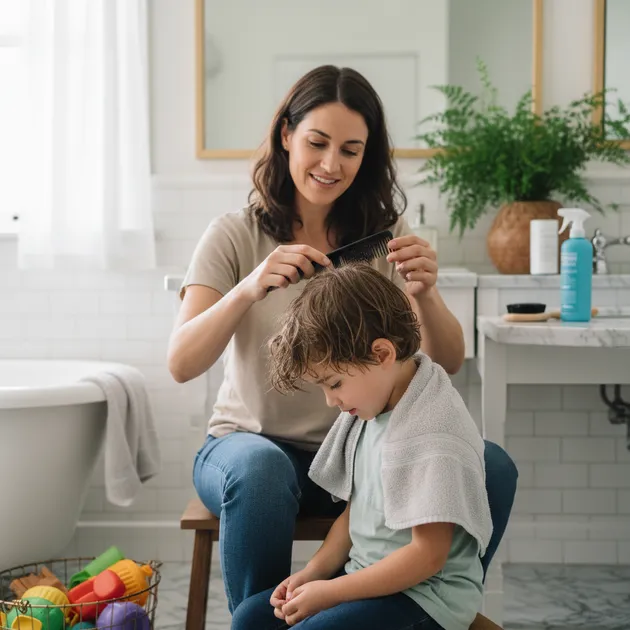
The best way to detect lice is through systematic wet combing:
- Wash the hair with regular shampoo and leave conditioner in (makes hair slippery)
- Use a lice comb (fine-toothed with a tooth gap of 0.2–0.3 mm)
- Comb through all the hair systematically from scalp to ends
- Wipe the lice comb on white paper towel after each stroke
- Look for lice and nits on the paper towel
Check especially behind the ears, at the nape, and at the temples, these are lice's favorite spots.
Buy a good lice comb from the pharmacy. Cheap plastic combs are often not fine enough. A metal comb with stiff, closely-spaced tines is most effective.
Treating Head Lice
There are two main methods to get rid of lice: wet combing and lice treatments. Current pediatric guidance recommends starting with wet combing.
Method 1: Wet Combing (First-Choice Approach)
Systematic wet combing is the most gentle and effective method. It requires patience but no chemicals.
Procedure:
- Day 1. Wash hair with conditioner, comb thoroughly with lice comb. Remove all lice and nits
- Day 5. Repeat wet combing. New lice from undiscovered nits may have hatched
- Day 9. Another wet combing session. The hatching time for lice eggs is 7–10 days
- Day 13. Final check combing. If you find lice, start over from Day 1
- Day 17. Extra check to confirm all lice are gone
The most important thing is to carry out all combing sessions on schedule. If you skip one session, newly hatched lice can lay new eggs before you check again, and you're back to square one.
Method 2: Lice Treatments
If wet combing alone doesn't work, you can use lice treatments from the pharmacy. There are two types:
Silicone-based treatments (recommended):
- Dimethicone (e.g., Hedrin, Nyda, LiceMD)
- Suffocates lice physically by blocking their breathing
- Lice cannot develop resistance to these
- Follow instructions carefully
Chemical lice treatments:
- Permethrin-based products
- Pyrethrin-based products
- Some resistance has been reported in lice populations
- Use as second-line option
Important when using lice treatments:
- Treat twice with 7–10 days between treatments (to catch recently hatched lice)
- Always combine with wet combing for best results
- Follow the instructions on the packaging
- Speak with a pharmacist about choice of product
Household Cleaning. What's Necessary?
Lice survive for a very short time away from the scalp (maximum 1–2 days without blood). Current guidelines therefore recommend limited household cleaning:
- Bedding and towels, wash at 60°C (140°F) or higher
- Hats, scarves, hair accessories, wash or place in the freezer for 24 hours
- Hairbrushes and combs, clean thoroughly in hot water (60°C/140°F) or put in the freezer
- Stuffed animals, place in a sealed bag for 3 days or wash at 60°C
You do not need to:
- Vacuum the entire house extensively
- Wash all the clothes in the house
- Spray furniture with lice treatments
- Wash curtains or carpets
Lice spread from head to head, not from objects. Extensive cleaning is unnecessary and just creates extra stress in an already challenging situation.
School and Daycare Policies
Rules About Absence
In most countries, there is no requirement to keep children home from daycare or school because of lice. Head lice are not a notifiable disease.
Most schools and daycares have their own guidelines:
- The child can return after the first treatment has been completed
- Notify the school/daycare so other parents can check their children
- Cooperation between parents is the key to stopping outbreaks
Prevention at Daycare
- Check the child's head regularly (weekly) with a lice comb
- Children with long hair should have their hair tied up at daycare
- Teach children to avoid head-to-head contact (but be realistic, children are children)
- Respond quickly to notifications about lice at daycare
Head Lice in Babies and Young Children
Lice are uncommon in babies under 1 year, but can occur through close contact with older siblings. Special considerations:
- Wet combing is safe for all ages
- Lice treatments, check the age restriction on the packaging. Some products are not suitable for the youngest children
- Talk to a pharmacist before using lice treatments on children under 2 years
- Be extra gentle with the lice comb, babies' scalps are more sensitive
Prevention
There is no guarantee against getting lice, but some measures can reduce the risk:
- Check regularly, weekly combing with a lice comb, especially after alerts
- Long hair tied up, reduces the contact area
- Inform each other, openness between parents makes it easier to stop outbreaks
- Treat quickly, the sooner you start, the easier it is to eliminate the lice
Do not use lice treatments preventively. Unnecessary use can irritate the scalp and contribute to resistance developing in the lice population. Only use lice treatments when living lice are actually found.
Frequently Asked Questions
Can lice survive in water?
Yes. Lice can survive in water for several hours by closing their breathing passages. Swimming alone does not kill lice, and chlorine in swimming pools has no effect.
Can pets get head lice?
No. Head lice are species-specific and only live on humans. Dogs, cats, and other animals cannot get or transmit human head lice.
How long is the child contagious?
The child is contagious as long as they have living lice in their hair. After the first thorough treatment (wet combing or lice treatment), the risk of transmission is significantly reduced.
Do tea tree oil or lavender oil help against lice?
There is no scientific evidence that essential oils prevent or treat lice. Some parents feel it helps, but this is not proven, and essential oils can irritate the scalp.
Sources
- Centers for Disease Control and Prevention (CDC). Head Lice
- American Academy of Pediatrics. Head Lice
- NHS. Head Lice and Nits
🔧 Helpful Tools
- Baby Milestones Tracker. Track your baby's developmental milestones
- All Baby Tools. Browse all free tools for pregnancy and baby care